

Omnichannel – Myth, Reality or Utopia?
Omnichannel – is it a Myth, Reality or Utopia? Over the past 20 or so years the way products and services get sold and customer service as well as marketing get delivered changed dramatically. Gone are the times where a potential customer was addressed via a radio- or TV-spot or an ad printed in a newspaper, advertising mail in the mailbox … – well, it still happens, but the focus shifted dramatically. We started off from one single ‘channel’ – customer goes to the store and interacts with a person – and added an ever increasing number of additional ones, like the ones mentioned, plus many more. For retail businesses the store will not go away. Generally spoken, human interaction will stay important, probably increase in importance; human customer service will not vanish – but is likely to change … please hold this thought. In today’s omnichannel world we also have telephone, e-mail, web-delivered ads, mobile apps, branded and white-label communities, social media like Facebook, Instagram, Twitter, etc., knowledge bases in combination with self-service, chat, messenger applications like WhatsApp, FB Messenger, Snapchat, iMessage; chat supported by ‘machine intelligence’, exposed via so called chatbots, and what not. The list could virtually go on and on. This is all supported by and implemented on a platform that leverages integrated applications, which work on a joint, or at least consistent data model – with clean data – utilizing strong real-time analytics capabilities that powers both, customer segmentation and knowledge categorization for efficient search. And it delivers a great customer experience. In Real Life Uhhm, I am just awaking from my dream …...
Customer Experience – It is all in the Data. Really?
A while after my earlier discussion with Abinash Tripathy from Helpshift about the value for customer experience of bots in customer support he contacted me with some exciting news about what he and his team are doing now. Believe me, it is interesting – but read for yourself. Our conversation, of course, led on to another vivid discussion about things to come and things that in our opinions should come. The bottom line is that we live in a data driven, always on, real-time world, where prediction of events or the ability to suggest an action is becoming increasingly a differentiator … be it in a B2B- or a B2C world. Think of Rolls-Royce selling uptime of their engines, entire airplanes nearly continuously sending telemetry data “home”, or the massive amount of data that a Formula 1 car continually sends in order for the team to take proper real-time decisions. Any car already collects a lot of data – it just needs to get connected to allow for prediction of maintenance to prevent failures. Or think of entire power grids that are already instrumented in a way that allows the operator to predict a failure several days in advance, so that the affected element can get fixed before it fails. It is all in the data? The secret is in having the data. And in the algorithms, be they event- and rule based, or more sophisticated and using machine- or deep learning. Neither data nor algorithms alone are the goal. Because what is needed is actionable insight. Actionable insight emerges only if the right algorithms are applied to the...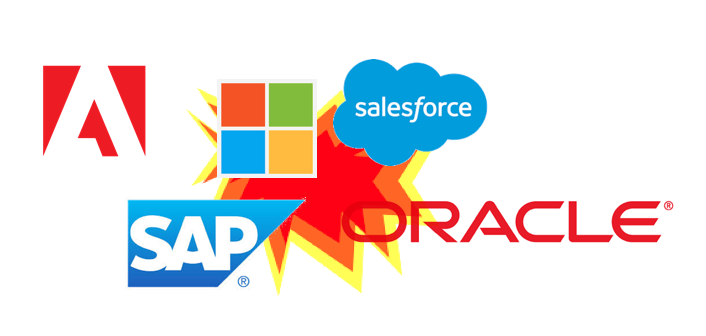
Clash of Titans – SAP, Oracle, Microsoft, Oracle Quo Vadis?
Following all those announcements of AI, machine learning, IoT, IaaS, PaaS and what not over the past months, I was beginning to wonder where the big business software vendors are going. What is the game plan of Microsoft, Oracle, Salesforce, SAP? How does newcomer Adobe fit in there? Maybe Amazon and Google, too; or Facebook. It is a time for another Quo Vadis – this time: Quo Vadis, industry? Clash of Titans In the last about 2 – 3 years we have seen a strong acceleration of innovation, or at least talk about it. Cloud computing, offering nearly unlimited scalability and elasticity of computing resources has become main stream. Cloud computing also allows for nearly 100 per cent uptime Since the advent of the iPhone (yes, I know this was earlier than 2013) the proliferation of sensors has increased a lot, resulting in them becoming cheaper and cheaper, allowing for an increasing number of data rich applications This has also driven fast mobile connectivity, which has become nearly ubiquitous; maybe except a few blessed spots on this planet, which will be covered soon, too. Think of Google’s Balloon project or Facebook’s drone Memory has become dirt cheap, and fast In-memory technologies, No-SQL databases, Hadoop, Spark, and improvements of analytics algorithms make it possible to work with huge sets of data in real time The (re-)emergence of AI technologies, progress in machine learning and deep learning, enabled by the now available computing power, help in pattern recognition that allows machine driven suggestion, prediction, and prescription of actions, based upon huge amounts of data Data, be it machine-generated or human created...