thomas.wieberneit@aheadcrm.co.nz
The Orchestration Layer in Enterprise AI Just Got Named. It Has a Gemini Logo on It.

The Orchestration Layer in Enterprise AI Just Got Named. It Has a Gemini Logo on It.

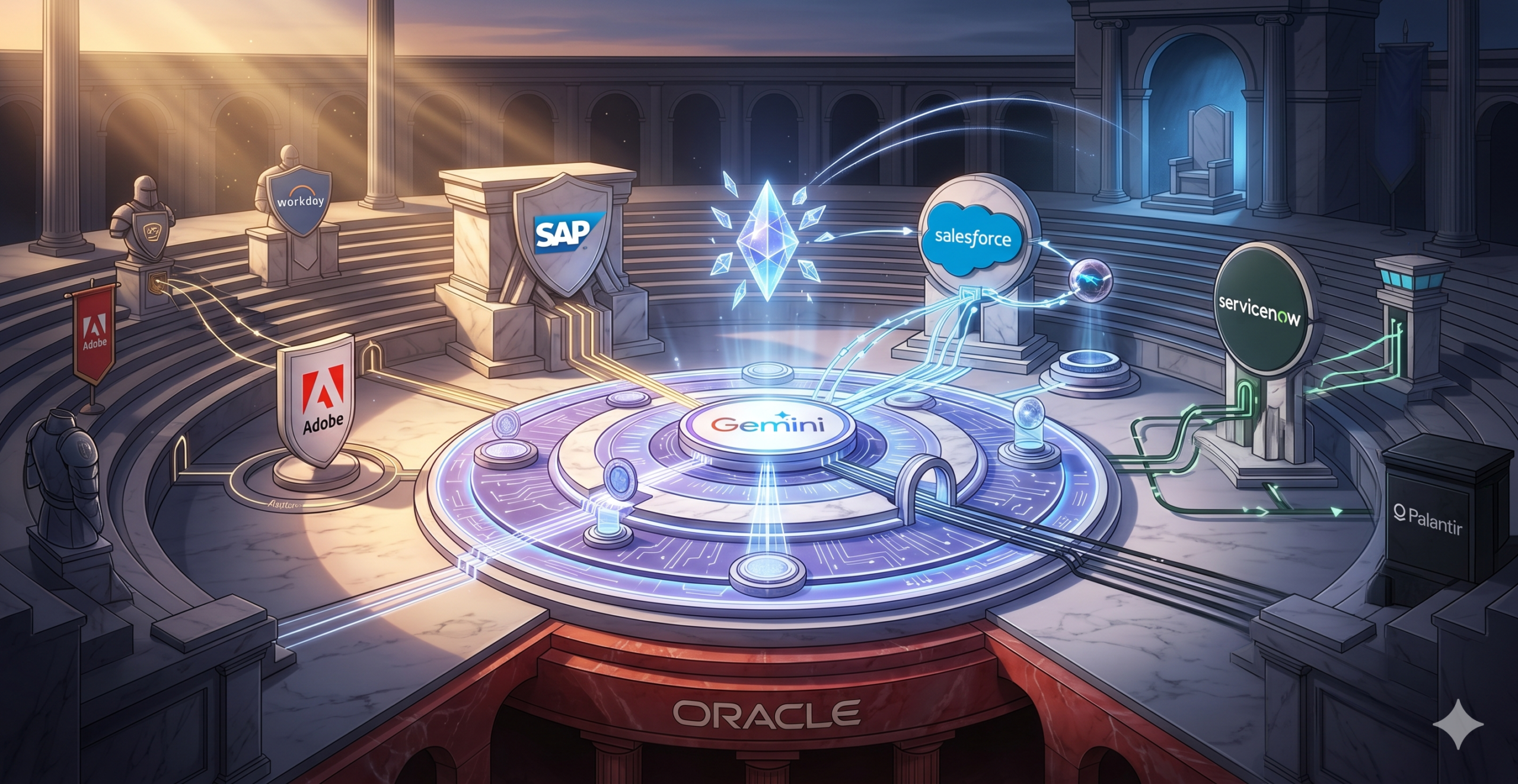
What Google Cloud Next 2026 actually told us about the titan pecking order Google Cloud Next 2026 wrapped last week. The official version of the story is the one Google wanted you to read: 260 announcements, 1,302 customer use cases, the Gemini Enterprise Agent Platform, eighth-generation TPUs, a $750 million partner fund, an $240 billion Marketplace backlog. Big numbers. On-message keynote. Tidy “agentic era” framing. The more interesting story is who showed up to validate it, and what Google actually built underneath. Five of the seven enterprise titans I track walked into Las Vegas and announced expanded partnerships that all rest on the same architecture: Gemini Enterprise as the agent control plane, with the titan’s product playing the role of premium ingredient. Salesforce. SAP. ServiceNow. Oracle. Adobe. Add Workday and Palantir Technologies to the picture, both adjacent to my titan list but visibly aligned in the same direction. Two titans were not in the picture. Microsoft, because Copilot is the direct counter-position and Cloud Next is not Microsoft’s stage. Zoho, because Zoho’s stack does not need a Google motion and Zoho’s buyer is not the same buyer. Both absences matter. More about them a little later. What Google actually built Let’s start with the framing. Google did not just ship a model platform with new features. It repositioned Google Cloud from “AI development environment” to enterprise agent control plane. Vertex AI services and roadmap evolutions are now delivered through the new Agent Platform rather than as a standalone product. That is not a naming change, it’s an entirely different playground. The Agent Platform stack now visibly includes: Agent Identity...
The Agent Wars Are Over. The Substrate Wars Just Started

The Agent Wars Are Over. The Substrate Wars Just Started

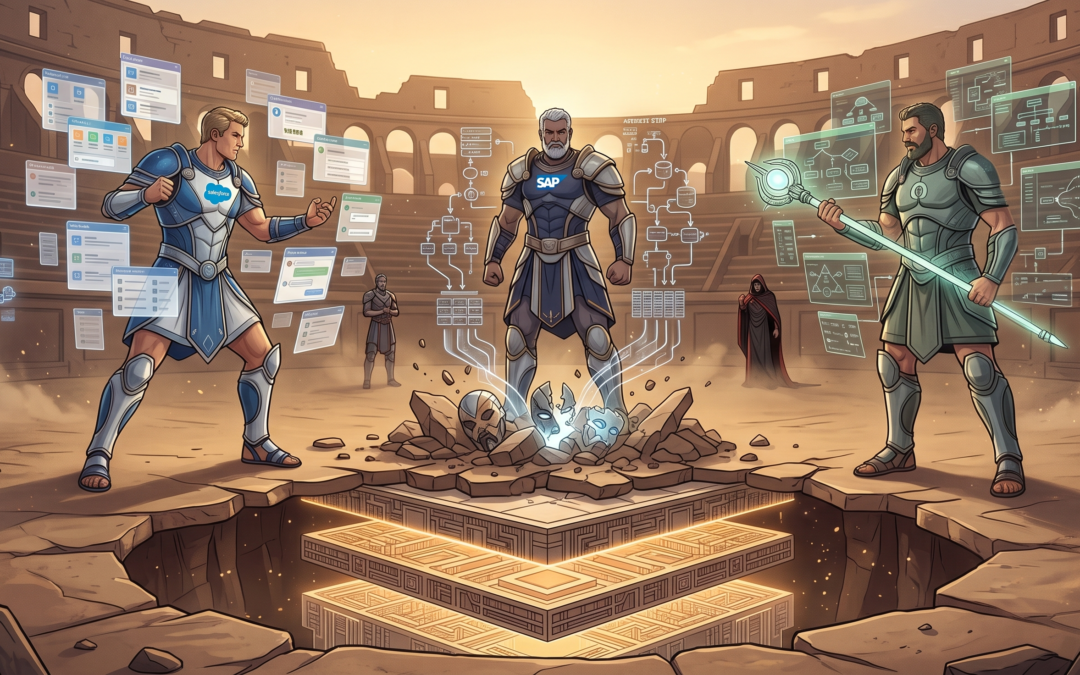
Three titan announcements in two weeks reveal what enterprise software vendors are actually fighting over in 2026, and it is not agents. If you have been tracking enterprise AI announcements through 2025, you have been watching a race about agent counts. How many prebuilt agents. How many industry-specific use cases. How many customer stories. Agents were the marketing, the demo, the SKU. A year of the same playbook. Something shifted in April 2026. Inside a two-week window, Salesforce, SAP, and ServiceNow each published an announcement that, at first glance, looks like more of the same agent theater. Salesforce launched Headless 360 at TDX 2026 and the Agentforce Experience Layer. SAP pushed a simplified-architecture argument alongside a persistent agent memory layer on BTP. ServiceNow rolled out Context Engine and, on its SPM community blog, Fred Champlain published an essay reframing governance itself as “strategic decision debt”. Different products. Different audiences. The same structural move. All three titans just walked one layer down the stack. Read individually, each announcement is a product release. Read together, they are a category shift. The competition is no longer about who has the best agent. It is about who owns the substrate those agents operate on. And each titan is staking a different piece of it. The Pattern Nobody Is Naming Strip the vendor branding from all three sets of material and the structural claim is identical: “Your agents are only as good as the layer underneath them. The data they ground on, the logic they inherit, the memory they carry, the permissions they respect, and the decisions they represent. That layer is what we...
You are a platform player? How to not be doomed!

You are a platform player? How to not be doomed!

These days every significant software vendor and some others, too, is positioning itself as a CX- and/or a platform player. By now, it is well known, what it means to be a platform player, and this is also not the main topic of this post. Just as much: In order to be a significant CX player, one quite simply needs to be a platform player.  Also, regardless of whether one has a platform or not, if everyone is a CX and a platform player, then obviously this is nothing that differentiates one vendor from the other anymore. Customers meanwhile nearly expect a set of solutions by one vendor being built upon one platform – or at least to appear like they are built on one platform. This basically means that “platform” as a thing to emphasize on has reached its zenith. And then, there is an additional problem associated with the platform game. A platform market is a kind of a winner takes it all market. Following the analysis and argumentation of Ray Wang in his new book Everybody Wants to Rule the World, in a platform market there will be only two major players. All other players are becoming insignificant or will vanish. While this sounds somewhat dystopian the point that I want to make is that there will not be a great many successful and strong players in a platform market. To use a metaphor, at one point in time a few vendors will have created enough gravity to become the entity that customers are attracted to. It is also visible that the first vendors have understood this and are acting...