
The Lost Strategy: What CRM Was Supposed to Be
CRM at its very origin, was a strategy. With the advent of systems that support the execution of this strategy, the term more and more got shifted to describe a system. This shift can get seen in the words of CRM Godfather Paul Greenberg. His pre-2009 definition of CRM was “a philosophy and a business strategy, supported by a system and a technology designed to improve human interaction in a business environment.” This changed to "Customer Relationship Management is a technology and system that sustains sales, marketing and customer service activities. It is designed to capture and interpret customer data, both structured and unstructured, and to sustain the management of the business side of customer related operations. CRM technology automates processes and workflows and helps organize and interpret data to support a company in engaging its customers more effectively" in acceptance of this change (emphasis by me). These days, people often even mean a sales force automation system, when they say “CRM”.
In another dimension, the systems themselves more and more turned into systems of record. Implementations often were management-oriented as opposed to team-oriented, which led to increasing dissatisfaction and the creation of new terms and categories like social CRM, system of engagement, customer data platform, customer engagement, customer experience management, and so on.
There is much more, but in consequence, CRM lost both, the “C” and the “R”. CRM turned from a strategy into a glorified rolodex and a tool to manage teams, in particular sales teams, instead of helping organizations and teams to manage and improve the customer relationship.
The Great Divide: The Gap Between Sales and Marketing
As CRM turned into a sales tool, obviously marketing and customer service needed their own tools. Which vendors happily supplied, up to an extent that the 2025 Martech Landscape Supergraphic counts well above 15,000 applications. This marks a 100x growth since 2011. The number of sales or service-oriented SaaS applications is similarly substantial.
In the era of on-premises software, technology purchasing was centralized. The CIO controlled the strings of the wallet. But the rise of SaaS brought with it the era of decentralized budgets. Suddenly, a VP of Marketing could swipe a corporate credit card and purchase a Marketing Automation Platform without consulting IT or Sales. Simultaneously, the VP of Sales was buying their own "best-of-breed" tools for outreach, forecasting, and enablement.
Shadow IT raised its ugly head.
The Accelerant: SaaS and the Era of Shadow IT
If the reduction of CRM to a sales tool created a crack between Marketing and Sales, this combination of decentralized purchasing with the explosion of the SaaS model turned that crack into a chasm.
This “democratization” of technology happened without operational guardrails.
Marketing bought tools to generate leads.
Sales bought tools to close deals.
Customer Success bought tools to manage tickets.
None of these systems were designed to talk to one another natively. Integration became an afterthought. We traded a unified strategy for a "frankenstack" of disconnected applications. This technological anarchy created disjointed processes and solidified organizational and data silos. It meant that "Marketing Ops" and "Sales Ops" spent their days managing their specific tools, optimizing their own KPIs, rather than improving the customer journey and lifecycle. The proverbial shouting match between the VP of Sales claiming that sales doesn’t get any leads from marketing with the VP of Marketing countering that sales just doesn’t use them is a visible sign of this result.
The Emergence of Revenue Operations (RevOps)
RevOps emerged out of the necessity to overcome this. It “is the strategic integration of sales, marketing and service departments to provide a better end-to-end view to administration and management, while leaving day-to-day processes within the departments. The holistic approach of RevOps is designed to break down silos between departments.” RevOps’ objective is not just to align people, but to reign in the chaos of a decentralized tech stack that had spiraled out of control.
And importantly, RevOps is not a software tool, although there is an increasing number of RevOps and RevTech vendors. Still, it is mostly asking the wrong question. It asks “How can we align our teams to reduce friction?” While RevOps uses outside signals, it is still about fixing the machinery to be able to increase business, improve the margin, reduce cost, etc. It looks from the inside out. The key levers are organizational alignment, improved data flows, better integration and last, but not least, in-depth analytics and dashboards. In short, it establishes the operational backbone, the plumbing that enables inter-departmental cooperation based on shared data.
The Paradigm Shift: Why RevOps is a Part of CRM
The real question to ask is “How can we better help the customer become successful (and thereby become more successful ourselves)?”
In the rush to adopt the latest buzzwords, we, the tech industry, have made a critical error. Driven by vendors, analysts and consultants, we have started treating Revenue Operations as the successor to CRM. We look at RevOps as the "new and improved" version of CRM that makes the old concept obsolete. And just to be clear, RevOps is even more about the transaction than CRM ever was. Look at Gartner’s infographic titled “Is it time for RevOps?” as a good example for this (free, but behind a registration).
This is a fundamental misunderstanding of what CRM actually is.
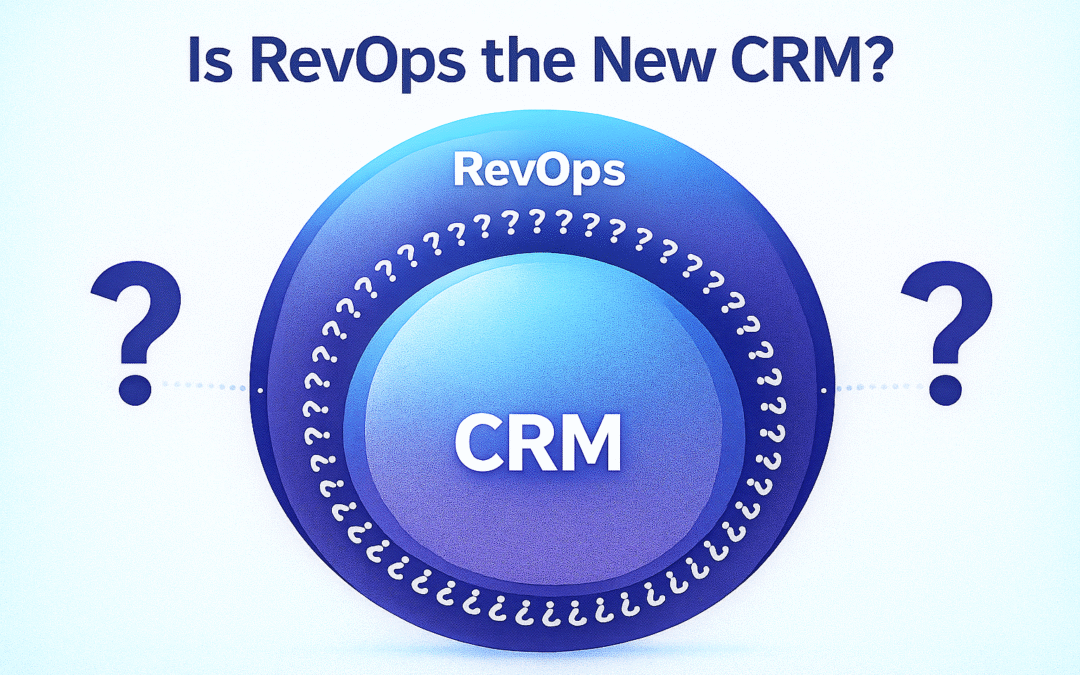
If we accept Paul Greenberg’s original definition that CRM is a business strategy designed to manage relationships, then the hierarchy becomes clear. RevOps does not replace CRM; it serves it, improves it. And yes, to do this, it needs technology and systems.
Inside-Out vs. Outside-In
To better understand why RevOps supports CRM, we have to look at the main thinking flow of these two concepts.
CRM starts with the customer and helps us identify what we need to do to make the customer successful within the constraints that our business has. It is "Outside-In." It asks: What does the customer need? How do they want to engage with us? How do we solve their specific problem? CRM is a market-facing philosophy that puts the customer at the center of the company and dictates how the company sets itself up to better serve this customer. The customer is the way.
RevOps, on the other side, is "Inside-Out." Revenue Operations, by definition, focuses on the machinery of the business. It looks at the fragmented mess of departments, sales, marketing, customer success, finance, etc. and asks “How is our data flowing? Are our APIs connected? Do our KPIs align?” RevOps is the harmonization of internal processes to remove friction. But "removing friction" is not a strategy in itself; it is an operational challenge. RevOps is a philosophy that helps optimizing internal processes so that the business can become more successful. The customer is the means.
The Engine Room of Strategy
For the last decade, companies have failed at CRM strategy because they lacked the necessary outside-in thinking to support it.
The strategy (CRM) promised a 360-degree view of the customer that helps businesses serve them better.
The reality (SFA) delivered a disconnected database where Marketing data didn't match Sales data.
This is where RevOps enters the picture. RevOps is the "how" to CRM’s "why."
When Marketing Ops and Sales Ops emerged, they were band-aids to fix department issues. They optimized locally. RevOps unifies these functions to optimize globally. It constructs the internal plumbing, the unified data model, the shared technology stack, the handoff SLAs, etc., that finally makes the outside-in promise of CRM possible.
But that’s it. RevOps does not replace CRM.
The Verdict
We must stop viewing Revenue Operations as the silver bullet that makes CRM irrelevant. Instead, we must recognize the dependency:
CRM is the destination: A business strategy that puts the customer at the center of all business operations.
RevOps is more of a tactic: it provides the operational infrastructure that is required to get there.
RevOps is therefore not the new CRM. RevOps is the operational backbone that allows CRM to function as a strategy, instead of just being a piece of software.
Restoring the Promise
For the past thirty or so years, businesses have been chasing a ghost. They spent billions on CRM software and made CRM the biggest market in enterprise software. They were made believe that all it needs to unlock customer loyalty and revenue growth is a license key or a subscription. Instead, they ended up with expensive digital rolodexes, systems that are geared for management, dismal adoption, and teams that speak different languages.
We, as an industry, failed because we confused the map with the terrain.
CRM is the terrain. It is the strategy. It is the outside-in philosophy that says the customer relationship is the single most important asset a company owns, and that this asset appreciates the more the company helps the customer be successful.
RevOps is the map and the compass. It is an inside-out discipline. It is the tool that provides the operational framework, the harmonized data, the integrated tech stack, and the aligned KPIs that are required to navigate that terrain.
Revenue Operations is not a replacement for CRM; it is a tool that helps linking internal processes to customer experience. One could say that it is the acknowledgment that you cannot have a seamless external customer experience if your internal operations are fractured by siloed tools and competing metrics.
So, stop looking for the next piece of software to save your sales numbers. The solution isn't in the tool; it's in the wiring. If you want to realize the strengths of the strategy of Customer Relationship Management, you must first build the engine of Revenue Operations. Want help? Contact me!