
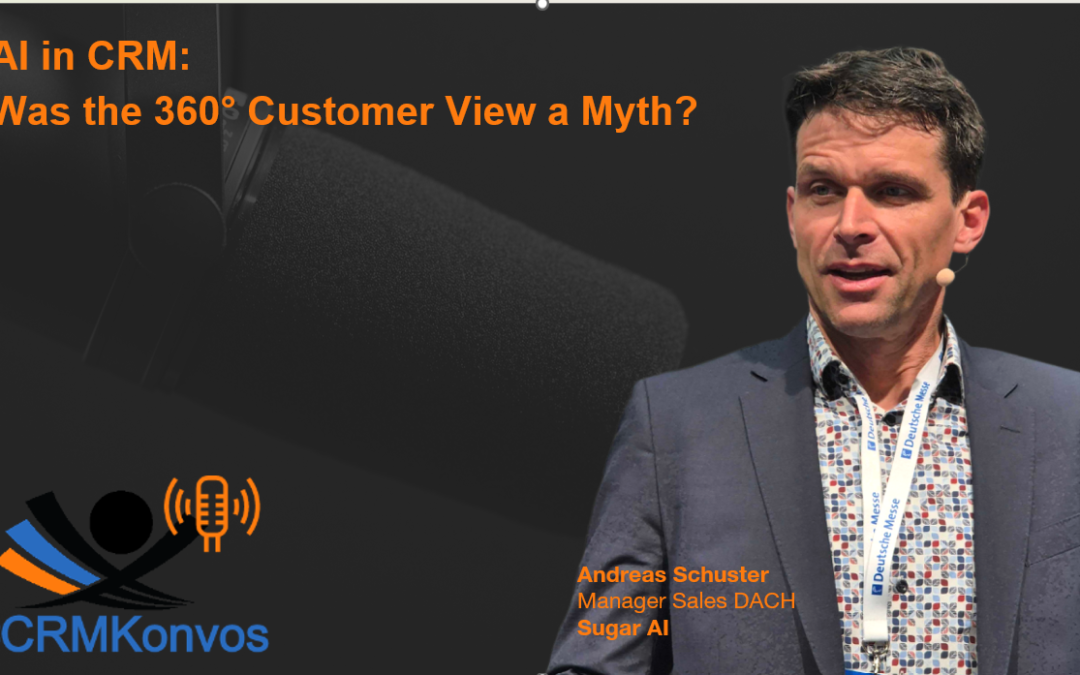
For more than twenty years, CRM vendors sold the 360-degree customer view as a commercial superpower: every contact, every transaction, every complaint, every campaign response in one place. As we discussed in our recent CRMKonvo with Andreas Schuster of SugarAI, the promise always had a flaw. Seeing everything is not the same as understanding anything, or seeing the right thing. The question is not whether AI completes the circle, but whether it lets us admit sellers never wanted the circle.
TL;DR
If you want to watch the full CRMKonvo, please go ahead here (optimized for smartphones) or here (optimized for tablets/computers).
Else, be my guest and continue to read.
Or do both …
Three Point Six Degrees and the Death of the Dashlet
Andreas opened with a wordplay that is better than most keynotes: out of the 360 degrees, perhaps only 3.6 matter. "The more they know in terms of data, the less guidance they get what to know." He recalled sales leaders of a decade ago starting each day in front of hundreds of dashlets. A hundred dashlets cannot all tell the same story, and nobody reconciles the contradictions before the first call.
His verdict on the 360-degree view was generous: not a lie, not a misconception, simply the best the technology of the day could do. Jon Reed of diginomica, commenting live, was less generous and, in my view, closer to the mark. As an aspiration, fine. Presented as reality, it was always nonsense. The 360-degree view was the same mistake as big data: we confused owning data with having information. You only want the part that helps in this moment, and not the whole pile.
The 360 Did Not Die; It Moved Below the Waterline
Yet the 360-degree view is not abandoned. Andreas still believes in it "as a data layer", because AI "needs material for learning, for filtering, for associations."
So the circle survives. It has simply been relegated from the seller's field of vision into the model's fodder. That’s a sensible architecture, but it doesn’t take the data quality problem out of the equation. It just became invisible. My co-host Ralf Korb put it more memorably than I can. Take two dirty stacks of data, put them together, and you do not get perfume. It stays dirty and smelly.
Andreas argued that large language models are getting better at smelling bad data. That may be true for inconsistencies such as duplicates or contradictory records. It is certainly not (yet?) true for data that is wrong but plausible. A visit report that records an optimistic buyer who was only being polite is not something a model can detect as false. It will summarize it fluently, in your language. A confident summary of bad input is still bad input, just with good grammar.
Andreas put the finger where it hurts: "you still need the input from sales reps." Voice capture, transcription and translation make this input cheaper. They do not make it optional.
Integration by Signal, Not by Replication
The most interesting idea of the hour was not about AI. But about integration. Andreas regularly asks prospects why they want to copy all their ERP data into CRM. Usually there are licensing reasons: nobody wants to buy sellers an SAP seat, so invoices and credit limits get pushed across, so "you create the same confusion on the other end." One customer per week asks about an invoice; for that the entire receivables history really doesn’t need to live in the CRM.
His counterproposal flips the direction. Instead of replicating ERP data, the back end watches for anomalies and sends a recommendation to the CRM. Three customers in one region get the same new product; one buys, two do not. One customer stops ordering machines in August and buys only spare parts. You do not need the quantities, but you surely need to "pick up the phone and call the company."
This is the right approach. Replication moves data. Signals move decisions. Combined with self-service portals that answer invoice questions without a salesperson, it shrinks what the CRM has to carry and frees the sales rep for more important jobs as a bonus.
The catch is that an anomaly is only an anomaly relative to a model of normal. Who defines normal? And a customer shifting to spare parts can mean churn risk or a perfectly healthy asset lifecycle. The recommendation is only as good as the business context encoded behind it, and that context is consulting work, not a feature toggle.
The Signal You Cannot Hear
When Ralf asked which signal carries the greatest predictive value, Andreas gave the best answer of the evening: the biggest threat is the thing you do not hear. Satisfied customers go quiet; so do customers about to leave, because they do not want you on alert. His most overrated customer signal? Kindness. Inexperienced sellers mistake it for a buying signal. And it is not.
This is where the AI story has a hard ceiling. Sentiment analysis can pick up words that people typically use when they are annoyed, even when they say them politely, but in Europe it requires consent and in any case it only works on conversations that happen. Silence produces no transcript. A buyer who has been thinking about a new CRM for five years produces no data in your system until the day they call. As Andreas put it, that is the first day for you, not for them. AI "knows what it knows," and it does not know what happened inside the buyer's organization before you arrived.
What the machine can do is cheap and underused: a two-minute summary of the customer's public news before the call, so you do not phone a prospect who replaced their CEO last week. That is homework, automated.
Proactive Until Someone Switches It Off
Sugar's answer to the "you don't know what to ask" problem is a mix of a conversational assistant and pushed "smart prompts": overdue tasks, meetings without notes, renewals at risk, SugarPredict recommendations. Andreas described the goal as a CRM that is proactive "but not too proactive," because a noisy system is one "you eventually switch off."
We are about to repeat the dashlet mistake with recommendations. A hundred prompts are just a hundred dashlets that talk. Andreas's own rule was three things a day, and "don't do anything else today." That is a good rule. But a rule is not a product constraint, and nobody on a vendor roadmap is rewarded for shipping fewer recommendations.
The same goes for real time. An IDC study, quoted by a viewer, claims that companies using real-time data do better with AI. Andreas agreed in principle; I did not so much. Website interactions need sub-second response; an email can wait an hour. Right time beats real time, and the two are only occasionally the same.
Andreas was candid on adoption: the majority of customers, many of them family-run manufacturers buying their first real CRM, are not yet using the AI features at all. The vision is ahead of the installed base, and adoption depends as much on whether sellers use AI privately as on anything the vendor ships.
The Seller Does Not Disappear; the Excuses Do
Andreas does not see the seller's job under threat, but he does see its profile changing: context, systematic work and determination. Qualification frameworks such as MEDDPICC belong inside the CRM, triggering workflows and escalations rather than living in a slide. And the days of visiting the reseller "where the coffee is the tastiest" are over.
His sharpest warning was aimed at management, not technology. When AI frees up seller time, the temptation is to refill it with administration. "No, no, no. Free up the time for good."
Pragmatic Playbook for Enterprise CX Buyers
The 3.6 degrees are a thing; I have written about it already years ago. But they do not come for free. Before you pay for guided selling, test these three things.
Demand integration by signal, not by replication. Ask the vendor which back-end events generate which recommendation, and how anomaly thresholds get tuned to your seasonality and product mix. If the answer is "it learns," ask “how” and who owns the tuning after go-live. Move invoice and credit questions to self-service before you move ERP tables into CRM.
Fund the data layer before the assistant. The 360-degree view now feeds the model, which makes its quality more important, not less. Measure how many opportunities have current visit notes and how many accounts have duplicates, before and after launch. If the recommendations rest on seller input nobody enforces, they rest on sand. Voice capture helps but it does not replace discipline.
Cap the recommendations and make them explain themselves. Insist on a daily limit, a stated reason for every prompt, and a human who decides. Track how often sellers ignore or dismiss prompts. A rising rate is your early warning that you have rebuilt the dashlet wall. And protect the time you free up. If it gets refilled with admin, the business case evaporates.
The best customer signal is still the call nobody made.