
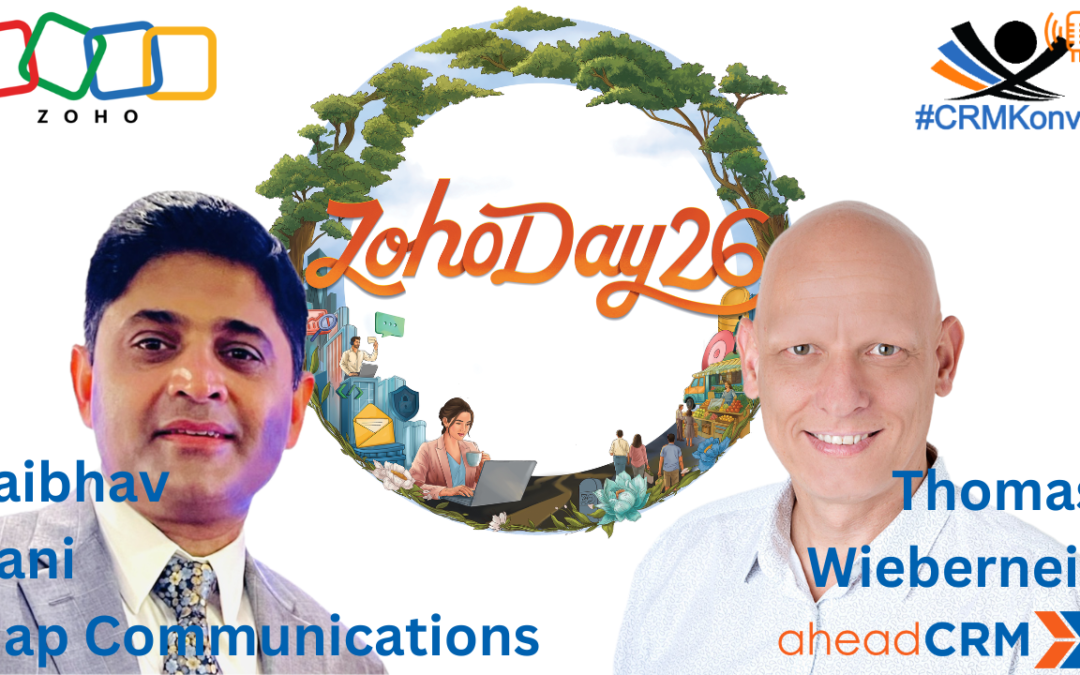
Recently, while on the ground in Austin, Texas, attending ZohoDay 2026, I had the pleasure of sitting down with Vaibhav Dani, the CEO of Map Communications. In the enterprise software ecosystem, we talk endlessly about digital transformation, but it is always refreshing to ground those lofty concepts in reality by speaking directly with the leaders navigating these complex implementations.
Our conversation touched on a surprisingly common, yet notoriously difficult challenge: harmonizing a homegrown operational tech stack with off-the-shelf enterprise software. Map Communications’ journey with the Zoho ecosystem provides a masterclass in pragmatic architecture, the age-old “buy versus build” dilemma, and the foundational data hygiene required to actually make artificial intelligence work.
TL;DR
If you do not want to read this, here’s the full length video interview.
Everybody else, please read on.
The Business Context: Bespoke Service at Scale
To understand their technology strategy, you first have to understand their business. Map Communications is a nationwide, employee-owned (ESOP) virtual receptionist and bespoke answering service operating across the US, Canada, and the UK. They serve a wide array of clients, ranging from legal firms and SMBs to large enterprises in various industries.
Because their core service is highly specialized, Map relies on its own proprietary, homegrown software lineup to manage day-to-day operations and real-time answering services. However, when it comes to managing the customer lifecycle from the moment a prospect lands on their website to the execution of contracts and ongoing support, they rely on the Zoho suite.
The Age-Old Dilemma: Buy vs. Build
As businesses grow and their processes add complexity, leadership is inevitably faced with a choice: do we build custom modules into our core software or do we buy an off-the-shelf solution?
Dani approaches this with a highly disciplined decision framework. Map evaluated their requirements and realized that building tools to manage vendor and customer contracts or constructing a native quoting tool that would expose their internal APIs simply wasn’t a valuable use of their development capacity.
Instead, they followed the Pareto principle and applied an 80/20 rule. As Dani rightly pointed out, “If 80 percent of the requirements are met, we’ll be fine because no system would have 100 percent software requirements“. Chasing those elusive final 20 percent now often results in over-engineered, heavily customized systems that become a nightmare to manage and support later. By accepting the solid 80 percent requirements fit that tools like Zoho Contracts and Zoho CRM offered, Map Communications avoids unnecessary technical debt while keeping their internal developers focused on their core, proprietary service offerings, the very ones that differentiate Map Communications.
Decluttering the Stack and the “Evil” of Copy-Paste
One of my core theses as an industry analyst and consultant is that the “copy and paste” of data is the root of all evil, well, at least much of it, in enterprise software. Dani wholeheartedly agrees. When data is manually moved or fragmented across multiple systems, automations break, billing mishaps occur, and the customer experience suffers.
Still, it is often necessary,
Map Communications deliberately architected a separation between their real-time operations and their CRM environment. They utilize Zoho Data Bridge to move data smoothly into Zoho CRM, Zoho Desk, and Zoho Analytics asynchronously, ensuring they don’t burden their live, day-to-day answering systems with heavy real-time external integration calls.
Furthermore, they are looking to Zoho Social to centralize their marketing technology, aggregating Google Ads, LinkedIn profiles, and Trustpilot reviews into a single pane of glass. The goal is clear: declutter the system. By minimizing the number of distinct data silos, Map establishes an authoritative data source, a single source of truth.
This isn’t just about clean reporting. As Dani wisely noted, the highly anticipated “agentic AI” that every vendor is currently hyping is practically useless without properly governed, centralized data. If your AI doesn’t know which system holds the truth, it cannot act effectively on your behalf.
Knowing When to Ask for Help
Another trait of a mature organization is knowing when to raise a hand and ask for help. Map Communications’ journey with Zoho began around 2021, and they initially worked directly with Zoho’s professional services teams, who worked tirelessly across time zones to pull off a complex legacy migration.
However, as they acquired more businesses and faced tighter integration timelines, they didn’t hesitate to bring in specialized external implementation partners, like Workflow Academy, to accelerate the process.
As a consultant myself, I always appreciate a leader who recognizes the value of an outside perspective. External partners bring cross-platform experience. They have seen migrations from Salesforce, Zendesk, or Freshdesk, and can help organizations avoid costly architectural mistakes early on. At the end of the day, this is mostly cheaper than running into a sequence of snafus. The key, according to Dani, is ensuring that the vendor provides thorough documentation and cross-training so the internal team isn’t left in the dark when it’s time for the next iteration.
Past the Honeymoon Stage: Looking to the Future
Map Communications is well past the “honeymoon stage” with their CRM vendor, entering that mature, long-term marriage phase where continuous improvement is the name of the game. And so far, this marriage seems to be a happy one.
But no software relationship is perfect. When asked for the one missing feature he desperately wants to get from Zoho, Dani didn’t hesitate: a unified single sign-on that allows C-suite executives to toggle seamlessly between their multiple, distinct Zoho instances without having to constantly log in and out.
Consider the pressure publicly applied, Zoho!
Ultimately, Map Communications proves that a successful CRM strategy isn’t about buying the most expensive system on the market. It’s about rigorous data governance, pragmatic vendor selection, avoiding scope creep, and relentlessly focusing on communicating value to the customer.
Three Key Takeaways for Pragmatic Tech Leaders
As we wrap up this insightful conversation, a few core themes stand out that any organization evaluating their software architecture should take to heart.
Embrace the 80/20 Rule: Chasing a system that perfectly fulfills 100 percent of your business requirements will lead to over-engineering, scope creep, and bloated budgets. If an off-the-shelf solution meets 80 percent of your needs, accept it, work around the remaining 20 percent, and avoid building costly, complex custom systems on top of it.
Clean Data Precedes AI: The industry is still not stopping to buzz about agentic AI, but as Dani correctly highlighted, AI is completely dependent on having an authoritative, decluttered data source, a single source of truth. Eliminating manual workarounds because copy-pasting of data across systems is truly evil, and harmonizing your core tech stack are absolute prerequisites for any future AI success.
Demand Knowledge Transfer from Partners: Recognizing when you need external help for complex software migrations is a sign of mature leadership. It is a strength, not a weakness. However, when you do bring in outside consultants or vendor implementation teams, you must mandate thorough documentation and cross-training. Your internal team needs to be fully empowered to manage, fix, and iteratively improve the system long after the consultants have rolled off the project.I am already looking forward to checking back in with Dani in the course of the next year to see how Map Communication’s preparations for agentic AI going forward and eventually help the company.