

Salesforce Aims At Making Life Easier For Agents
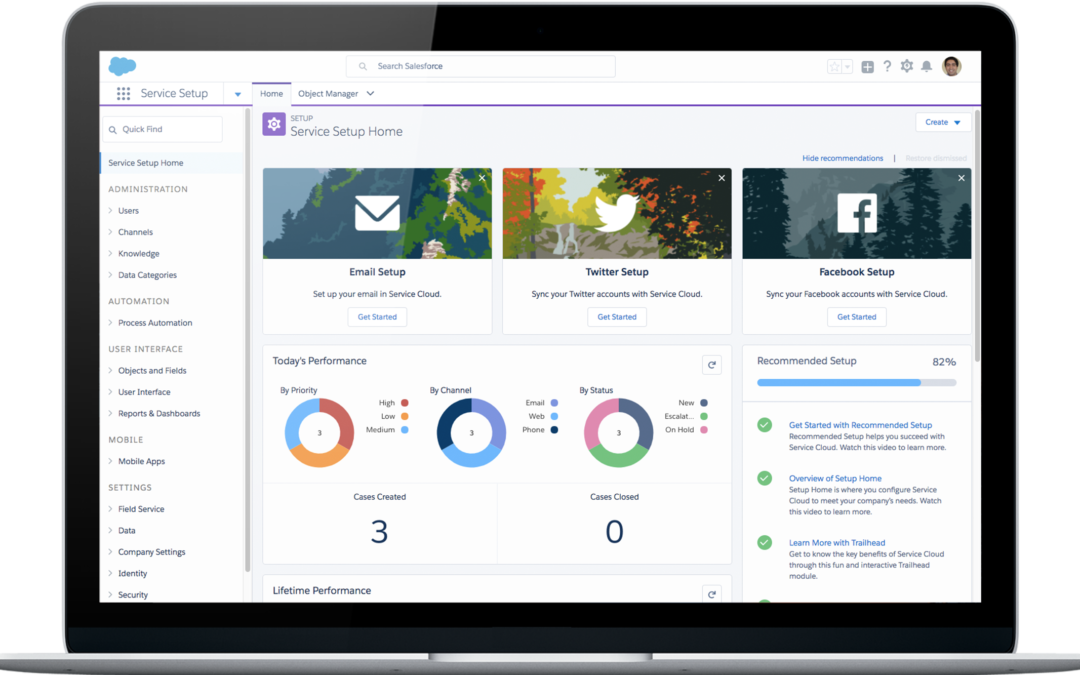
On July 27, 2017 Salesforce announced the availability of an update to their customer service platform Service Cloud. According to Keith Pearce, VP Marketing, Service Cloud, differentiation in customer service is no more a topic within industries, but across industries. Today, customer service in companies competes against the impression gained in another industry, telco vs. banking, vs airline, vs. … you get the picture. Consequently, winning organizations are concentrating on three areas: platform productivity mobile However, this focus can potentially slow down these organizations because they normally come with trade-offs, like scalability vs. speed of deployment, ease of use vs. complete information, or mobility for customers vs. mobility for agents. Salesforce wants to address these trade-offs with this release by making the solution very easy to set up, easier to customize and enhance, easier to use and finally by offering a new mobile app for agents and supervisors. There is a scripted set up that lets admins deploy a usable application in a short time; Salesforce speaks of less than one day. A component library helps in easily adding relevant functionality via drag and drop in a simple application builder. Of course there are additional components and applications available via the AppExchange market place. Agents shall be made more productive by a clean Kanban-style UI, a tool called Community360 that helps in surfacing community content that a user reviewed before logging an incident, a federated search that is capable of searching across open search compatible providers, and the ability for agents to script tasks. Lastly, there is a new mobile app for agents and supervisors. Here is the complete...
CustServ Solutions – Why Choose one Over the Other?
For a while now I am contemplating about why companies choose one custserv solution over another. After all the market is pretty crowded. Vendors have a hard time to differentiate themselves. Just looking at G2Crowd one finds 88 Help Desk Solutions. Larger organizations are likely to be influenced by Gartner’s Magic Quadrant on Customer Engagement Centers or the Forrester Wave on Customer Service Solutions. Smaller organizations are probably looking more at the new breed of peer-to-peer review sites, like the aforementioned G2Crowd or GetApp, TrustRadius, Capterra and others. Many companies conduct research and establish an RFP process to determine the best fit; some see a bottom-up approach from team level to corporation. A kind of ‘shadow IT’ emerges to solve a team’s particular problem. This solution over time could get corporate blessing and may even become the main solution. A clear and reliable roadmap is mandatory for all vendors, so no difference here. Same for share of mind – this has become table stakes. But what is it that makes one vendor win over another? Are there patterns? To get more insight I asked some smart people who stay unnamed here – but you know who you are! So What Are Contributing Factors? The good news is that there seem to be only a few factors. Based on the discussions I can roughly group them into six categories. Here they are, in no particular order: A particular feature is needed or desired Suite- vs. Best-of-Breed thinking Size of the customer organization Relationship building Referrals Departmental adoption Of course they are not mutually exclusive. Let me briefly dive into each...
IoT becomes Outcome Orientated with SAP Leonardo – Finally
On January 10, 2017, SAP announced a bundling of their IoT portfolio of initiatives to focus on business outcomes instead of technology while combining the set of emerging products and solutions under the brand name Leonardo – as in Leonardo Da Vinci, one of the most forward looking artists and innovators ever. This announcement substantiates SAPs commitment to invest two billion Euro in IoT over the next 5 years. The new portfolio will combine adaptive applications, big data and connectivity as packaged line-of-business solutions, covering a range of topics. It bases upon a rebranded – and repackaged(?) HANA Cloud Platform, enhanced by the micro services for machine learning that were announced earlier and which I covered here. This enhanced platform is now called SAP Cloud Platform. As per a blog post accompanying the Leonardo announcement, the high level architecture of SAPs new offering looks like below and covers, besides a set of existing applications an IoT adapter – SAP Leonardo for Edge Computing – which serves as a device independent data input layer, essentially a kind of middleware, probably built on or using HCI. a foundational layer – SAP Leonardo Foundation – which includes the IoT business services that are to be exposed, enabling rapid development of applications. This makes up the functional core. and a ‘bus’ layer – SAP Leonardo Bridge – which enables the combination of real time data with applications and processes Leonardo is accompanied by a jump-start enablement program to accompany this initiative. This program includes introductory pricing and is intended to help organizations identify and validate IoT pilots and use cases, including expert staffing...