thomas.wieberneit@aheadcrm.co.nz
The Orchestration Layer in Enterprise AI Just Got Named. It Has a Gemini Logo on It.

The Orchestration Layer in Enterprise AI Just Got Named. It Has a Gemini Logo on It.

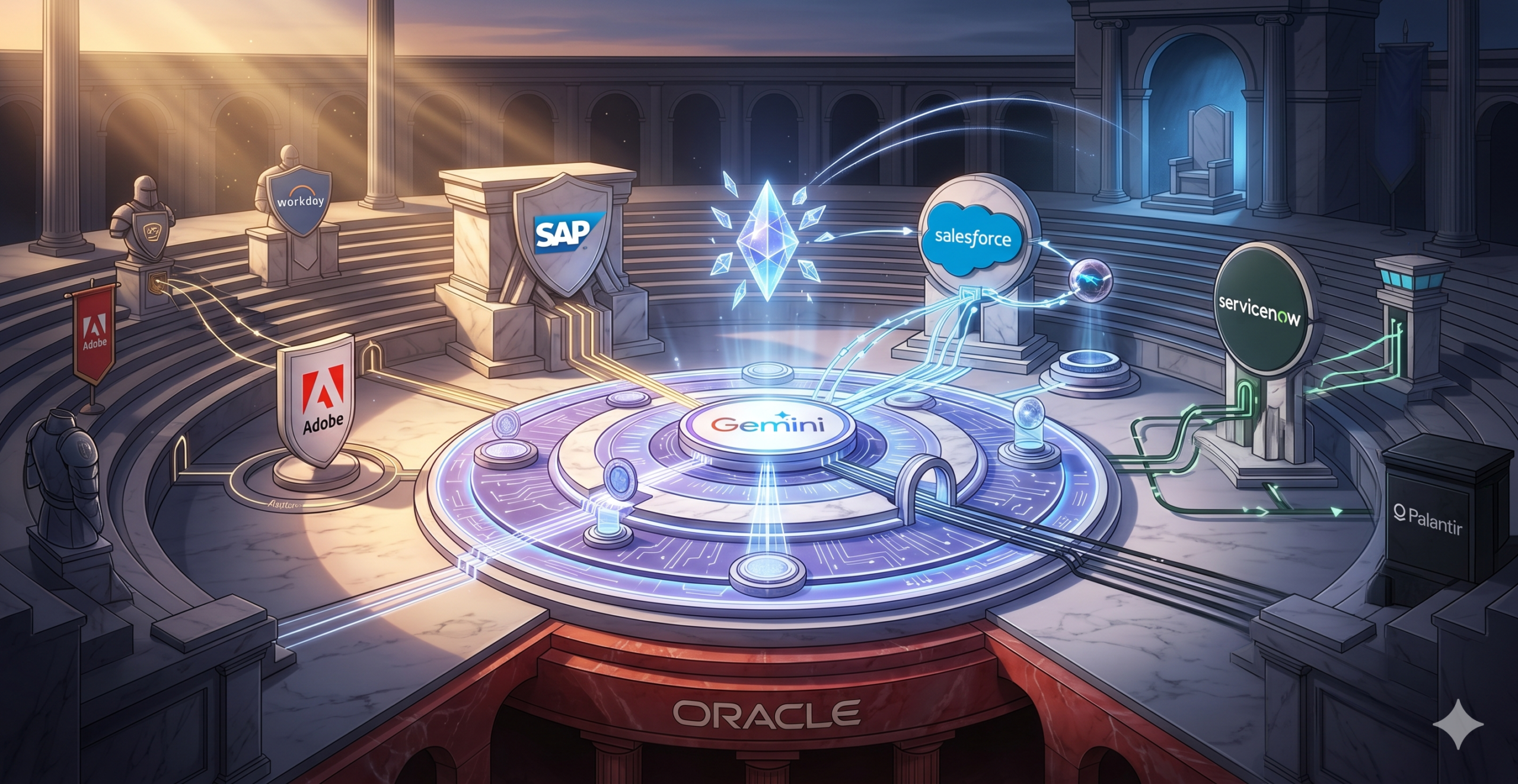
What Google Cloud Next 2026 actually told us about the titan pecking order Google Cloud Next 2026 wrapped last week. The official version of the story is the one Google wanted you to read: 260 announcements, 1,302 customer use cases, the Gemini Enterprise Agent Platform, eighth-generation TPUs, a $750 million partner fund, an $240 billion Marketplace backlog. Big numbers. On-message keynote. Tidy “agentic era” framing. The more interesting story is who showed up to validate it, and what Google actually built underneath. Five of the seven enterprise titans I track walked into Las Vegas and announced expanded partnerships that all rest on the same architecture: Gemini Enterprise as the agent control plane, with the titan’s product playing the role of premium ingredient. Salesforce. SAP. ServiceNow. Oracle. Adobe. Add Workday and Palantir Technologies to the picture, both adjacent to my titan list but visibly aligned in the same direction. Two titans were not in the picture. Microsoft, because Copilot is the direct counter-position and Cloud Next is not Microsoft’s stage. Zoho, because Zoho’s stack does not need a Google motion and Zoho’s buyer is not the same buyer. Both absences matter. More about them a little later. What Google actually built Let’s start with the framing. Google did not just ship a model platform with new features. It repositioned Google Cloud from “AI development environment” to enterprise agent control plane. Vertex AI services and roadmap evolutions are now delivered through the new Agent Platform rather than as a standalone product. That is not a naming change, it’s an entirely different playground. The Agent Platform stack now visibly includes: Agent Identity...
How vendors help generating value with generative AI

How vendors help generating value with generative AI

The hype around generative AI, in particular ChatGPT is still at a fever pitch. It created thousands of start-ups and at the moment attracts lots of venture capital.  Basically, everyone – and their dog – jumps on the bandwagon, with the Gartner Group predicting that it is getting worse, before it is going to be better. According to them, generative AI is yet to cross the peak of inflated expectations.  Gartner Hype Cycle for Artificial Intelligence, 2022; source Gartner There are a few notable exceptions, though. So far, I haven’t heard major announcements by players like SAP, Oracle, SugarCRM, Zoho, or Freshworks. Before being accused of vendor bashing … I take this is a good sign. Why? Because it shows that vendors like these have understood that it is worthwhile thinking about valuable scenarios before jumping the gun and coming out with announcements just to stay top of the mind of potential customers. I dare say that these vendors (as well as some unmentioned others) are doing exactly the former, as all of them are highly innovative. Don’t get me wrong, though. It is important to announce new capabilities. It is probably just not a good style to do so too much in advance, just to potentially freeze a market. This only leads to disappointments on the customer side and ultimately does not serve a vendor’s reputation.  For business vendors, it is important to understand and articulate the value that they generate by implementing any technology. Sometimes, it is better to use existing technology instead of shifting to the shiny new toy. The potential benefits in these cases simply do not outweigh the disadvantages, starting...
Google and SAP – A Marriage in the Clouds

Google and SAP – A Marriage in the Clouds

On Mach 8, 2017, SAP and Google announced another marriage in the cloud during Google’s Cloud Next event: SAP HANA is certified on Google’s Cloud Platform GCP, and is generally available now. SAP Cloud Platform and more products and solutions are to follow. The Google Cloud Launcher marketplace will be utilized to offer and deploy to and for customers and partners, starting with SAP HANA, express edition, which is already available, too. Further topics that are covered by this partnership are Improving Google’s containerization technologies for enterprise workloads Security, privacy, and integrity of customer data in the cloud. As part of this SAP software shall act as a data custodian (NB: How that works in legal and political environments remains to be seen) and joint solutions for access control, governance, risk and compliance shall get developed Integrate Google’s G Suite into SAP applications. This has already been implemented for Identity and Access Management. More on the still fuzzy side are end-to-end integrations and collaborations in the areas of AI and machine learning. True to the SAP mantra of being an ecosystem player this is all about choice – choice for the customer to implement what is best for them. My Take Another interesting one! Good Win for SAP SAP now covers all major cloud platforms. HANA is now certified on AWS, Azure, and GCS, apart from running in the SAP cloud. With this SAP now has the broadest footprint when it comes to running on an IaaS platform. With the SAP Cloud Platform being available soon there also will be a very powerful PaaS solution on one of the...