

Customer Experience is a Platform Play – Always Was
The most important tool that enterprise software vendors have in their respective arsenals is their platform. While Vinnie Mirchandani rightfully states that Enterprise Software Platforms have so far underwhelmed, Denis Pombriant proclaims them the new battleground. In my opinion it is not that new a battleground but as part of the Clash of Titans it is becoming more evident as a battleground. An enterprise software platform was always part of the battle for dominance in the customer engagement – or putting it into (marketing) industry lingo – customer experience market. It is actually an integral part of it. This is largely because of the ongoing commoditization of transactional business applications. But it was sexier to talk about shiny topics like engagement and experience than to talk about the grease and the machinery behind that drives and enables the technical delivery of engagements – note, that there are systems of engagement, but there is nothing like a system of experience. And now topics like chatbots, machine learning, AI, ambient computing, IoT, to name a few, made the machinery – the platform – the new black. A – perhaps not so – brief history When looking at the broad topic of CRM, customer engagement or customer experience, we have seen a lot of change happening since the early days of Sales Force Automation, SFA. Back in the early 90s one of the first topics has been SFA, with a focus on making a distributed sales force more effective and efficient. Contact management came even earlier, call center software and field service quickly followed. The emerging industry was dominated by little players...
Salesforce embraces the User Microsoft like – A Dreamforce Analysis
Now that the major waves of Dreamforce 2017 have settled, the announcements and a good part of the running commentary has been delivered, it is time for me to have a look at my pre-Dreamforce predictions. Having been briefed before the event but unluckily not been able to attend (nor having had the time to write this piece earlier, I now have the advantage of having had more ‘thinking time” and can put the main announcements that we were briefed on into a bigger picture. On the backdrop of an IDC study (sponsored by Salesforce) that postulates 3.3 million new jobs and an overall GDP impact of 859 billion dollar by 2022 in the “Salesforce economy”, the announcements basically revolve around one single topic: How to enable the employees (of Salesforce customers and partners) to deliver to this magnitude. They were around Easier consumption of AI technology with Einstein, and improved IoT support, Opening up Trailhead to Salesforce customers in order to support company specific learning maps Enabling Lightning, as the platform to become fully themed, i.e. embrace the customers’ brands. Although technologically different I club the ability to create and easily upload branded mobile apps to the app stores into this Collaboration using Quip, the software that Salesforce acquired about a year ago, and a new partnership with Google And in order to emphasize on the fact that they are serious about enabling people individually, Salesforce resuscitated the dot com prefix “my”. Thus myEinstein, myTrailhead, myLightning, mySalesforce, myIOT and mySalesforce got born. A topic that might be slightly overlooked is covered by two sentences in the announcement of...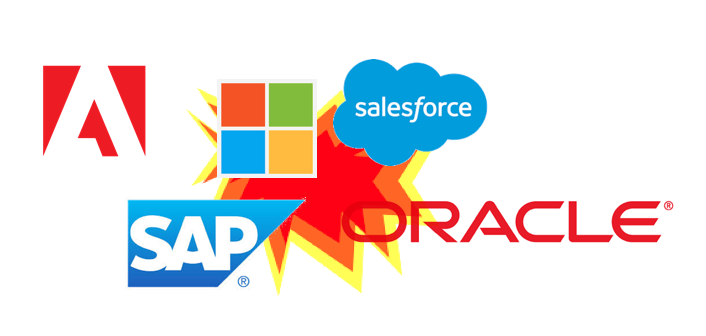
Oracle Ups The Ante – Does the Salesforce Empire Strike Back?
The fall conference season is in full swing. Of the big 4 we had Oracle Open World and the SAP Hybris Summit, with the Salesforce Dreamforce, SAPPHIRE, and Microsoft Connect() still to come. I have covered the SAP Hybris Summit, so do not need to say much about it anymore. The event was short on great announcements – maybe they will come at SAPPHIRE – but certainly contributed to showing the clear vision forward that SAP has. And it is a compelling and consistent vision. OOW 17 was a different beast, most notably with the announcement of Oracle 18c. A year ago Oracle took Amazon full on, declaring it enemy number 1. Many analysts, including myself, were confused about this. Why Amazon and not Microsoft? After all Microsoft is the company that has a very credible IaaS, PaaS, and SaaS. Add the operating system and productivity software and you have a company with a formidable software stack that can be on the winning side of a Clash of Titans. While CTO Larry Ellison still took pot shots at Amazon in his keynotes, one can come to the conclusion that these are a kind of diversion, and that Oracle is back in best Musashi style. Oracle steps up its IaaS game The AI driven automation of Oracle 18c is game changing in the database play, and hence in IaaS. The new container engines should bring Oracle’s cloud on par with AWS and Azure. All three, Microsoft, Salesforce, and SAP now have something to chew upon. SAP, because their databases are now lacking a real important argument. And that has an...