

Freshdesk acquires Pipemonk – A Snap Analysis
Last week Freshdesk announced the acquisition of Bengaluru based SaaS data integration company Pipemonk, the seventh acquisition since mid of 2015. Pipemonk has been launched in 2014 and since has implemented integrations between many leading e-commerce-, accounting-, CRM-, Marketing-, and Billing applications, including Amazon, Shopify, Salesforce, Zoho, Hubspot, Mailchimp, and Stripe. So far Freshdesk was not on their list. Pipemonk’s promise and objective is to deliver easy-to-setup, pre-built bi-directional integrations between SaaS applications. On their web site they reported to have more than 2,000 customers acquired in the short life span, with a seed capital of only 2 million dollar. So one can say that they delivered successfully. Freshdesk itself has its roots in customer service and since increased its portfolio to include help desk (hotline), a sales application (Freshsales), chat (Freshchat) and social testimonials using acquisitions and own developments. My Take I think that this was an important step for Freshdesk. It enables Freshdesk to easily expand its reach to integrate with a raft of SaaS applications in different business domains, prebuilt or custom. Further, I was wondering for a while whether and how Freshdesk would go on integrating their own application stack, which as per my understanding so far consists of different, only lightly (if at all) integrated applications – although my understanding may be wrong. Assuming that Freshdesk intends to continue their aggressive growth trajectory with this acquisition the team also has the foundation to integrate new and newly acquired functionality fast, based upon an established architecture. Overall, congratulations to both...
Kustomer – A New Kid on the Customer Service Block
Sparked by an article by Bob Thompson, titled You had me at “Treat Customers as People” about Kustomer, a new kid on the customer service block, I ventured to reach out to founder Brad Birnbaum and his team to get some more information. After all the customer quadrant of software is quite crowded, and a new company needs to offer good ideas to keep up and go beyond the incumbents, most of them being young companies as well. One of the basic questions that I had was: Do we need another customer service solution? After all, G2Crowd already lists 19 in their Help Desk grid; and these are only the ones that made it into the grid. Overall G2Crowd counts 78 solutions, excluding Kustomer. And quite some of them are quite strong. Figure 1: G2Crowd Grid for Help Desks as of December 2016 Brad and his team certainly seem to be of the opinion that there is an unmet need; as are their investors who brought in $ 12.5 million into seed- and series A funding in less than a year. The founders bring experience that dates back to 1996 and includes the success of Assistly, now desk.com, which is part of Salesforce. Another question is: How does Kustomer want to differentiate itself or, which issue do they solve that the other companies do not yet solve. Quite simply put, Kustomer claims that there are too many unconnected point solutions that customers – and hence employees – need to deal with. This issue gets addressed by the Kustomer platform that acts as an integration hub and connects customer service...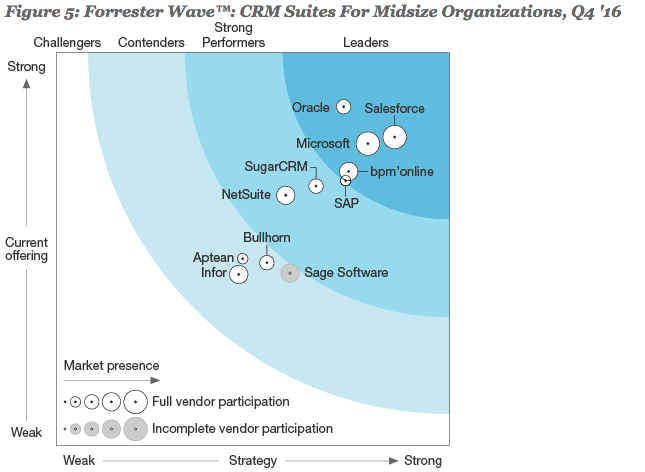
Forrester Wave CRM Suites for Mid-Sized Businesses – What it Means
Finally, the much-anticipated Forrester Wave on CRM Suites for Mid-Sized Businesses Q4/2016 has been published by Kate Leggett and her team at Forrester Research. Besides the usual suspects Oracle, Microsoft, Salesforce, and SAP it covers 7 more vendors that fulfil Forrester’s definition of a CRM suite for mid-sized businesses. This definition roughly is To be considered a suite the software covers at least three of the CRM disciplines Marketing Sales Force Automation Customer Service Field Service E-Commerce Customer Analytics There needs to be prebuilt integration between the products, if they are not within the same system; integration shall be via open standards to allow for integrating other applications. The software needs to be targeted at organizations between 250 and 999 employees. Multiple industries need to be targeted. Of course, the solutions need to be in active use and there need to be customer references. The Forrester Wave has some interesting results, some confirming what other people see, too, others somewhat surprising. Let me start with the confirmations, continue with bits that surprised me, and close with an SAP specific view. The Confirmations Of course, we are talking cloud – cloud and nothing else. As can be expected all vendors strive to deliver a toolset that helps their customers to deliver consistent customer experiences. Now I, and others, would argue that the experience is largely in the realm of the end customer and the users and that there is nothing like a ‘system of experience’. Delivering consistent experiences encompasses far more than a CRM suite. But then it is far easier (and sexier) to talk about delivering experiences than about...
SAP and MachineLearning – A Strong Approach, but none too early
In my yesterday’s analysis of SAP’s HANA announcement, I wondered why SAP stays silent on the AI and MachineLearning frontiers. Well, today I know. They saved this announcement for today. And the announcement is a bang. SAP will deliver what they call ‘intelligent business applications’ that are based upon SAP’s new machine learning platform. The platform itself shall be made available with SAPPHIRE NOW 2017. The first significant intelligent application by SAP that is mentioned, is a brand intelligence application that leverages deep learning to analyze brand exposure in video and images to provide ‘accurate, real-time insights into sponsoring and advertising ROI”. You may remember that SAP earlier showcased an application to reduce recruiting bias, which is based on the machine learning platform, too. According to Juergen Mueller, Chief Innovation Officer at SAP, the new machine learning platform is intended to serve SAP’s and their ecosystem’s applications with the goal of creating more business value. Consequently, there are two more aspects to the announcement. SAP launched a partner program dedicated to SAP Application Intelligence. SAP invests into education offerings, starting with a ‘massive open online course’ on Enterprise Machine Learning on their OpenSAP platform. MyPoV This announcement clearly shows that SAP is as serious about machine learning as the company is about leveraging the power of its ecosystem. As I, and many other people, have often said, SAP is a formidable organization if and when it chooses to drive a topic. This is shown here again. And SAP is absolutely on the right track by pursuing this three-pronged approach of delivering a platform with first solutions, encouraging partners, and...