Building a CRM Strategy Brick by Brick
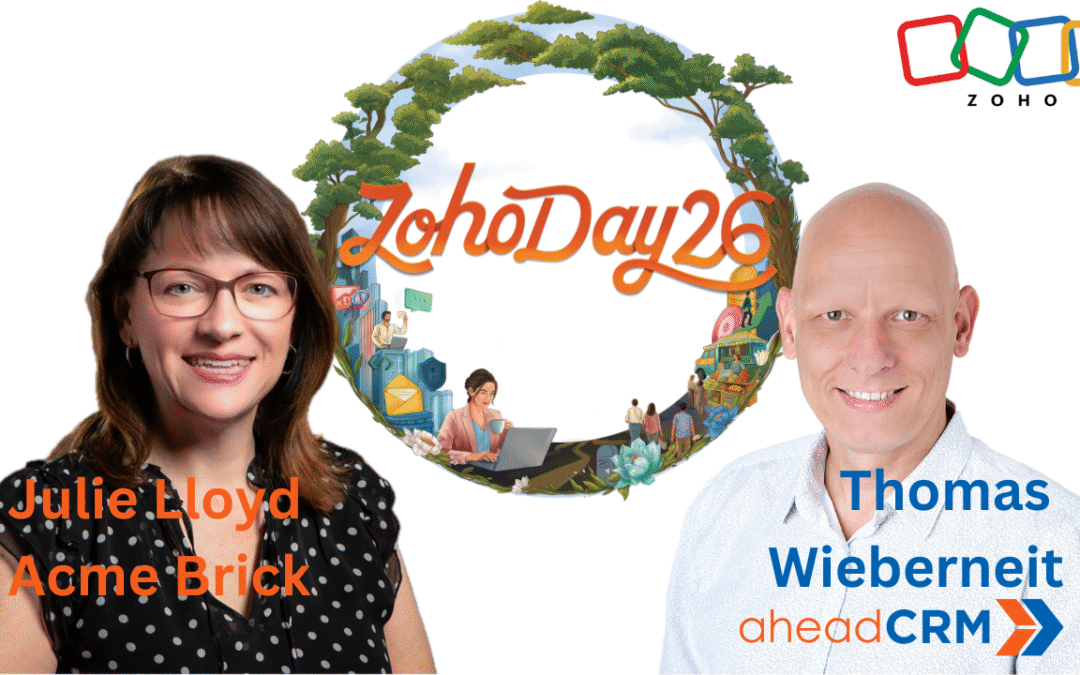
During ZohoDay26, I had the absolute pleasure of sitting down and talking CRM with Julie Lloyd from Acme Brick in beautiful Austin, Texas,. Naturally, the topic of the day was Acme Brick’s fascinating journey into the Zoho ecosystem. As a CRM analyst and consultant, I’ve seen countless software deployments crash and burn because organizations focus entirely on the technology rather than the people actually using it. That is why talking with Julie was such a breath of fresh air; her focus is entirely on the human element of Acme Brick’s digital transformation. For those who aren’t familiar, Acme Brick isn’t just any company; they are the largest US-owned manufacturer of brick. They deal in a wide gamut of materials, including manufactured block, stone, tile, and various other wall cladding. It is a sizeable operation with around 1,700 employees spread across 13 states. This coming April, Acme Brick is celebrating a its 135th birthday. When a company with that much history decides to overhaul its CRM technology, you know there’s a good story behind it. Even more so, if it is a system replacement story, Julie has been with Acme Brick for two years, and what keeps her up at night is CRM training and ensuring user adoption. TL;DR If you do not want to read, here’s the full video interview. For everyone else, read on. Having said all this, let’s dive into why they made the switch and how they are making it work this time. The Square Peg, Round Hole CRM Disaster Before migrating to Zoho, Acme Brick used another CRM system. We won’t name names here, but...
How to speed up your expense process from days to minutes
During the recent ZohoDay 2025, I had the pleasure of talking to Jaroslaw Pietraszko, CIO for IFFCO Group, about what IFFCO is doing with Zoho, why, and what the outcomes of their Zoho implementation are. IFFCO is a privately held multinational company that is active in the fast-moving consumer goods (FMCG) sector that also has some beauty business and is active in packaging and transportation. The company has its headquarters in Dubai, UAE and has operations in 50+ countries on five continents. The company has more than fifteen thousand employees. Due to its distributed nature and also multiple ERP systems in the back end, IFFCO – and in particular also IFFCO’s employees – suffered from slow, inconsistent and regularly manual expense management process. This also caused a policy adherence and compliance problem, as reporting was virtually impossible. Only two countries used an Intranet based digital process that still was cumbersome due to the company’s matrix organization. “It was completely manual process. So just imagine that someone from the one category of the businesses has some marketing spend in Indonesia. Line manager sometimes is not aware because it’s a matrix reporting. They need to exchange multiple emails between the Indonesia then the finance and the potential marketing from UAE to get this approval and that you can proceed and claim this expense. So, it was very inefficient process. It could take between two to three weeks to get this something approved.” So, there was very clearly a need for a streamlined solution that could be rolled out globally and that ultimately could cover travel, expenses, and petty cash transactions. Here...
You think you can’t achieve 100% CRM adoption? Try this!
During ZohoDay2025 I had the pleasure of having a conversation with Udit Pahwa, CIO of Blue Star Ltd. Blue Star is a nearly 80-year-old company, based in India, which is a leader in cooling solutions for both the residential and commercial market. The company offers a variety of cooling products, including deep freezers, air conditioners, and chillers. Solutions are provided through direct sales, channel sales, or a combination of both. Blue Star went through a series of five CRM proof of concepts, evaluations and implementation attempts with limited success before settling on Zoho CRM. Blue Star certainly has been a “burnt child” at that time. The main reason for Blue Star deciding for going with Zoho CRM is that Blue Star did not want to go for what Pahwa calls a canned solution. Zoho offered the willingness and ability to co-create a solution that is tailored to Blue Star’s needs. “They’re ready to tailor it for us. That was a big advantage” he says. Before embarking into this sixth implementation, Blue Star performed what Pahwa calls an introspection to find out why there was no adoption but, in fact, resistance. He says that “what we came to know is any CRM for a sales guy is looked upon as moral policing”. This is not terribly uncommon and can be addressed. Blue Star chose to work with a comprehensive set of three levers to drive adoption. Here you can watch the full conversation with Udit Pahwa, The company started with executive sponsorship and a top-down approach in a division that had what Pahwa calls a “visionary leader who was also...