

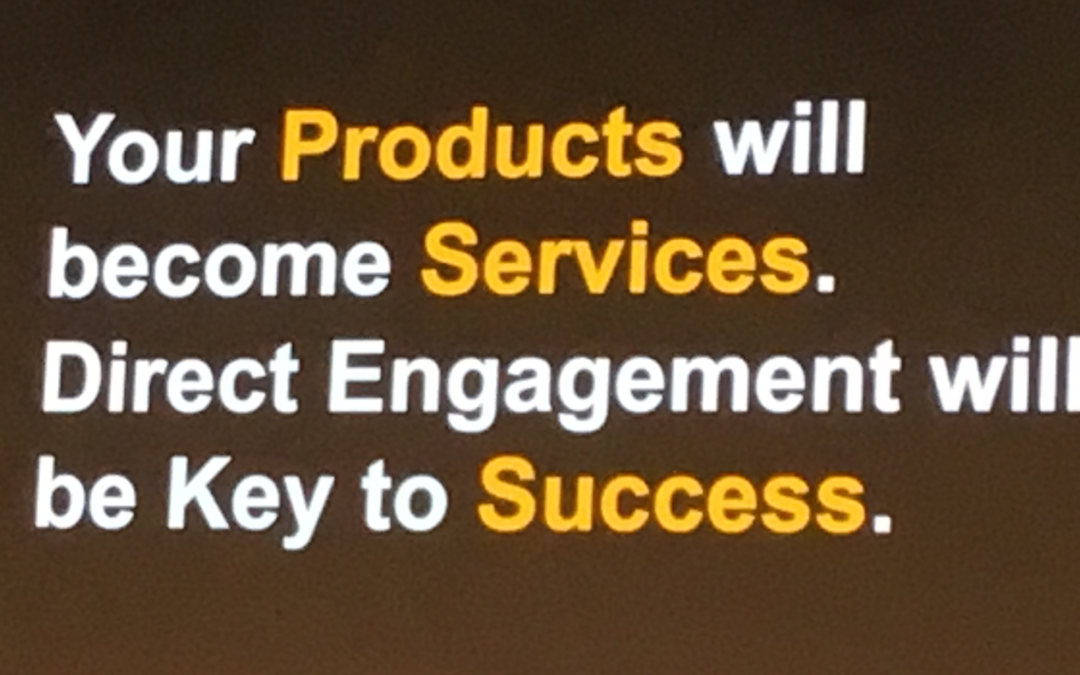
Products to Services – The SAP Hybris Summit 2017
This year’s SAP Hybris Summit in Barcelona was attended by almost 3,000 paying participants, which is likely to make it the biggest ever, in spite of the recent unrest in Catalonia. It was packed with partners and presentations. The message all around was about subscription economy, how companies will need to transform themselves from product- to service companies, and how SAP supports this by delivering YaaS, networked solutions, IoT and machine learning, based upon the SAP Cloud platform. Owing not only to the topic of subscription economy GDPR was, of course, a topic, too. The key message here was: Our software helps you being compliant. With SAP Hybris standing not only for ecommerce but also for SAP’s new brand of CRM (oops, engagement) solutions, there was astonishingly little information about the Sales- and Service Clouds and only a few bits about the Marketing Cloud. The pending acquisition of Gigya was naturally out of scope, although Gigya as a partner featured in the show with a booth and presentations in the theaters. Day One Having said this, the first keynote, held by SAP Hybris president Carsten Thomas, was slightly underwhelming. It set the stage for the topic, but was essentially last year’s content. The narrative was all about how companies like Uber and Airbnb change the game for traditional companies, the impact of machine learning, and the importance of focusing on experiences (not even outcomes). In brief: nothing new, and only a fuzzy view on SAP Hybris’ strategy. It, however, was presented very well. The Q&A’s offered on day one added some more flesh to the topics, also on the...
Customer Service in a World of Ambient Computing – The Service Center View
A few weeks ago I wrote an article about customer service in a world of ambient computing. This article looked at customer service from a customer’s point of view. In it I described how I see customer service getting humanized again by leveraging the advances in AI technologies like Natural Language Processing, speech-to-text- and text-to-speech generation along with intent determination. Leveraging these technologies customer service will turn into a conversation and it won’t matter anymore whether service is delivered by a bot or by a human. For the customer it will all appear to be the same. Instead of FAQs or web searches, bots will be the first line of support and escalate a problem to humans if they cannot solve it on their own. The obvious question is whether there will be an impact on the customer service center? And it probably does. Call centers, and with it the service agents as well as their managers, already now are under intense pressure to deliver, and to deliver more efficiently. With the increasing use of call deflection technologies like FAQs and communities there is a trend for the incidents facing the agents becoming more challenging. For example Helpshift states that already with its technology it is able to deflect about 90% of all incidents, which are solved via the native in-app FAQ that is delivered by the them. This statement basically says that the support staff is basically relieved of dealing with simple matters but has the chance to take up the more challenging ones. Still, in a world of ambient computing any given app can have hundreds of...
Customer Service in a World of Ambient Computing – The Service Center View
A few weeks ago I wrote an article about customer service in a world of ambient computing. This article looked at customer service from a customer’s point of view. In it I described how I see customer service getting humanized again by leveraging the advances in AI technologies like Natural Language Processing, speech-to-text- and text-to-speech generation along with intent determination. Leveraging these technologies customer service will turn into a conversation and it won’t matter anymore whether service is delivered by a bot or by a human. For the customer it will all appear to be the same. Instead of FAQs or web searches, bots will be the first line of support and escalate a problem to humans if they cannot solve it on their own. The obvious question is whether there will be an impact on the customer service center? And it probably does. Call centers, and with it the service agents as well as their managers, already now are under intense pressure to deliver, and to deliver more efficiently. With the increasing use of call deflection technologies like FAQs and communities there is a trend for the incidents facing the agents becoming more challenging. For example Helpshift states that already with its technology it is able to deflect about 90% of all incidents, which are solved via the native in-app FAQ that is delivered by the them. This statement basically says that the support staff is basically relieved of dealing with simple matters but has the chance to take up the more challenging ones. Still, in a world of ambient computing any given app can have hundreds of...