thomas.wieberneit@aheadcrm.co.nz
Gartner MQ BI and Analytics Platforms – Lots of Movement

Gartner MQ BI and Analytics Platforms – Lots of Movement

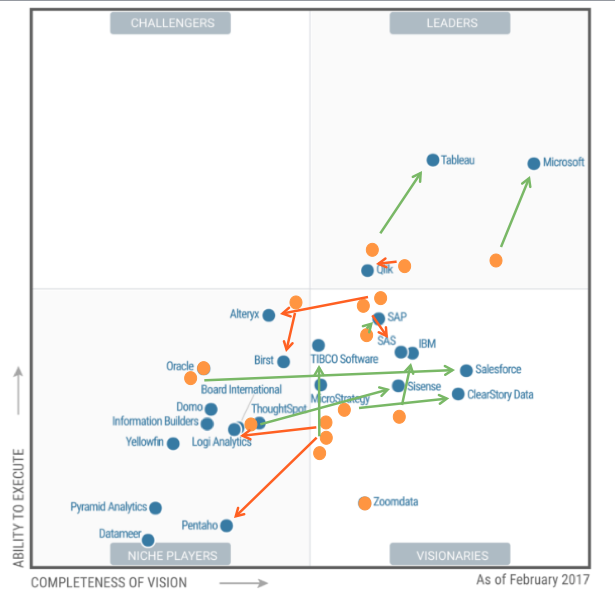
Last week Gartner published the updated version of its Magic Quadrant for Business Intelligence and Analytics Platforms, and I need to say that there has been a lot of movement in both directions, up as well as down. There has been a lot of reshuffling especially in the Visionaries quadrant. This can partly be attributed to a changing market that caused Gartner to combine a few of last year’s assessment criteria as well as adding two more critical criteria as below: Critical Capabilities Dropped or Changed: Combined BI Platform Administration with Security and User Administration Modified Data Source Connectivity to Data Source Connectivity and Ingestion Combined Publish Analytics Content and Collaboration and Social BI to Publish, Share and Collaborate on Analytic Content Added Visual Appeal to Ease of Use Capabilities Added: Smart Data Discovery Platform Capabilities Workflow Integration Smart Data Discovery emphasizes the increasing importance of AI and machine learning as part of analytics systems. Gartner defines it around the automatically “finding, visualizing and narrating of important findings such as correlations, exceptions, clusters, links and predictions in data that are relevant to users without requiring them to build models or write algorithms. Users explore data via visualizations, natural-language-generated narration, search and natural-language query technologies”. Workflow Integration acknowledges that there is no actionable insight if there is a standalone analytics system. It is defined around the number of products “needed to deliver the critical capabilities and the degree of seamless integration and workflow between capabilities/components”. This has been true for a long time, but hey, better late than never. Gartner itself states that the changes have been major and that...
Forrester Wave CRM Suites for Mid-Sized Businesses – What it Means

Forrester Wave CRM Suites for Mid-Sized Businesses – What it Means

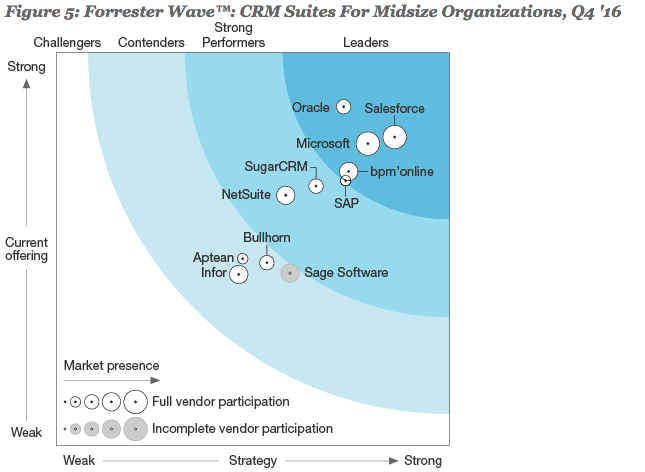
Finally, the much-anticipated Forrester Wave on CRM Suites for Mid-Sized Businesses Q4/2016 has been published by Kate Leggett and her team at Forrester Research. Besides the usual suspects Oracle, Microsoft, Salesforce, and SAP it covers 7 more vendors that fulfil Forrester’s definition of a CRM suite for mid-sized businesses. This definition roughly is To be considered a suite the software covers at least three of the CRM disciplines Marketing Sales Force Automation Customer Service Field Service E-Commerce Customer Analytics There needs to be prebuilt integration between the products, if they are not within the same system; integration shall be via open standards to allow for integrating other applications. The software needs to be targeted at organizations between 250 and 999 employees. Multiple industries need to be targeted. Of course, the solutions need to be in active use and there need to be customer references. The Forrester Wave has some interesting results, some confirming what other people see, too, others somewhat surprising. Let me start with the confirmations, continue with bits that surprised me, and close with an SAP specific view. The Confirmations Of course, we are talking cloud – cloud and nothing else. As can be expected all vendors strive to deliver a toolset that helps their customers to deliver consistent customer experiences. Now I, and others, would argue that the experience is largely in the realm of the end customer and the users and that there is nothing like a ‘system of experience’. Delivering consistent experiences encompasses far more than a CRM suite. But then it is far easier (and sexier) to talk about delivering experiences than about...
Clash of Titans – SAP, Oracle, Microsoft, Oracle Quo Vadis?

Clash of Titans – SAP, Oracle, Microsoft, Oracle Quo Vadis?

Following all those announcements of AI, machine learning, IoT, IaaS, PaaS and what not over the past months, I was beginning to wonder where the big business software vendors are going. What is the game plan of Microsoft, Oracle, Salesforce, SAP? How does newcomer Adobe fit in there? Maybe Amazon and Google, too; or Facebook. It is a time for another Quo Vadis – this time: Quo Vadis, industry? Clash of Titans In the last about 2 – 3 years we have seen a strong acceleration of innovation, or at least talk about it. Cloud computing, offering nearly unlimited scalability and elasticity of computing resources has become main stream. Cloud computing also allows for nearly 100 per cent uptime Since the advent of the iPhone (yes, I know this was earlier than 2013) the proliferation of sensors has increased a lot, resulting in them becoming cheaper and cheaper, allowing for an increasing number of data rich applications This has also driven fast mobile connectivity, which has become nearly ubiquitous; maybe except a few blessed spots on this planet, which will be covered soon, too. Think of Google’s Balloon project or Facebook’s drone Memory has become dirt cheap, and fast In-memory technologies, No-SQL databases, Hadoop, Spark, and improvements of analytics algorithms make it possible to work with huge sets of data in real time The (re-)emergence of AI technologies, progress in machine learning and deep learning, enabled by the now available computing power, help in pattern recognition that allows machine driven suggestion, prediction, and prescription of actions, based upon huge amounts of data Data, be it machine-generated or human created...
Is a Twitter acquisition pending? A Snap Analysis

Is a Twitter acquisition pending? A Snap Analysis

Back in June most of us got surprised by the news that Microsoft has acquired LinkedIn. Neither of us deemed this a bad move from a company point of view. There ae just too many potential synergies between MS Dynamics CRM, Office365, Azure on one side and LinkedIn, as the leading business network on the other. At that time many of us, including myself, were musing about when Twitter will be acquired, and by who. #MSFT acquired #LinkedIn – Twitter now the last source of global personal #data. Is it up for grabs? Who would buy? #AAPL? #Google? — Thomas Wieberneit (@twieberneit) June 16, 2016 thinking of it – @SAP might find Twitter a good match, looking at their recent offerings #bigdata #AI #analytics https://t.co/sgUpcLgRBK — Thomas Wieberneit (@twieberneit) June 16, 2016 My initial guesses have been Apple or Google, then suggesting SAP to have a look into it. Thinking of it I could have added Oracle, IBM and Salesforce or media companies including telcos into the mix. In brief, a lot of companies should be interested in the treasure pit of data, behavioral data, that Twitter holds. Why? There are multiple reasons. Twitter is the last remaining independent social media outside Facebook and the big Chinese ones that the big western companies will not get access to; Tencent, Alibaba, Momo, etc. are rather buying it themselves than being for sale (to a western company), Facebook doesn’t need to. Twitter has a profitability and growth challenge, but an interesting technology and, importantly, is a great source of real time information about a lot of topics, from business to consumer....