

Data Wars: SAP Vs. Salesforce In The AI-Driven Enterprise Future
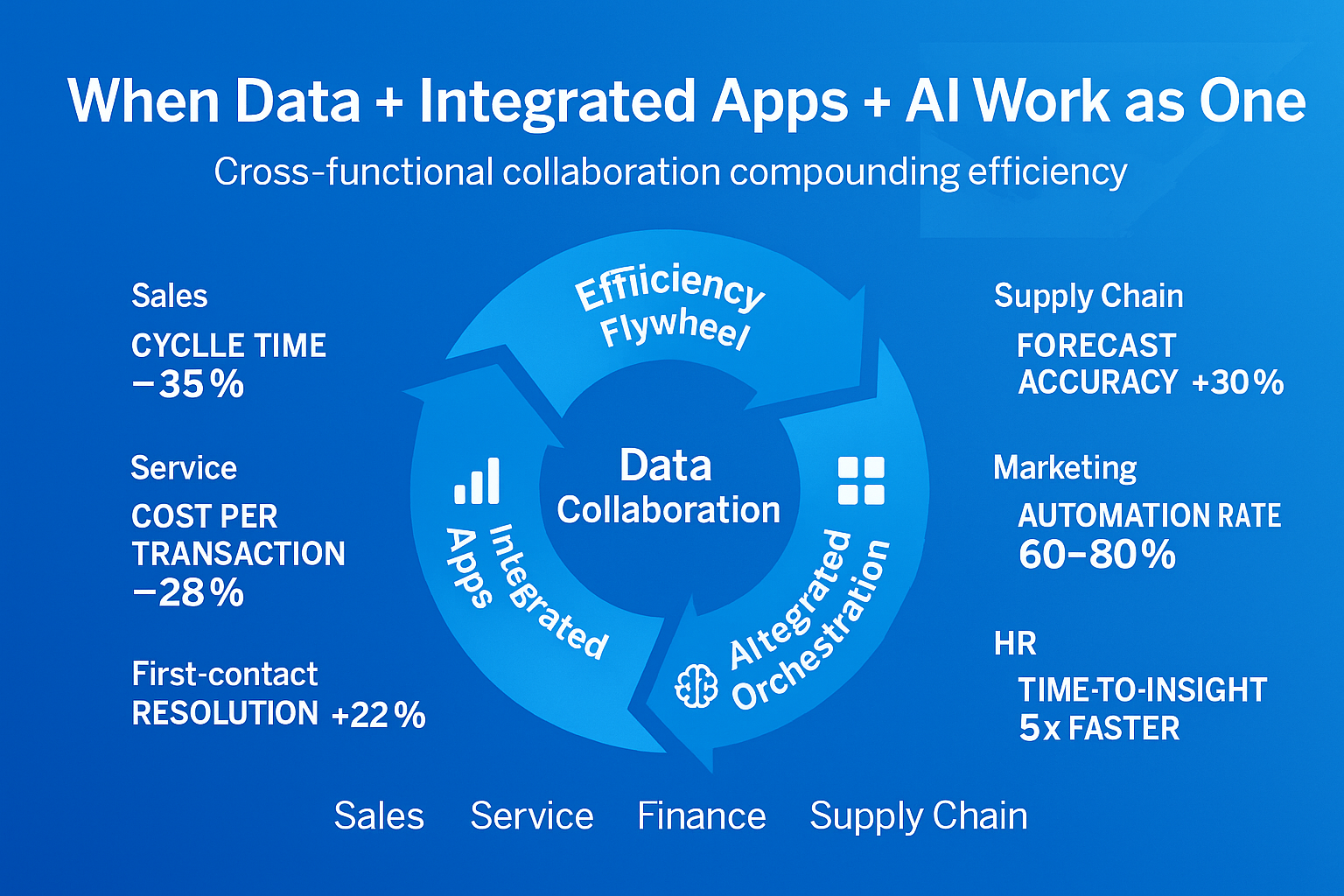
The past weeks certainly brought a lot of news, with SAP Sapphire and Salesforce’s surely strategically timed announcement of acquiring Informatica, ranging at the top. I have covered both in recent articles. The enterprise software landscape is crackling with energy, and Artificial Intelligence (AI) is certainly the star of the show. It isn’t anymore about AI as a mere feature; it’s about AI as the strategic core of enterprise software. Two recent announcements underscored this shift: SAP’s ambitious AI-centric vision that was unveiled at its Sapphire 2025 conference, and, arriving hot on its heels, Salesforce’s agreement to acquire data management titan Informatica for $8 billion. Both signal an intensified battle for AI supremacy, where trusted, enterprise-wide data is the undisputed new monarch. Of course, SAP and Salesforce are not the only ones duking this one out. SAP’s Sapphire Vision: An AI-Powered, Integrated Enterprise At its Sapphire 2025 event in Orlando, SAP laid out a sweeping vision for an AI-driven future. The central themes resonating from Sapphire were “AI everywhere” and “the AI flywheel”, with intelligence deeply woven into its integrated suite of applications and powered by the SAP Business Data Cloud as a strong, unified data layer. Joule, SAP’s AI copilot, is slated to become “omnipresent,” extending its reach not only across the entire SAP ecosystem but also into third-party applications. It’s designed to proactively assist users and launch autonomous “Joule Agents” to automate a wide array of workflows. SAP has ambitious plans to significantly expand its library of these specialized agents. Underpinning this is the SAP AI Foundation that includes Joule Studio for agent development, a Knowledge Graph...
SAP Sapphire Orlando 2025: How to Steer Through Uncertainty with the AI-Powered Flywheel
The news SAP just held its annual Sapphire event in Orlando, FL. It is totally under the theme of uncertainty and how technology, in particular SAP’s technology, can help businesses steer through poorly charted waters, to use a nautical metaphor. Uncertainty is caused by evolving regulatory situations, tariffs and shipping delays with their impact on the supply chain, waning consumer confidence in the light of all of this, and of course, the big gorilla in the room: AI. SAP’s response to this is the “SAP Flywheel”, which consists of three components Applications, of which SAP commands the broadest portfolio amongst all business applications vendors Data, which all these applications create, which in turn gives SAP extensive access to semantically rich business data AI, which analyses all this data, makes it actionable and, in turn feeds it back to the applications, closing the loop to establish the flywheel. SAP demonstrated how this works in a scenario that showed how a C-suite consisting of a CFO, CRO, COO and CHRO use the integrated SAP suite with embedded AI to rapidly respond to new tariffs, managing compliance, assessing financial impact, developing strategies, adjusting supply chain plans, and aligning people strategy, all based on unified data. Key announcements are based on the concept that AI is changing how businesses, and therefore its business applications, operate. Supporting this, is the purpose of SAP’s business AI, which has its foundation in SAP’s Business Technology Platform, BTP. A centerpiece of this change in how businesses – and users – operate is Joule, which is embedded (or will be soon) in all SAP applications and being expanded...
SAP belittles its CX chops – and why this is dangerous
Cloud Wars’ Bob Evans recently did an excellent and very interesting interview with SAP CEO Christian Klein about SAP’s priorities, which include integrating generative AI with SAP Business AI “to address complex business challenges an drive holistic transformation by optimizing processes like quote to cash”. Klein repeatedly referred to end-to-end (E2E) and SAP’s great library of E2E processes that gives the essence of or at least a standardized framework for the value streams within a business. Not surprisingly, and correctly so, Klein also repeatedly emphasized the value of AI and, in particular, generative AI, to create customer value. This happens via Joule’s ability to orchestrate different agents across the value chain, i.e., different E2E processes. Joule is SAP’s Ai assistant. He also emphasized on the value of the suite and on the importance to “in the core business” not run with “agents of 100s of different tech companies”. This is where “the suite is winning”. Evans writes that SAP had “significant growth in applications, outpacing competitors. Klein attributes this to SAP’s suite approach, which provides a comprehensive solution for core business processes. He talks about the importance of integration and extensibility, allowing customers to choose the best solutions for their needs.” This is technically a correct statement. I am fairly sure that SAP will report another outstanding year on January 28, 2025. In the first three quarters of FY 2024 SAP certainly outpaced the cloud business applications competition, including Salesforce. However, there is a caveat to it. This growth is largely attributable to S/4HANA cloud. Don’t get me wrong, doing this is no mean feat. SAP profitably grows while...