
SAP and MachineLearning – A Strong Approach, but none too early
In my yesterday’s analysis of SAP’s HANA announcement, I wondered why SAP stays silent on the AI and MachineLearning frontiers. Well, today I know. They saved this announcement for today. And the announcement is a bang. SAP will deliver what they call ‘intelligent business applications’ that are based upon SAP’s new machine learning platform. The platform itself shall be made available with SAPPHIRE NOW 2017. The first significant intelligent application by SAP that is mentioned, is a brand intelligence application that leverages deep learning to analyze brand exposure in video and images to provide ‘accurate, real-time insights into sponsoring and advertising ROI”. You may remember that SAP earlier showcased an application to reduce recruiting bias, which is based on the machine learning platform, too. According to Juergen Mueller, Chief Innovation Officer at SAP, the new machine learning platform is intended to serve SAP’s and their ecosystem’s applications with the goal of creating more business value. Consequently, there are two more aspects to the announcement. SAP launched a partner program dedicated to SAP Application Intelligence. SAP invests into education offerings, starting with a ‘massive open online course’ on Enterprise Machine Learning on their OpenSAP platform. MyPoV This announcement clearly shows that SAP is as serious about machine learning as the company is about leveraging the power of its ecosystem. As I, and many other people, have often said, SAP is a formidable organization if and when it chooses to drive a topic. This is shown here again. And SAP is absolutely on the right track by pursuing this three-pronged approach of delivering a platform with first solutions, encouraging partners, and...
SAP HANA 2 – Revolution or Evolution?
Yesterday SAP announced SAP HANA 2, an updated and improved version of its flagship product SAP HANA, and new SAP HANA microservices through SAP Hybris as a Service. SAP HANA 2 will be available for first customers on November 30 and an express edition shortly after its general availability. Note: if SAP talks about RTC this usually differs from General Availability, which is only after a successful ramp-up period of about 3 months to validate a product with early adopter customers. So the Express Edition will probably be released around end of Q1/2017. In usual bold marketing words SAP HANA 2 is poised to be a “new foundation for digital transformation” and is according to Bernd Leukert, member of the executive board, Products and Innovation at SAP SE, the continuation of “breakthrough innovation on a highly stable core data platform for our customers”. SAP HANA 2 shall deliver enhancements in the areas of database management, data management, analytical intelligence and application management as well as well as two more services for cloud customers: Text Analysis and Earth Observation Analysis. The latter in a beta status only. These latter two new HANA functionalities are likely to be the reason of tying the two announcements. The update cycle of HANA 2 shall be 6 months. Some Observations It is interesting that SAP refers to the new HANA services as microservices. This suggests that these services are built on top of the HANA 2 core – or else HANA itself has been rearchitected to be built on a microservice architecture. I rather think the former, also as the delivery is via YaaS....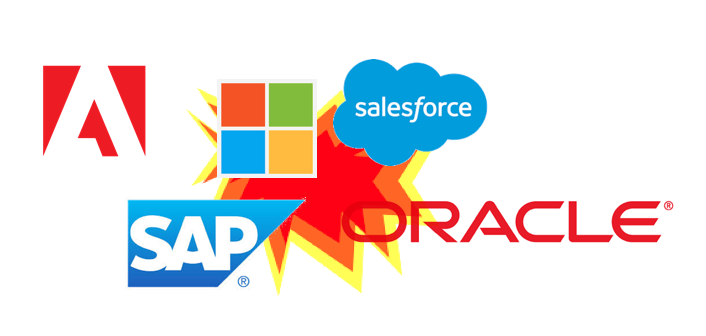
Clash of Titans – SAP, Oracle, Microsoft, Oracle Quo Vadis?
Following all those announcements of AI, machine learning, IoT, IaaS, PaaS and what not over the past months, I was beginning to wonder where the big business software vendors are going. What is the game plan of Microsoft, Oracle, Salesforce, SAP? How does newcomer Adobe fit in there? Maybe Amazon and Google, too; or Facebook. It is a time for another Quo Vadis – this time: Quo Vadis, industry? Clash of Titans In the last about 2 – 3 years we have seen a strong acceleration of innovation, or at least talk about it. Cloud computing, offering nearly unlimited scalability and elasticity of computing resources has become main stream. Cloud computing also allows for nearly 100 per cent uptime Since the advent of the iPhone (yes, I know this was earlier than 2013) the proliferation of sensors has increased a lot, resulting in them becoming cheaper and cheaper, allowing for an increasing number of data rich applications This has also driven fast mobile connectivity, which has become nearly ubiquitous; maybe except a few blessed spots on this planet, which will be covered soon, too. Think of Google’s Balloon project or Facebook’s drone Memory has become dirt cheap, and fast In-memory technologies, No-SQL databases, Hadoop, Spark, and improvements of analytics algorithms make it possible to work with huge sets of data in real time The (re-)emergence of AI technologies, progress in machine learning and deep learning, enabled by the now available computing power, help in pattern recognition that allows machine driven suggestion, prediction, and prescription of actions, based upon huge amounts of data Data, be it machine-generated or human created...