
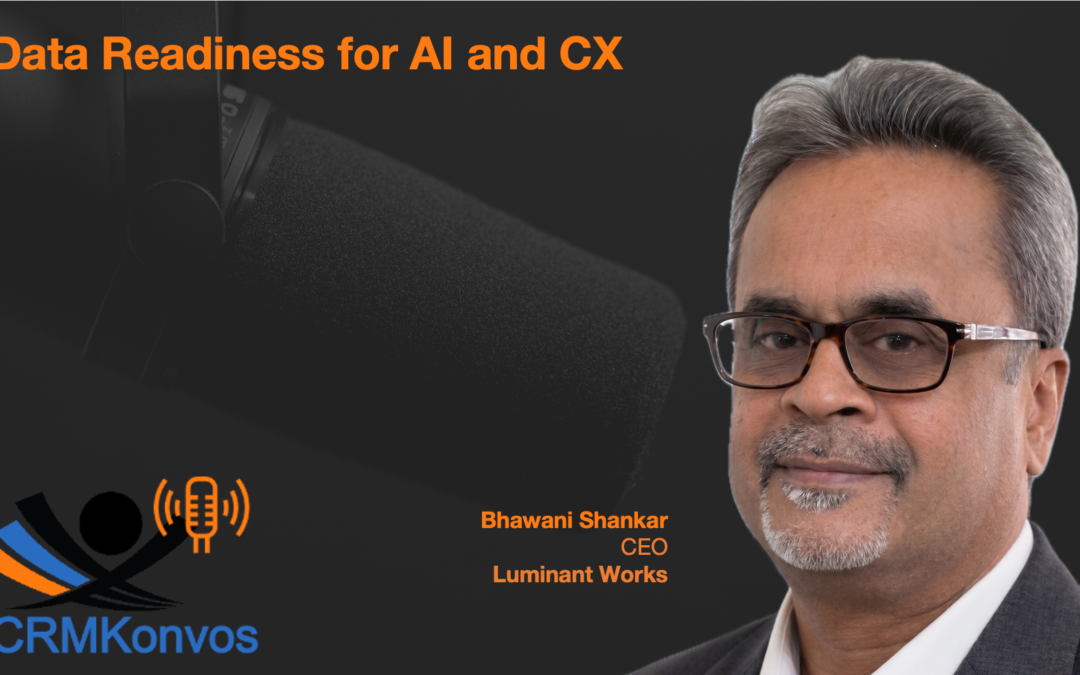
We have reached a point in the hype cycle where "AI" is being sprinkled on enterprise software like a seasoning on a cheap steak: it masks the poor quality of the underlying meat but doesn't make it more nutritious. In the latest CRMKonvo, Bhawani Shankar and the CRMKonvo team tore into the reality of what it actually takes to make "Agentic AI" work in a Customer Experience (CX) environment.
The analysis? Most enterprises are trying to drive a Ferrari without wheels.
Bhawani used this metaphor that I find particularly apt: the AI model is the shiny red car that gets the CEO excited; but the data is the wheels, the engine, and the fuel; and they come as options. If you buy the car without ensuring the wheels are attached and the tank is full of high-octane, verified data, you aren't going anywhere. You are just sitting in an expensive garage making engine noises.
TL;DR
If you want to watch the full CRMKonvo, please go ahead here (optimized for smartphones) or here (optimized for tablets/computers).
Else, be my guest and continue to read.
Or do both …
The Death of the "System of Record"
For decades, we have worshipped at the altar of the "System of Record." The goal was simple: get the data into the CRM. It didn't matter if the data was messy, duplicated, or six months out of date; as long as it was "in the system", leadership was happy. But as Bhawani correctly pointed out, we need to be moving from a system of record to a system of context.
In the old world, a marketing campaign was a monolithic beast planned over months. In the new, agentic world, context changes by the hour. If your AI agent is trying to help a customer but is basing its "reasoning" on a record that doesn't include the tweet they sent ten minutes ago, the click history of the past 5 minutes or the failed login attempt just now, the agent is useless. It isn't just about having the data; it is about having the connected data in a "Golden Context”.
The industry likes to use the term Master Data Management (MDM), but let’s just agree that this is becoming legacy terminology, and that fast. MDM implies a static, central truth. Agentic AI requires something more fluid. It requires an environment where the agent itself can find and connect data points across silos without a human having to manually build a brittle connector for every single API.
The Governance Paradox
Which brings us to the important concept of "dynamic governance." To an analyst, “something fluid” sounds like a polite way of saying "no governance”. Governance, by definition, is supposed to be the set of rules that keep things stable. If the rules are constantly moving, do you actually have a governed system?
The reality is that traditional, top-down, "thou shalt not" governance is dead. The stick does not work anymore. One could say that it never worked anyway; sales teams are stereotypically ungovernable because they are driven by incentives, not policy manuals. They rather ask for forgiveness later than for permission beforehand.
Bhavani’s solution is one I can get behind: incentive-linked, embedded governance. If the system makes it easier for a salesperson to hit their number by providing them with agentic support, they will use it. If the agent automatically transcribes a meeting and populates the CRM, the "governance" of data entry happens as a byproduct of a tool that actually helps the employee. Then, the system serves them, and not the other way round.
However, the human element remains the biggest hurdle. You can cook up the most sophisticated agentic sandwich in the world, but if the humans don't trust the data coming out of it, they will revert to their old spreadsheets and shadow IT "caves”.
Shadow Data: The Enemy Within
We often talk about "shadow IT”, but the real killer for AI is "shadow data”. These are the Excel sheets living on desktops, the manual exports from 2019 that are still being used for "reporting”, and the tribal knowledge that never gets digitized.
If you want to speed up your AI strategy, Bhavani’s advice is simple and straightforward: kill the shadow data. Anything that is not visible, verified, and connected is an impediment to an agent's ability to learn, hence an organizational impediment. An AI agent is only as good as the context it is offered. If half of your customer's context is hidden in a CSV file on a retired manager's hard drive, your "intelligent" agent is effectively flying blind in one eye, if not both.
Three Pillars for the Enterprise AI Buyer: A Reality Check
If you are currently sitting through vendor presentations where a 24-year-old in a slim-fit suit is promising you "Agentic CX Transformation”, here are three things you need to make sure of before you sign the check.
Demand "Golden Context," Not Just "Clean Data"
Stop asking if the data gets clean, and kept so, and start asking if it is connected. An agent doesn't just need a "clean" address; it needs to know why the customer changed that address, what they bought immediately afterward, and if they sounded annoyed on the last support call. If the vendor cannot show you how their AI bridges the gap between your static system of record and your moving system of context in real-time, they are just selling you a fancy search bar.
Verify the Incentive Alignment
Before deploying any AI tool, ask: "How does this make the user’s life easier in the first fifteen minutes?" If the tool requires more manual data entry or tagging to work, it will fail. It just will not be used, regardless of sticks or carrots. The best governance is invisible. You want a system that captures data as a byproduct of work (like meeting transcriptions or automated email logging) rather than one that treats data entry as a separate chore. If the AI doesn't give the employee an immediate win, they will starve it of the data it needs to survive, let alone help them.
Kill the Silos Before You Feed the Agents
Do not attempt to "fix" your data silos with AI. Fix the silos so that AI can function. Bhawani suggests an agentic assessment of your data landscape to identify where the "shadow data" is hiding. If you feed an AI agent data from five disconnected silos, it will hallucinate five different versions of the truth. Clear out the "caves" of manual data and lead everything into a visible, connected stream. Only then will your Ferrari actually have the wheels it needs to move.
The age of the static database is over. The age of the contextual agent is here. Just make sure you aren't the one paying for a shiny red car that is permanently parked.