
The Sales Automation Mirage: Why More AI Means Less Signal
The contemporary B2B sales landscape is currently drowning in its own engineering achievements. For the past decade, the holy grail of outbound sales development was scale: how many touches could an automated sequence tool squeeze out of a Sales Development Representative (SDR) per day? The answer was always “more”. With the mainstream infiltration of generative artificial intelligence and LLMs, the marginal cost of creating more text collapsed to zero, well, almost. Predictably, this did not produce a renaissance of enlightened business communication; it merely triggered an existential crisis in the recipients’ mailboxes. TL;DR If you want to watch the full CRMKonvo, please go ahead here (optimized for smartphones) or here (optimized for tablets/computers). Else, be my guest and continue to read. Or do both … When any entry-level sales rep can prompt a system to instantly parse a prospect’s digital footprint and draft a customized icebreaker, personalization is no more a competitive differentiator. As Ganesh Iyer of ASPR AI succinctly observes, personalization is officially the new spam. It has morphed into a meaningless background drone: a highly polished, entirely hollow manifestation of lazy marketing that enterprise decision-makers have naturally trained their brains to screen out completely. The structural mistake is confusing personalization with relevance. A cold email congratulating a Chief Revenue Officer on their recent round of series-B funding feels automated, even if an LLM wrote it dynamically. Why? Because one hundred other vendors are hitting the exact same spot with identical messages. Genuine relevance requires more: it needs a deep, mechanical understanding of the prospect’s actual current internal operational challenges. If a vendor can trace that the target...
Zendesk’s Specialist Bet Is the Right One; and Here’s What Would Make It a Moat
If you only read the press releases, Zendesk Relate 2026 told a strong, clean story. The era of the chatbot is over. Welcome the Autonomous Service Workforce. Resolution replaces deflection. Outcome-based pricing is the new norm. Specialization beats generalist orchestration. That’s strong. Really strong. If you also watched the customer panel, listened to the day-two keynote, and had the chance of having analyst one-on-ones, you got a richer story. One in which the strategic bets are well-placed, the customers describe a more nuanced reality than the slogans, and three specific refinements over the next twelve months that would turn a strong position into a durable moat. I came home quite positive. Here is why, and where I think the next twelve months are important. What Zendesk announced and why it lands The headline product story was the Autonomous Service Workforce: a network of specialized AI agents working alongside humans, orchestrated through what Zendesk now calls the Resolution Platform and improved continuously by the Resolution Learning Loop. Agent Builder gives customers a no-code interface to build bespoke agents. The Copilot suite expanded to four personas: Agent, Admin, Knowledge, Analyst. Voice AI handles 60+ languages mid-conversation. Employee Service AI agents from the Unleash acquisition live inside Slack and Teams. Knowledge Graph spans SharePoint, Google Drive, Notion, Guru, Contentful and Document360. Model Context Protocol support is bidirectional. Quality Score evaluates every interaction. This is quite a handful. Two of these messages are more powerful than the others. The first is resolution over deflection. Zendesk charges only when a resolution is verified by a second AI evaluation model; outcome-based pricing as the natural...
Sapphire 2026 – What SAP actually did for CX
SAP Sapphire 2026 was a major platform announcement, a competitive shot at ServiceNow, a coherent acquisition story across Reltio, Dremio and Prior Labs. It featured an Anthropic partnership that puts Claude at the center of the SAP Business AI Platform. For anyone who cares about customer experience, it was also a missed opportunity dressed up as ambition. If you watched only the keynote, you concluded SAP barely talks about CX. Klein did finance with JP Morgan. Herzig demoed pharma pricing. Industry AI showcased RWE wind turbines. The named flagship was the Autonomous Close Assistant. CX got line items. That reading is incomplete. Here is what actually happened for CX at Sapphire 2026, what it means competitively, and what SAP and SAP CX customers should do about it. What SAP actually shipped for CX On the same day as the keynote, Balaji Balasubramanian, SAP’s CX President and Chief Product Officer, published a substantive announcement listing ten named Joule Assistants for CX. Marketing gets Content and Campaign Assistants. Commerce gets Merchandising, Shopping and Order Management Assistants. Sales gets Sales, Deal Qualification and Deal Closing Assistants. Service gets Case Management and Service Management Assistants. The supporting announcements are the part most analyst coverage missed. A Google partnership brings Gemini into SAP CX, plus adoption of the open Universal Commerce Protocol. Vercel handles storefront development. SAP Unified Payment runs on Adyen, with Checkout.com and PayPal configurable. Expanded Parloa and Amazon partnerships cover voice and digital service. A new SAP Commerce Cloud, cloud ERP edition targets mid-market. Two Industry AI scenarios for CX: Autonomous Revenue Growth Management and Unified Commerce. All of it planned...
The AI Ferrari: Why Your CX Strategy is Stuck on Concrete Blocks
We have reached a point in the hype cycle where “AI” is being sprinkled on enterprise software like a seasoning on a cheap steak: it masks the poor quality of the underlying meat but doesn’t make it more nutritious. In the latest CRMKonvo, Bhawani Shankar and the CRMKonvo team tore into the reality of what it actually takes to make “Agentic AI” work in a Customer Experience (CX) environment. The analysis? Most enterprises are trying to drive a Ferrari without wheels. Bhawani used this metaphor that I find particularly apt: the AI model is the shiny red car that gets the CEO excited; but the data is the wheels, the engine, and the fuel; and they come as options. If you buy the car without ensuring the wheels are attached and the tank is full of high-octane, verified data, you aren’t going anywhere. You are just sitting in an expensive garage making engine noises. TL;DR If you want to watch the full CRMKonvo, please go ahead here (optimized for smartphones) or here (optimized for tablets/computers). Else, be my guest and continue to read. Or do both … The Death of the “System of Record” For decades, we have worshipped at the altar of the “System of Record.” The goal was simple: get the data into the CRM. It didn’t matter if the data was messy, duplicated, or six months out of date; as long as it was “in the system”, leadership was happy. But as Bhawani correctly pointed out, we need to be moving from a system of record to a system of context. In the old world, a...
The AI Content Trap: Multiplying Mediocrity at Scale
The AI Content Trap: Multiplying Mediocrity at Scale Marketing has always suffered from a volume addiction; however, the advent of generative AI has turned a bad habit into a terminal condition. In the recent discussion with Volker Hildebrand in our CRMKonvo, we explored the uncomfortable reality that while AI has made marketing faster and cheaper, it has largely failed to make it better. The cynical view, which I happen to hold is that marketers frequently confuse the amount of content produced with the actual impact on the customer. We are now in an era where everyone has the same tools to flood the market with what in the words of Volker just “multiplies mediocrity” – or in mine creates instant mediocrity. The core problem is that generative AI multiplies mediocrity by definition. It ingests existing data and spits out an average of what is already there; consequently, when every startup uses these tools to build their websites and social posts, they all end up saying the same. If you look at the CRM space today, the messaging is often nearly indistinguishable. Everyone promises “revolutionary” efficiency and “seamless” integration. As Volker noted, this is a trap for startups; if they cannot differentiate their story, they simply will not survive the noise. TL;DR If you want to watch the full CRMKonvo, please go ahead here (optimized for smartphones) or here (optimized for tablets/computers). Else, be my guest and continue to read. Or do both … The Productivity Mirage Vendors love to sell AI based on productivity gains. They promise you can save 20 percent of your time on content creation. But...
SAP’s Double Acquisition: How Dremio and Prior Labs Complete a Data Strategy the Competition Can’t Easily Match
On May 4, 2026, SAP announced two acquisitions in the same breath: Dremio, an Apache Iceberg-native agentic data lakehouse, and Prior Labs, a pioneer of Tabular Foundation Models. Neither acquisition is exotic. Together, they are contributing to the most coherent enterprise AI platform strategy any major vendor has shown this year. Let me unravel what each company actually brings, why the combination matters, what it means for the competitive field, and — most importantly — what buyers and SAP customers should be doing right now. The Problem SAP Is Solving Before diving into the deals, let’s formulate the problem addressed. SAP’s CTO Philipp Herzig said it clearly: “Enterprise AI doesn’t stall because the models aren’t good enough; it stalls because the data isn’t ready for AI agents“. That is not a marketing line. It describes a pattern analysts and practitioners see constantly: AI pilots perform in a sandbox and fail when they hit production. The reasons are familiar: data is locked in proprietary formats across a dozen systems, there’s no consistent business context, ETL pipelines take months to build, and governance gaps make audit-ready AI decisions nearly impossible. SAP has also faced an additional problem. The narrative about SAP is and always was that it works brilliantly if everything lives inside SAP and required considerable engineering if you want to connect it to anything else. In an enterprise world where the average organization uses dozens of SaaS applications, that story is a liability. Both acquisitions address these problems directly from different angles. Acquisition One: Dremio and the Data Layer Dremio is an open-data lakehouse built on Apache Iceberg. That...
SAP Draws a Perimeter around Agentic AI and What That Means for the Rest of US
The most consequential enterprise AI governance document published this year arrived in late April with surprisingly little fanfare. SAP’s updated API Policy, version 4/2026, is a short document in plain English. The clause that is most interesting is Section 2.2.2. It restricts how autonomous and generative AI systems are permitted to interact with SAP APIs. Read literally, it has the potential to change the architecture of agentic AI projects across every SAP customer landscape. Read carefully, it is also more interesting than the lock-in headlines suggest. The policy targets a specific category of AI behavior, not AI as such. It connects to commercial mechanics that go well beyond API stability. And the literal text, in its current form, will probably not survive the next two policy revisions intact. There is a lot to unpack. I will walk through what the policy actually says, how the SAP-watching community is reading it, what the rest of the major enterprise vendors are doing in comparison, what counts as an “endorsed architecture”, and what customers and partners should be doing about it now. I’ll close with a view on whether the policy can stand the test of time. What Section 2.2.2 actually says The operative sentence is direct. “Except through and within the limits of SAP-endorsed architectures, data services, or service-specific pathways expressly identified and intended for such purposes, SAP prohibits API use for interaction or integration with semi-autonomous or generative AI systems that plan, select, or execute sequences of API calls”. The same paragraph also prohibits scraping, harvesting, or systematic large-scale data extraction. Three things flow from that. First, only Published APIs,...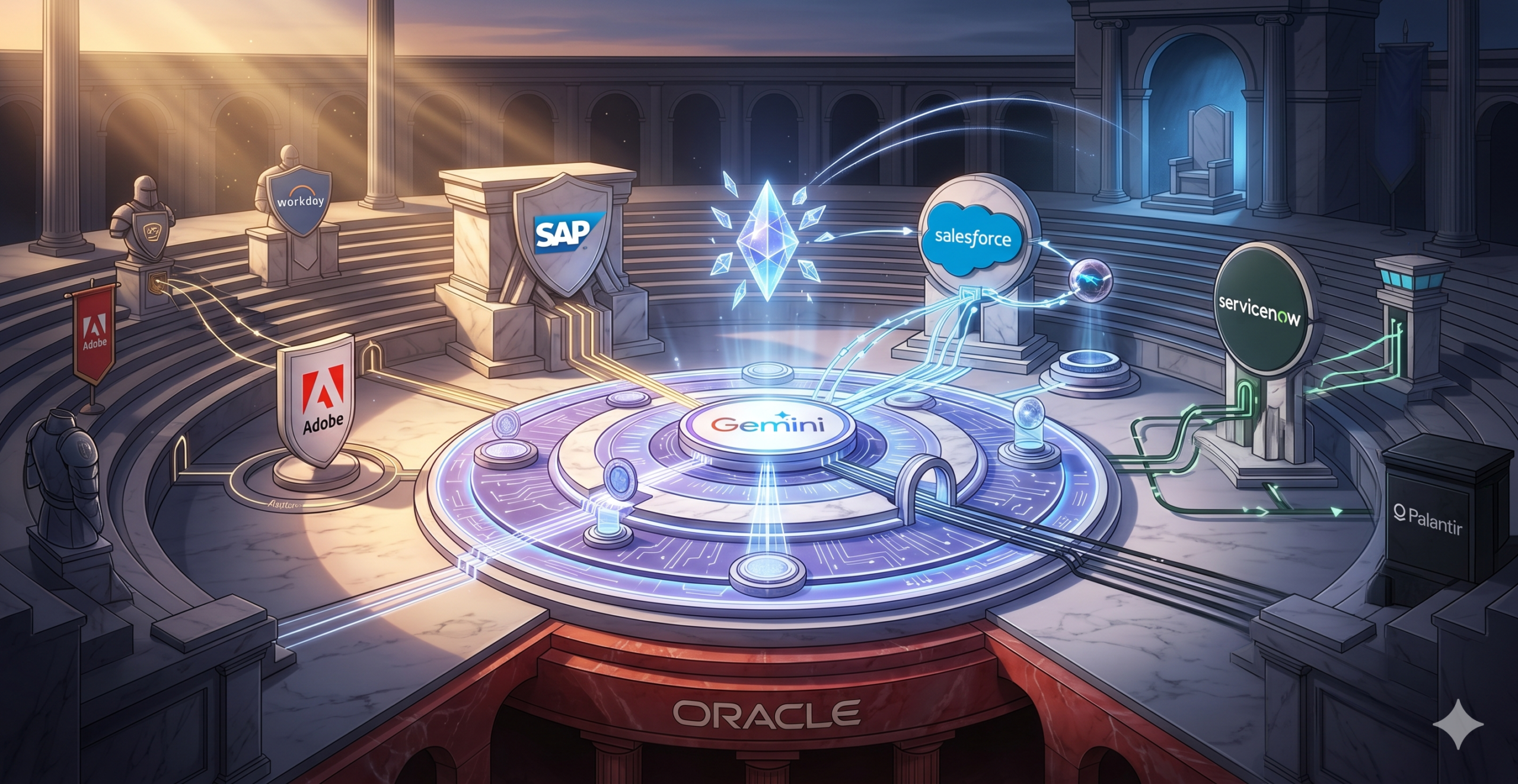
The Orchestration Layer in Enterprise AI Just Got Named. It Has a Gemini Logo on It.
What Google Cloud Next 2026 actually told us about the titan pecking order Google Cloud Next 2026 wrapped last week. The official version of the story is the one Google wanted you to read: 260 announcements, 1,302 customer use cases, the Gemini Enterprise Agent Platform, eighth-generation TPUs, a $750 million partner fund, an $240 billion Marketplace backlog. Big numbers. On-message keynote. Tidy “agentic era” framing. The more interesting story is who showed up to validate it, and what Google actually built underneath. Five of the seven enterprise titans I track walked into Las Vegas and announced expanded partnerships that all rest on the same architecture: Gemini Enterprise as the agent control plane, with the titan’s product playing the role of premium ingredient. Salesforce. SAP. ServiceNow. Oracle. Adobe. Add Workday and Palantir Technologies to the picture, both adjacent to my titan list but visibly aligned in the same direction. Two titans were not in the picture. Microsoft, because Copilot is the direct counter-position and Cloud Next is not Microsoft’s stage. Zoho, because Zoho’s stack does not need a Google motion and Zoho’s buyer is not the same buyer. Both absences matter. More about them a little later. What Google actually built Let’s start with the framing. Google did not just ship a model platform with new features. It repositioned Google Cloud from “AI development environment” to enterprise agent control plane. Vertex AI services and roadmap evolutions are now delivered through the new Agent Platform rather than as a standalone product. That is not a naming change, it’s an entirely different playground. The Agent Platform stack now visibly includes: Agent Identity...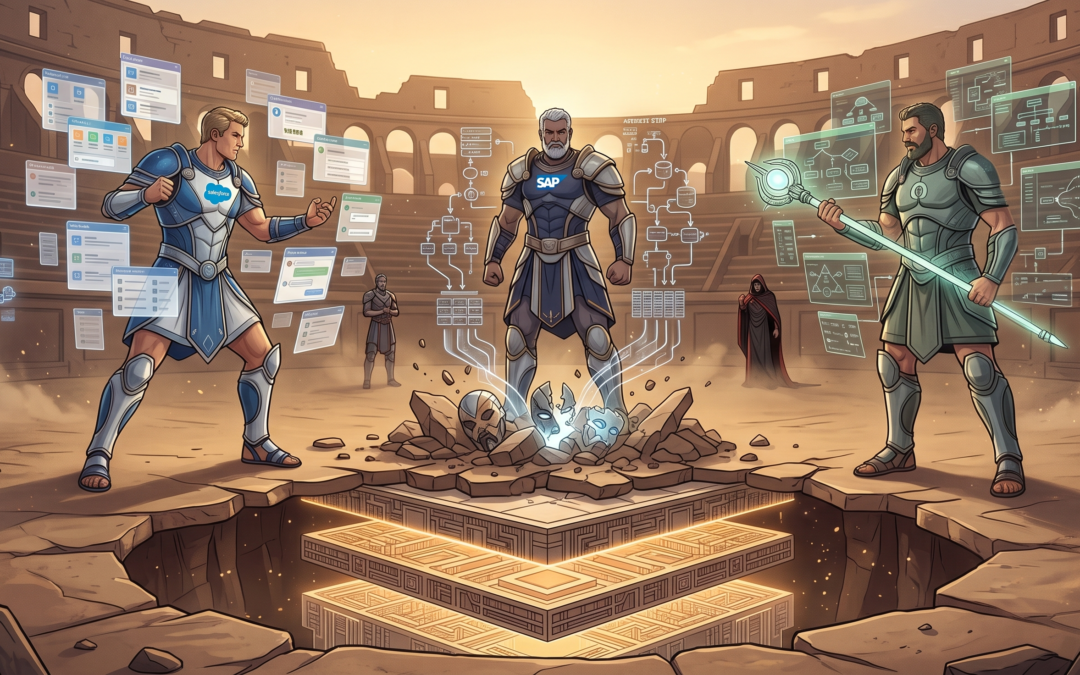
The Agent Wars Are Over. The Substrate Wars Just Started
Three titan announcements in two weeks reveal what enterprise software vendors are actually fighting over in 2026, and it is not agents. If you have been tracking enterprise AI announcements through 2025, you have been watching a race about agent counts. How many prebuilt agents. How many industry-specific use cases. How many customer stories. Agents were the marketing, the demo, the SKU. A year of the same playbook. Something shifted in April 2026. Inside a two-week window, Salesforce, SAP, and ServiceNow each published an announcement that, at first glance, looks like more of the same agent theater. Salesforce launched Headless 360 at TDX 2026 and the Agentforce Experience Layer. SAP pushed a simplified-architecture argument alongside a persistent agent memory layer on BTP. ServiceNow rolled out Context Engine and, on its SPM community blog, Fred Champlain published an essay reframing governance itself as “strategic decision debt”. Different products. Different audiences. The same structural move. All three titans just walked one layer down the stack. Read individually, each announcement is a product release. Read together, they are a category shift. The competition is no longer about who has the best agent. It is about who owns the substrate those agents operate on. And each titan is staking a different piece of it. The Pattern Nobody Is Naming Strip the vendor branding from all three sets of material and the structural claim is identical: “Your agents are only as good as the layer underneath them. The data they ground on, the logic they inherit, the memory they carry, the permissions they respect, and the decisions they represent. That layer is what we...