The Sales Automation Mirage: Why More AI Means Less Signal
The contemporary B2B sales landscape is currently drowning in its own engineering achievements. For the past decade, the holy grail of outbound sales development was scale: how many touches could an automated sequence tool squeeze out of a Sales Development Representative (SDR) per day? The answer was always “more”. With the mainstream infiltration of generative artificial intelligence and LLMs, the marginal cost of creating more text collapsed to zero, well, almost. Predictably, this did not produce a renaissance of enlightened business communication; it merely triggered an existential crisis in the recipients’ mailboxes. TL;DR If you want to watch the full CRMKonvo, please go ahead here (optimized for smartphones) or here (optimized for tablets/computers). Else, be my guest and continue to read. Or do both … When any entry-level sales rep can prompt a system to instantly parse a prospect’s digital footprint and draft a customized icebreaker, personalization is no more a competitive differentiator. As Ganesh Iyer of ASPR AI succinctly observes, personalization is officially the new spam. It has morphed into a meaningless background drone: a highly polished, entirely hollow manifestation of lazy marketing that enterprise decision-makers have naturally trained their brains to screen out completely. The structural mistake is confusing personalization with relevance. A cold email congratulating a Chief Revenue Officer on their recent round of series-B funding feels automated, even if an LLM wrote it dynamically. Why? Because one hundred other vendors are hitting the exact same spot with identical messages. Genuine relevance requires more: it needs a deep, mechanical understanding of the prospect’s actual current internal operational challenges. If a vendor can trace that the target...
Zendesk’s Specialist Bet Is the Right One; and Here’s What Would Make It a Moat
If you only read the press releases, Zendesk Relate 2026 told a strong, clean story. The era of the chatbot is over. Welcome the Autonomous Service Workforce. Resolution replaces deflection. Outcome-based pricing is the new norm. Specialization beats generalist orchestration. That’s strong. Really strong. If you also watched the customer panel, listened to the day-two keynote, and had the chance of having analyst one-on-ones, you got a richer story. One in which the strategic bets are well-placed, the customers describe a more nuanced reality than the slogans, and three specific refinements over the next twelve months that would turn a strong position into a durable moat. I came home quite positive. Here is why, and where I think the next twelve months are important. What Zendesk announced and why it lands The headline product story was the Autonomous Service Workforce: a network of specialized AI agents working alongside humans, orchestrated through what Zendesk now calls the Resolution Platform and improved continuously by the Resolution Learning Loop. Agent Builder gives customers a no-code interface to build bespoke agents. The Copilot suite expanded to four personas: Agent, Admin, Knowledge, Analyst. Voice AI handles 60+ languages mid-conversation. Employee Service AI agents from the Unleash acquisition live inside Slack and Teams. Knowledge Graph spans SharePoint, Google Drive, Notion, Guru, Contentful and Document360. Model Context Protocol support is bidirectional. Quality Score evaluates every interaction. This is quite a handful. Two of these messages are more powerful than the others. The first is resolution over deflection. Zendesk charges only when a resolution is verified by a second AI evaluation model; outcome-based pricing as the natural...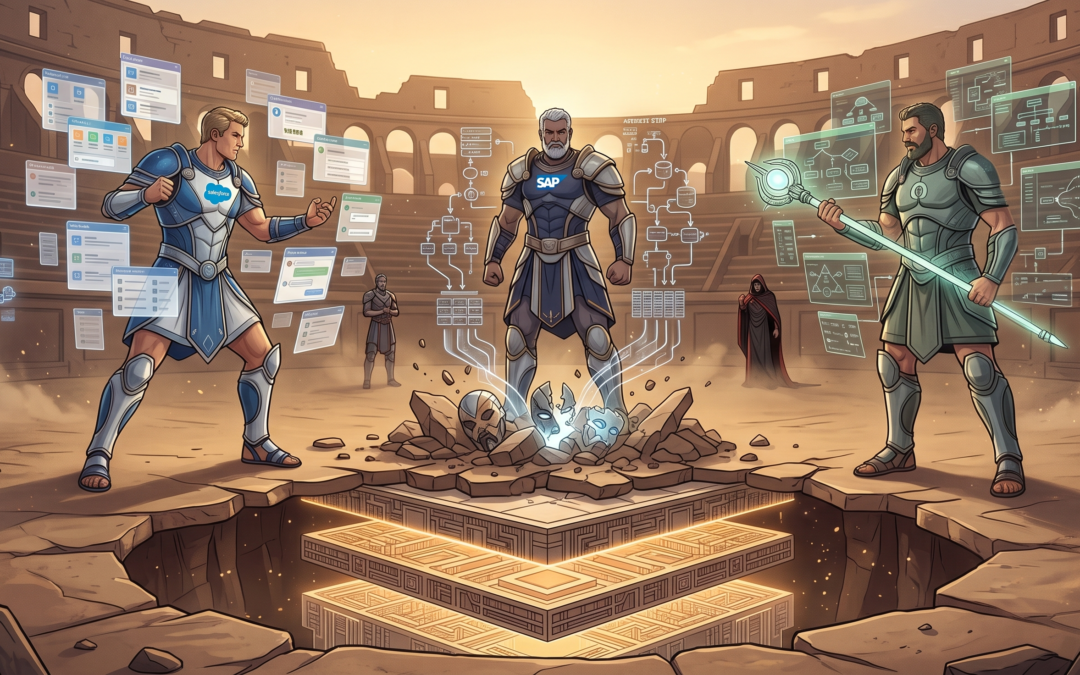
The Agent Wars Are Over. The Substrate Wars Just Started
Three titan announcements in two weeks reveal what enterprise software vendors are actually fighting over in 2026, and it is not agents. If you have been tracking enterprise AI announcements through 2025, you have been watching a race about agent counts. How many prebuilt agents. How many industry-specific use cases. How many customer stories. Agents were the marketing, the demo, the SKU. A year of the same playbook. Something shifted in April 2026. Inside a two-week window, Salesforce, SAP, and ServiceNow each published an announcement that, at first glance, looks like more of the same agent theater. Salesforce launched Headless 360 at TDX 2026 and the Agentforce Experience Layer. SAP pushed a simplified-architecture argument alongside a persistent agent memory layer on BTP. ServiceNow rolled out Context Engine and, on its SPM community blog, Fred Champlain published an essay reframing governance itself as “strategic decision debt”. Different products. Different audiences. The same structural move. All three titans just walked one layer down the stack. Read individually, each announcement is a product release. Read together, they are a category shift. The competition is no longer about who has the best agent. It is about who owns the substrate those agents operate on. And each titan is staking a different piece of it. The Pattern Nobody Is Naming Strip the vendor branding from all three sets of material and the structural claim is identical: “Your agents are only as good as the layer underneath them. The data they ground on, the logic they inherit, the memory they carry, the permissions they respect, and the decisions they represent. That layer is what we...