


How to assess your AI readiness with 50 questions
By now, everyone has recognized that we are in an AI hype. Again. It is probably the fourth since Joseph Weizenbaum developed the famous ELIZA, a natural language processing program that was intended to explore communication between humans and machines. In the early nineties we saw another wave when we saw the first neural networks; in the tens of this century, we saw machine learning making strides and now … Now we have generative AI. And every vendor – and buyer – jumps on it, often thinking of drastically improving business and employee performance – or replace some employees with technology – and of enjoying the ultimate competitive advantage. Nothing could be farther from the truth. Adapting and using AI tools gives a temporary advantage at best. Why temporary? Temporary, because technology is nothing that the competition cannot use. In fact, they will do the same and with that, any, or at least most, competitive advantage gets leveled again. And why at best? Because you might not get an advantage at all, for several reasons. Chief of them is missing corporate readiness. AI can be a very helpful tool, but it is a tool, that needs an organization to be prepared across several dimensions. Regardless of how these dimensions are laid out in detail, they include Strategy and leadership, infrastructure, people, culture, governance and last, but not least, data. Not being prepared in one or more of these dimensions can greatly diminish the projected benefits of adopting AI technology. A simple yet obvious example would be the employees being hesitant to use the provided tool if they feel that...
How Zendesk builds the future of AI-powered service
The News On April 15 to April 18, 2024, Zendesk held its annual Relate event, including a half day analyst track on April 15. The event was attended by around 1,600 customers, partners and analysts. It was about Zendesk’s strategy, which revolves around – no surprise here – AI to deliver better customer experiences. As part of this strategy, Zendesk also made clear how the past twelve month’s acquisitions of Klaus, Ultimate, and tymeshift get integrated into Zendesk’s customer service offerings, enriching and rounding them off. The company is betting big on AI, working on the assumption that interaction volumes between customers and companies are continuing to increase very fast. As a conclusion of this, service needs to become AI driven to accommodate this scale. Secondly, Zendesk sees AI as the technology underlying the necessary high degree of personalization. Together, this is estimated to increase the market size available to CX solutions that automate CX labor tremendously. At the event, Zendesk had three key announcements. They were AI agents to improve self service solutions, a copilot that helps agents solve incoming tickets faster and provides insight to further optimize the service and a workforce engagement solution that helps improve the productivity of digital and human agents as well as the quality of conversations. Behind all this lies the recognition that customer service is very much conversational. Customers and partners that I talked with had a keen interest in learning more about AI use cases. Many of them had started to use AI but estimated themselves still in early stages. The bigger picture The customer service software market has become...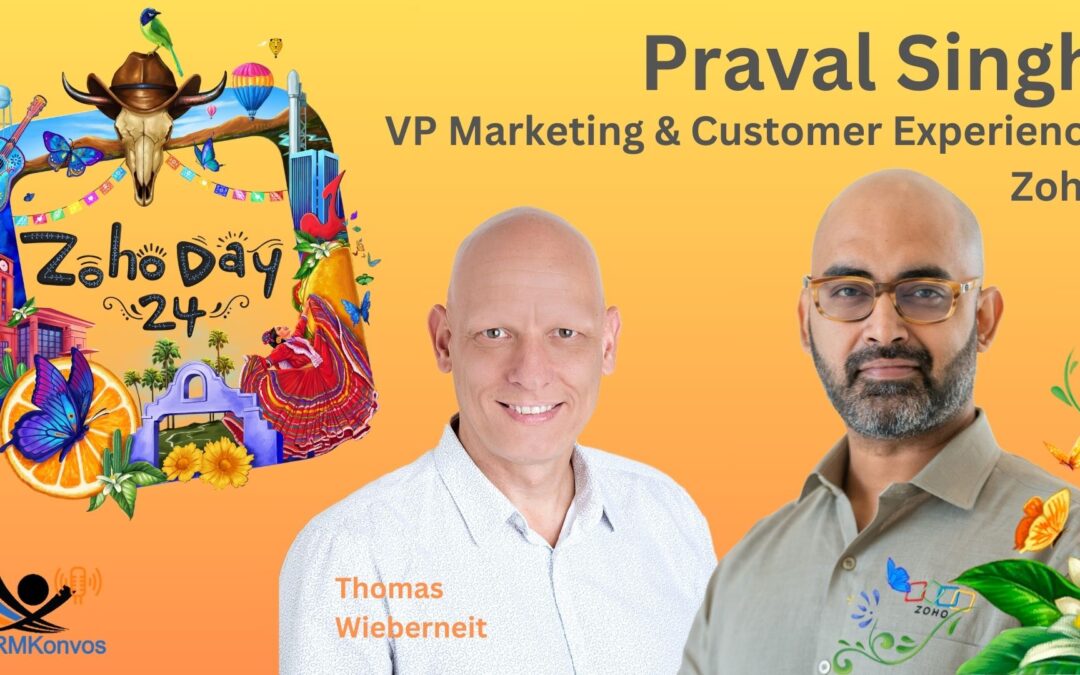
What the heck is customer experience?
What the heck is customer experience, and who is responsible for it? These are two very good questions, for which I, myself, have some very distinct answers. Let’s start with them, before I dive deeper into that topic with Praval Singh, VP Marketing for Customer Experience at Zoho, who – naturally – has some good answers, too. You prefer the original? Of course, you can watch the complete conversation, too. Praval Singh of Zoho talks customer experience Here it goes. Re customer experience, I am with Paul Greenberg and Bruce Temkin, who some years ago defined customer experience. Paul defines customer experience as “how the customer feels about a company over time” while Temkin defines it as “the perception that customers have of their interactions with an organization”. Either does it for me. It is the customer’s perception. This makes it quite easy to answer the second question. Who is responsible? Answer: The customer! Why? Because the organization cannot control how I perceive my interactions because it simply doesn’t know enough about my current context, aka situation, at any given time. Organizations regularly do not know enough about my cultural background, my current situation, or my current mood. What they can do, is taking an educated guess, based upon whatever data and algorithm or AI they have at hand. What the organization can control to some extent, is their half of an engagement. This means that the best intended engagements can result in unintended and undesired perceptions. Customer experience is a function of the customer’s experiences, the expectations towards a brand/product/company and the customer’s mood at the time of...