
Dreamforce 2023 – How right does Salesforce get AI?
The News Dreamforce 2023 has started. It is the first post-Covid physical Dreamforce. The event has more than 40,000 participants from all over the world, which is almost small, considering past events. As usual, Dreamforce was opened by a keynote that was accompanied by a flurry of announcements. In an interesting twist, the keynote was accompanied by an analyst watch party held by Salesforce’s analyst relations. There was a “competing” watch party by the CRM Playaz. Not surprisingly, the topic of AI was front, right and center of the keynote after some emphasis on a culture of giving and the celebration of Salesforce as the #3 software vendor worldwide with an expected revenue of $34.8B US while continuing to lead the CRM market by a considerable margin. This is, indeed, quite an achievement. However, the focus of the keynote was set in the watch party by Salesforce’s Chief Enterprise Strategist Bruce Richardson with the following posting in the chat: “gen AI to boost global economy by $4.4 trillion. Since the release of ChatGPT in November 2022, it’s been all over the headlines, and businesses are racing to capture its value. Within the technology’s first few months, McKinsey research found that generative AI (gen AI) features stand to add up to $4.4 trillion to the global economy—annually. Source: McKinsey (August 23, 2023)” Consequently, much of what Salesforce currently does, capitalizes on this opportunity and helps businesses work with this opportunity. The key vehicles for this are the new Einstein 1 Platform and Einstein Copilot that comes together with a low code development environment Einstein Copilot Studio. Einstein Copilot is an “out of the box conversational AI assistant built into the user...
Salesforce lets the Genie out of the bottle!
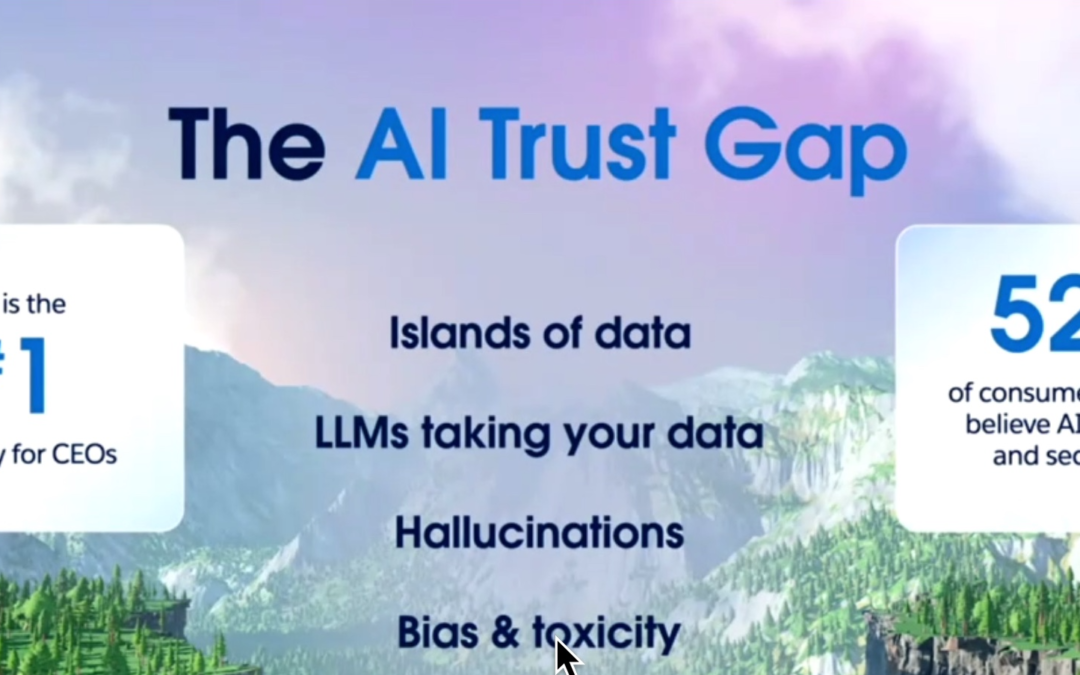
The news During the Salesforce AI Day on June 12 as well as the Salesforce AI Industry Analyst Forum on June 20, Salesforce provided a lot of interesting information on how the company addresses the challenge – or should I say problem – of trust into artificial intelligence. Salesforce sees this gap caused by hallucinations, lack of context and data security as well as toxicity and bias. According to Salesforce, this gets compounded by the need for integrating external models into business software. To address this problem, Salesforce has announced its AI Cloud that combines an “Einstein GPT Trust Layer”, Customer 360 and its CRM to offer AI-powered business processes that are built right into the system, based on an AI that can be trusted. The main vehicle is the Einstein GPT Trust Layer that takes care of secure data retrieval from business applications, dynamic grounding to reduce the risk of hallucinations and to increase response accuracy by automatically enriching prompts with relevant business-owned data, data masking, the anonymization of sensitive data to avoid its unintentional exposure of sensitive data to external tools, toxicity detection to make sure that generated content adheres to corporate policy, is free of unwanted words or images, and unbiased, creating and maintaining an audit trail, the external (or internal) AI not retaining, storing, any corporate information that gets sent to it via the request. This trust layer sits in between the used AI models and the apps and the respective development environments. All requests to the models, along with their data, get routed through this layer, ensuring authorization protected retrieval of data, the grounding...
Zoho – How a technology company reimagines business software
The News On May 4, 2023, Zoho held its Zoholics conference in Austin, TX which included a media and analyst track in addition to the customer track. After all, Zoholics is a customer event. During this event, about 80 participants of the former track had ample opportunity to learn about and discuss the latest news at Zoho. We also had the opportunity to listen to – and question – a panel of customers who gave candid answers about their journey with Zoho and challenges they faced. Of course there was plenty of room for mingling and networking with Zoho executives and, of course, with analysts and customers. In addition to the breaks between the tracks, there was a pre-evening reception, a dinner on the event day and a casual brunch at the Zoho farm just outside of Austin. As usual for Zoho, the sessions were less about feeding us with PowerPoint (or Zoho Show, to be precise. Why would Zoho not use a Zoho product?) but about giving good information and a genuine interest in getting feedback. This was evident not only during the sessions but also by the customer panel and an open Q and A with representatives of the Zoho leadership team. Of course, the customers were reference customers. Still, they openly admitted challenges. In one case e.g., it became evident that Zoho’s HR software has scope for improvement, another example was users preferring MS Teams to Zoho Cliq. The sessions covered four grand themes: The release of Ulaa, a privacy orientated browser Zoho’s upmarket momentum A kick-start set of solutions to help solopreneurs and very small businesses to...