
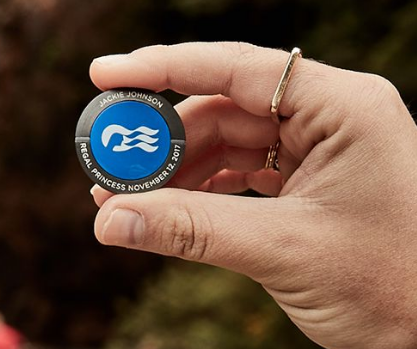
Ocean Medallion – Which Customer Problem Does it Solve?
A few years ago Disney embarked on a massive customer experience journey that included the introduction of a ‘Magic Band’. Disney at that time followed (and likely still does) an idea that can be paraphrased as looking at everything through the eyes of the customer and pay attention to all details. During his 2016 CRM Evolution opening keynote Dennis Snow explained this concept and implementation in depth (see also my earlier CRM Evolution post). Dennis talked about the Disney way of creating great customer experiences, which basically follows three simple rules Design your processes with the customer in mind, not with internal/operational priorities; look through the lens of the customer Pay attention to details Create little “Wow Moments”. These add up to a lasting great experience and are easier to achieve than single “big” experiences. To me the most important message that Dennis conveyed is that the simple things and consistency are what matters. Consistently provide little experiences throughout the customer life cycle. He underpinned this with some examples from the ‘ordeal’ of getting out of the park and back into the hotel. Everybody is exhausted, kids may be edgy, riding the bus is usually not fun. What about the bus driver singing some songs or doing a little trivia? The rooms showing some little surprise, like specially folded towels? Another of his core messages was that a company gets loyalty and advocacy only by creating those “wow” moments mentioned above. For this to be effective, however, it must not fail at base priorities. Customer expectations can get mapped to a pyramid. Every customer expects accuracy and availability. These...
AI and Machinelearning in 2017 – What to Expect
2016 has been the year of Artificial Intelligence and machinelearning. With the year being almost at an end, let me chime in to the gang of pundits who venture into prediction land and pronounce what we get out of our glass balls. So here are my 5 plus 2 bonus ones. AI gets mainstream in Consumer Environments Alexa paved the way, the Google Assistant is on its heels, Microsoft Cortana wants to get there, too – and Apple, amazingly, is a late starter in this environment. Amazon started with a pretty smart strategy by not overselling the capabilities of its underlying AI, as Apple did with Siri, which caused some grief for Apple and some laughs for many people around. More and more helpful Alexa skills are developed and implemented that improve its usefulness. Similarly Google; they started late but are in the game now, too – following a different strategy of adding new functionality by just making it available in contrast to Amazon, who opt to have users individually enable ‘skills’. Identification of what these systems can do will be an interesting question. Facebook’s Mark Zuckerberg created a butler for his house, who he calls Jarvis, like the one of Tony Stark in the Ironman movies. Google recently based its translation engine on machinelearning and AI, seeing vastly improved translations. Facebook’s translations base on an AI, too – although this one still seems to have a lot to learn. Not to mention all the countless other consumer services Google has, that utilize machinelearning and AIs in the background. Two of the main developments to look at here are...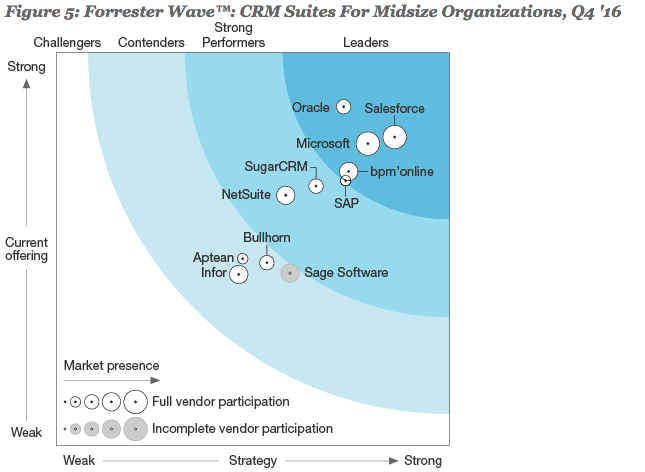
Forrester Wave CRM Suites for Mid-Sized Businesses – What it Means
Finally, the much-anticipated Forrester Wave on CRM Suites for Mid-Sized Businesses Q4/2016 has been published by Kate Leggett and her team at Forrester Research. Besides the usual suspects Oracle, Microsoft, Salesforce, and SAP it covers 7 more vendors that fulfil Forrester’s definition of a CRM suite for mid-sized businesses. This definition roughly is To be considered a suite the software covers at least three of the CRM disciplines Marketing Sales Force Automation Customer Service Field Service E-Commerce Customer Analytics There needs to be prebuilt integration between the products, if they are not within the same system; integration shall be via open standards to allow for integrating other applications. The software needs to be targeted at organizations between 250 and 999 employees. Multiple industries need to be targeted. Of course, the solutions need to be in active use and there need to be customer references. The Forrester Wave has some interesting results, some confirming what other people see, too, others somewhat surprising. Let me start with the confirmations, continue with bits that surprised me, and close with an SAP specific view. The Confirmations Of course, we are talking cloud – cloud and nothing else. As can be expected all vendors strive to deliver a toolset that helps their customers to deliver consistent customer experiences. Now I, and others, would argue that the experience is largely in the realm of the end customer and the users and that there is nothing like a ‘system of experience’. Delivering consistent experiences encompasses far more than a CRM suite. But then it is far easier (and sexier) to talk about delivering experiences than about...