


Ambient Computing and the Future of Mobile Apps
A short while ago Craig Rentzke from Helpshift pointed me to a particular episode of CXOTalk, featuring Kevin Henrikson of Microsoft and professor Anindya Ghose from NYU. Henrikson is responsible for Microsoft’s Outlook for Mobile, a personal information manager (PIM) app, whereas prof. Ghose comes more from a B2C angle, with B2C being more concerned with convenience. This interesting episode deals with the future of mobile computing and given that, apparently about how mobile apps will (have to) look like and what it is that vendors should do and what they should not do with the apps. The Now Naturally, the discussion immediately zeroed in on two topics the purpose of the app and data The purpose of the app mainly determines two things, which are first the way that users are presented with information and are engaging with the app and second the data that gets collected and used in order to (positively) influence the user experience while considering their privacy. The data that gets collected needs to be used to provide the users with timely and relevant information, which does not only benefit the vendor but also, and chiefly, the user. That the data collection ‘behaviors’ of especially B2C apps are not hitting that objective is probably the industry’s worst kept secret. The apps collect more than necessary and use it for a very wide range of purposes, mostly wider than the users are aware of. They basically strip the user of their personal data. This realization was also what led a friend of mine and me found Epikonic, with the clear intention of giving users a...
Customer Service in a World of Ambient Computing – The Service Center View
A few weeks ago I wrote an article about customer service in a world of ambient computing. This article looked at customer service from a customer’s point of view. In it I described how I see customer service getting humanized again by leveraging the advances in AI technologies like Natural Language Processing, speech-to-text- and text-to-speech generation along with intent determination. Leveraging these technologies customer service will turn into a conversation and it won’t matter anymore whether service is delivered by a bot or by a human. For the customer it will all appear to be the same. Instead of FAQs or web searches, bots will be the first line of support and escalate a problem to humans if they cannot solve it on their own. The obvious question is whether there will be an impact on the customer service center? And it probably does. Call centers, and with it the service agents as well as their managers, already now are under intense pressure to deliver, and to deliver more efficiently. With the increasing use of call deflection technologies like FAQs and communities there is a trend for the incidents facing the agents becoming more challenging. For example Helpshift states that already with its technology it is able to deflect about 90% of all incidents, which are solved via the native in-app FAQ that is delivered by the them. This statement basically says that the support staff is basically relieved of dealing with simple matters but has the chance to take up the more challenging ones. Still, in a world of ambient computing any given app can have hundreds of...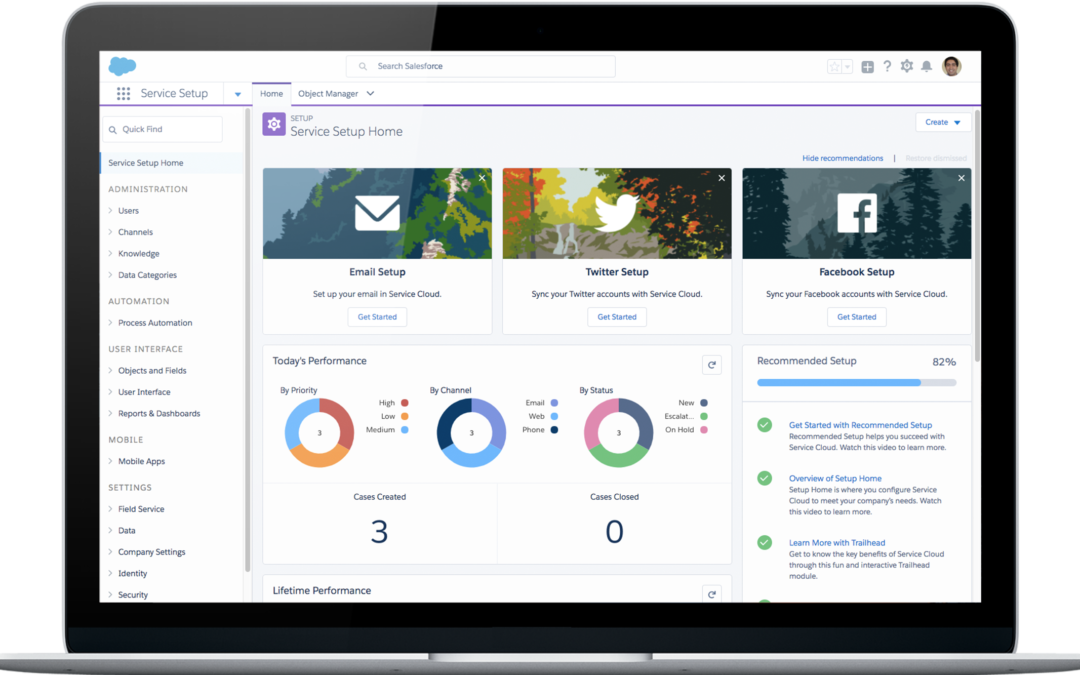
Salesforce Aims At Making Life Easier For Agents
On July 27, 2017 Salesforce announced the availability of an update to their customer service platform Service Cloud. According to Keith Pearce, VP Marketing, Service Cloud, differentiation in customer service is no more a topic within industries, but across industries. Today, customer service in companies competes against the impression gained in another industry, telco vs. banking, vs airline, vs. … you get the picture. Consequently, winning organizations are concentrating on three areas: platform productivity mobile However, this focus can potentially slow down these organizations because they normally come with trade-offs, like scalability vs. speed of deployment, ease of use vs. complete information, or mobility for customers vs. mobility for agents. Salesforce wants to address these trade-offs with this release by making the solution very easy to set up, easier to customize and enhance, easier to use and finally by offering a new mobile app for agents and supervisors. There is a scripted set up that lets admins deploy a usable application in a short time; Salesforce speaks of less than one day. A component library helps in easily adding relevant functionality via drag and drop in a simple application builder. Of course there are additional components and applications available via the AppExchange market place. Agents shall be made more productive by a clean Kanban-style UI, a tool called Community360 that helps in surfacing community content that a user reviewed before logging an incident, a federated search that is capable of searching across open search compatible providers, and the ability for agents to script tasks. Lastly, there is a new mobile app for agents and supervisors. Here is the complete...