
Salesforce, Service, AI and … IoT
AI, IoT, and CRM, three acronyms. However, these three belong together and should not be treated or looked at separately. One important reason for this is that companies and organizations can provide significantly better service experiences and, more importantly, results, by combining the capabilities behind these acronyms. Good field service not only gets dispatched smartly but also equipped with the right parts and, ideally, in a proactive manner. This can get delivered by the combination of Field Service, AI, and IoT data. That’s why I found Salesforce’s early December announcement of having added a component “IoT insights” to its Field Service Lightning product quite interesting. As the press release said, this capability enables service agents and representatives to see IoT signals together with other CRM data, so that the triple p of personalized, proactive, even predictive service is possible. After all, Einstein is embedded into Field Service Lightning for quite some time now. Doing so, Salesforce wisely did not implement yet another IoT platform but enabled its system to ingest data from existing IoT platforms, thus sticking to the core competencies of the company. The solution helps in three areas: Enabling of early issue anticipation (rather than detection, which is responsive) and remote diagnosis Providing agents with more relevant information, to speed up issue resolution And automation via rules and workflows. Says Paolo Bergamo, SVP and GM, Salesforce Field Service Lightning: Let me first clarify that we’re not competing with IoT platforms from the likes of AWS IoT or Azure IoT. Our solution extends the value of these platforms – they provide streams of device data that then flow...
The Return of the Suite
The suite is back. I have said and written that a good number of times in the past few years. And that is a good thing (that the suite is back, not that I said it, of course), because one of the major challenges with a best of breed approach is integration. The suite is back, but it is in an incarnation that vastly differs from what we knew about suites back in the times before cloud computing and Salesforce brought back a supremacy of best of breed over the suite. Integrating different pieces of software from different vendors into one coherent whole is easily accounting for one third to one half of project budgets. And this part of the overall cost for implementing new software is often plaid down by best of breed vendors. Which is not a crime, especially if the benefits of the best of breed software outweigh the cost of integration. However. Often it does not. And not openly addressing cost of integration backfires. Always. Believe me. If you research my background well enough you will find out why you should. Little hint: I am not only writing about things. Another strong argument in favor of the suite is the platform war that is currently going on. Why? Simply, because a platform is not only a technical platform. It is more. A platform consists of mainly four pieces: a technical platform the ability of turning data into insight, an ecosystem, and productivity support. And, very importantly, a necessary capability that is provided by the technical platform is integration. Some other aspects include the provision of...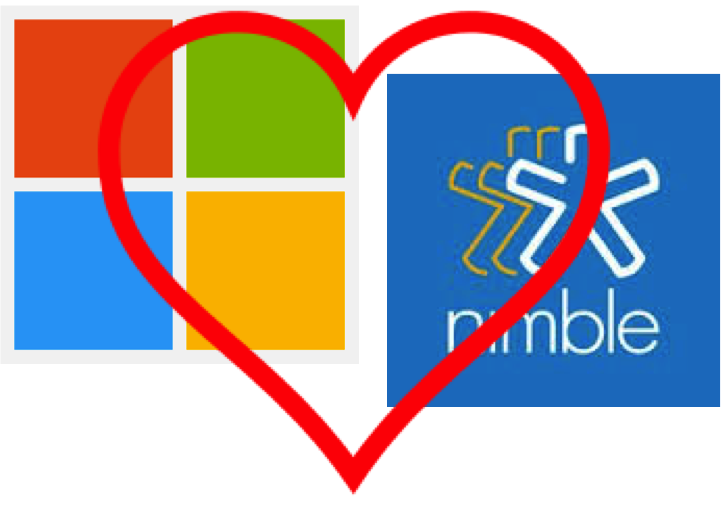
Nimble 2018 – The Story continues
The year 2018 is coming to an end, which means it is high time for some interesting product and roadmap news. Here’s some Nimble news (ok, not THAT fresh anymore, I have been incredibly busy recently). For starters, Nimble released its long awaited Mobile 3.0 for Android, complementing the iOS version that got released earlier this year. Nimble unifies contacts from teams’ mobile, cloud-based, and desktop records into an all-in-one relationship manager. With minimal taps, sales and marketing professionals can prepare for meetings by quickly scanning social insights, sales intelligence, and contact engagement history from their portal device. To keep the momentum going, Office 365 and G Suite users can send personalized responses using template, trackable emails, and monitor opportunities across all deal stages from their portable devices. “People buy from the people they know, like, and trust,” said Nimble CEO Jon Ferrara. “We therefore designed Nimble Mobile to give users the insights they need to build confidence, engage in productive discussions, and follow through promptly anytime, anywhere.” With this milestone, Nimble has now truly achieved a vision of being a simple, smart ‘CRM’ for MS Office and G-Suite users that works for the user. I put the CRM into quotes as this term for me and most other people relates to a stragegy or system that includes marketing, sales and service capabilities and not only Sales Force Automation (SFA). And SFA, particularly contact management, is what is at the core of Nimble. Still, Nimble combines key ingredients of the digital workplace that a mobile, sales person needs, into one single place. It provides the user with vital information about...