Nimble and Microsoft are Getting ever Closer
It has been three months since I last talked with Jon Ferrara, CEO of Nimble. Back in February, he introduced me to their Nimble Smart Contacts add-in to Outlook Mobile. It delivered people and company social relationship insights for free to over 40M Outlook Mobile users. Since then, he and his Nimble team have been pretty busy working with Microsoft, as one could see from his Facebook posts – having one coordination session in Seattle after the other. Nimble will soon announce that they extended the Nimble freemium Smart Contacts for Outlook Mobile add-in to become a free plugin into Outlook Desktop Windows/Mac and Office 365. This move recognizes that the world is going cloud and mobile and that the Microsoft stack of productivity applications is the most widely used set of applications in Enterprises of all sizes. Google applications, with the notable exception of Google Mail, do not stand a chance here. The same holds true for Salesforce, which acquired the productivity tool startup Quip in August of last year, or Zoho’s Docs, or any other smaller vendor tools. The logical next step is to … … integrate Nimble into Outlook Desktop and Office 365. I already speculated about this in my February post: Imagine the following: The Smart Contacts App, or rather Nimble becoming part of the Office365 fabric, working with the full Microsoft application stack, like Outlook, Skype, Team, Dynamics, Office365, LinkedIn, PowerBI and Azure. Add the fact that many smaller businesses are still working without a CRM system, but merely use their mail clients and spreedsheets – and MS Office. Continue the thought with: Salesforce,...
Google and SAP – A Marriage in the Clouds
On Mach 8, 2017, SAP and Google announced another marriage in the cloud during Google’s Cloud Next event: SAP HANA is certified on Google’s Cloud Platform GCP, and is generally available now. SAP Cloud Platform and more products and solutions are to follow. The Google Cloud Launcher marketplace will be utilized to offer and deploy to and for customers and partners, starting with SAP HANA, express edition, which is already available, too. Further topics that are covered by this partnership are Improving Google’s containerization technologies for enterprise workloads Security, privacy, and integrity of customer data in the cloud. As part of this SAP software shall act as a data custodian (NB: How that works in legal and political environments remains to be seen) and joint solutions for access control, governance, risk and compliance shall get developed Integrate Google’s G Suite into SAP applications. This has already been implemented for Identity and Access Management. More on the still fuzzy side are end-to-end integrations and collaborations in the areas of AI and machine learning. True to the SAP mantra of being an ecosystem player this is all about choice – choice for the customer to implement what is best for them. My Take Another interesting one! Good Win for SAP SAP now covers all major cloud platforms. HANA is now certified on AWS, Azure, and GCS, apart from running in the SAP cloud. With this SAP now has the broadest footprint when it comes to running on an IaaS platform. With the SAP Cloud Platform being available soon there also will be a very powerful PaaS solution on one of the...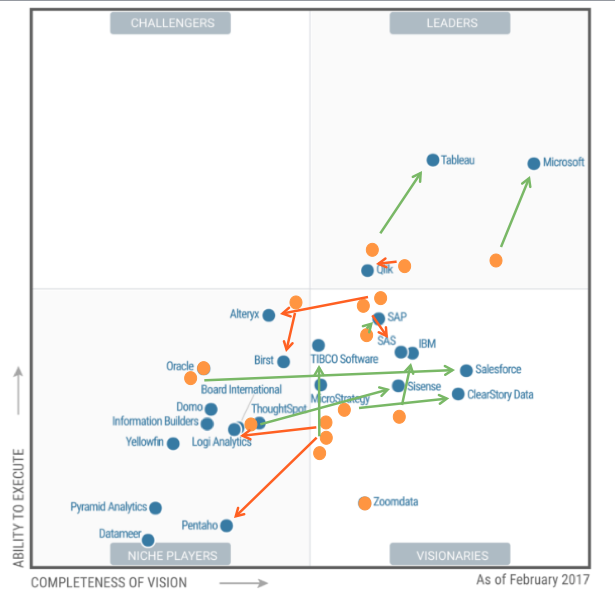
Gartner MQ BI and Analytics Platforms – Lots of Movement
Last week Gartner published the updated version of its Magic Quadrant for Business Intelligence and Analytics Platforms, and I need to say that there has been a lot of movement in both directions, up as well as down. There has been a lot of reshuffling especially in the Visionaries quadrant. This can partly be attributed to a changing market that caused Gartner to combine a few of last year’s assessment criteria as well as adding two more critical criteria as below: Critical Capabilities Dropped or Changed: Combined BI Platform Administration with Security and User Administration Modified Data Source Connectivity to Data Source Connectivity and Ingestion Combined Publish Analytics Content and Collaboration and Social BI to Publish, Share and Collaborate on Analytic Content Added Visual Appeal to Ease of Use Capabilities Added: Smart Data Discovery Platform Capabilities Workflow Integration Smart Data Discovery emphasizes the increasing importance of AI and machine learning as part of analytics systems. Gartner defines it around the automatically “finding, visualizing and narrating of important findings such as correlations, exceptions, clusters, links and predictions in data that are relevant to users without requiring them to build models or write algorithms. Users explore data via visualizations, natural-language-generated narration, search and natural-language query technologies”. Workflow Integration acknowledges that there is no actionable insight if there is a standalone analytics system. It is defined around the number of products “needed to deliver the critical capabilities and the degree of seamless integration and workflow between capabilities/components”. This has been true for a long time, but hey, better late than never. Gartner itself states that the changes have been major and that...