


SAS Customer Intelligence 360 – Turn Data into Experience
A while ago Angela Lipscomb from SAS got in touch with me to get me introduced to SAS’s concept of a Customer Decision Hub. Their Customer Decision Hub is a solution concept that shall allow organizations to derive insights and to trigger actions from interactions with external parties, like customers based upon rules and the derived insights. A Customer Decision Hub e.g. orchestrates the determination of Next Best Actions, and allows responding to an incoming request in real time using analysis and decision logic. At the same time standard communications can get suppressed based upon the same set of rules. In other words, the Customer Decision Hub fosters customer engagement based upon inbound signals that get analyzed and processed through the organization. Why is this remarkable, I hear you asking? It is remarkable because SAS Software first of all is an analytics company with a strong reputation for enterprise analytics at the higher end of performance and price point. SAS describes itself on LinkedIn as “the leader in business analytics software and services, and the largest independent vendor in the business intelligence market. Through innovative solutions, SAS helps customers at more than 70,000 sites improve performance and deliver value by making better decisions faster. Since 1976 SAS has been giving customers around the world the power to know®.” SAS is not a company that is widely known for being actively engaged in the customer engagement market (pun intended). So I was intrigued. And so should you be. Finally, a few days ago my somewhat erratic schedule allowed me to have a follow-up with Troy Kusabs of SAS Software in...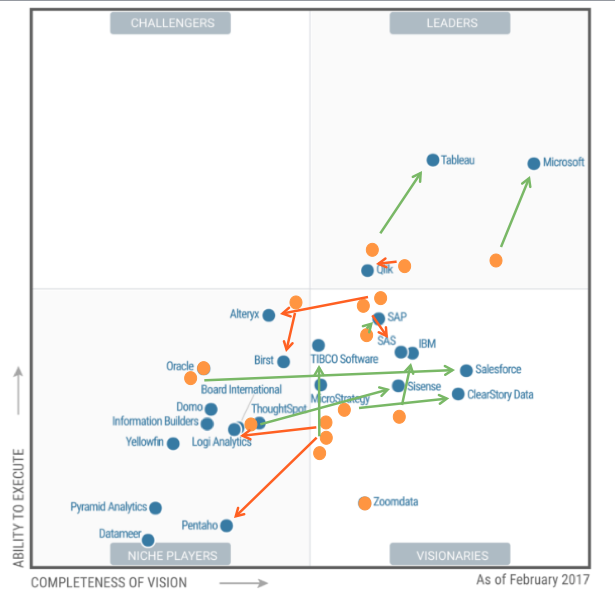
Gartner MQ BI and Analytics Platforms – Lots of Movement
Last week Gartner published the updated version of its Magic Quadrant for Business Intelligence and Analytics Platforms, and I need to say that there has been a lot of movement in both directions, up as well as down. There has been a lot of reshuffling especially in the Visionaries quadrant. This can partly be attributed to a changing market that caused Gartner to combine a few of last year’s assessment criteria as well as adding two more critical criteria as below: Critical Capabilities Dropped or Changed: Combined BI Platform Administration with Security and User Administration Modified Data Source Connectivity to Data Source Connectivity and Ingestion Combined Publish Analytics Content and Collaboration and Social BI to Publish, Share and Collaborate on Analytic Content Added Visual Appeal to Ease of Use Capabilities Added: Smart Data Discovery Platform Capabilities Workflow Integration Smart Data Discovery emphasizes the increasing importance of AI and machine learning as part of analytics systems. Gartner defines it around the automatically “finding, visualizing and narrating of important findings such as correlations, exceptions, clusters, links and predictions in data that are relevant to users without requiring them to build models or write algorithms. Users explore data via visualizations, natural-language-generated narration, search and natural-language query technologies”. Workflow Integration acknowledges that there is no actionable insight if there is a standalone analytics system. It is defined around the number of products “needed to deliver the critical capabilities and the degree of seamless integration and workflow between capabilities/components”. This has been true for a long time, but hey, better late than never. Gartner itself states that the changes have been major and that...
Customer Experience – It is all in the Data. Really?
A while after my earlier discussion with Abinash Tripathy from Helpshift about the value for customer experience of bots in customer support he contacted me with some exciting news about what he and his team are doing now. Believe me, it is interesting – but read for yourself. Our conversation, of course, led on to another vivid discussion about things to come and things that in our opinions should come. The bottom line is that we live in a data driven, always on, real-time world, where prediction of events or the ability to suggest an action is becoming increasingly a differentiator … be it in a B2B- or a B2C world. Think of Rolls-Royce selling uptime of their engines, entire airplanes nearly continuously sending telemetry data “home”, or the massive amount of data that a Formula 1 car continually sends in order for the team to take proper real-time decisions. Any car already collects a lot of data – it just needs to get connected to allow for prediction of maintenance to prevent failures. Or think of entire power grids that are already instrumented in a way that allows the operator to predict a failure several days in advance, so that the affected element can get fixed before it fails. It is all in the data? The secret is in having the data. And in the algorithms, be they event- and rule based, or more sophisticated and using machine- or deep learning. Neither data nor algorithms alone are the goal. Because what is needed is actionable insight. Actionable insight emerges only if the right algorithms are applied to the...