Building a CRM Strategy Brick by Brick
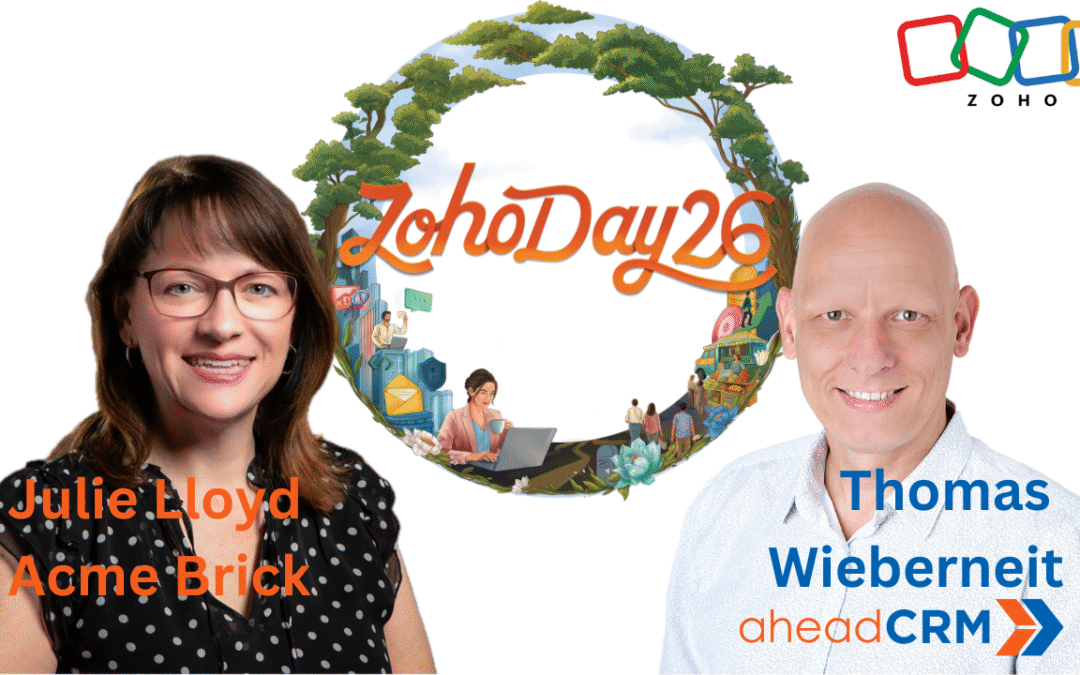
During ZohoDay26, I had the absolute pleasure of sitting down and talking CRM with Julie Lloyd from Acme Brick in beautiful Austin, Texas,. Naturally, the topic of the day was Acme Brick’s fascinating journey into the Zoho ecosystem. As a CRM analyst and consultant, I’ve seen countless software deployments crash and burn because organizations focus entirely on the technology rather than the people actually using it. That is why talking with Julie was such a breath of fresh air; her focus is entirely on the human element of Acme Brick’s digital transformation. For those who aren’t familiar, Acme Brick isn’t just any company; they are the largest US-owned manufacturer of brick. They deal in a wide gamut of materials, including manufactured block, stone, tile, and various other wall cladding. It is a sizeable operation with around 1,700 employees spread across 13 states. This coming April, Acme Brick is celebrating a its 135th birthday. When a company with that much history decides to overhaul its CRM technology, you know there’s a good story behind it. Even more so, if it is a system replacement story, Julie has been with Acme Brick for two years, and what keeps her up at night is CRM training and ensuring user adoption. TL;DR If you do not want to read, here’s the full video interview. For everyone else, read on. Having said all this, let’s dive into why they made the switch and how they are making it work this time. The Square Peg, Round Hole CRM Disaster Before migrating to Zoho, Acme Brick used another CRM system. We won’t name names here, but...The New Enterprise Moat? Zoho’s AppOS and Stack Sovereignty Signal the End of Fragmented SaaS
ZohoDay 2026 is in the books, and it has again been an intense two days of information and discussions, starting off with some impressive statistics. In time for its 30th anniversary, Zoho crossed the milestones of one million paying customers and an eye watering 150 million users. All this while not having raised a single dollar of external capital or buying technology or users. The company stays fiercely independent and continues to grow very profitably since it crossed the threshold of an annual revenue of $1bn back in November 2022. If I wanted to boil this event down to a few key messages, it would be value, independence, platform, and, of course, AI. The conference in a nutshell: Value is the result of the smart use of automation with AI that works on top of the corporate system of record, powered by a platform that is built on an independently owned stack. This is also the secret sauce of Zoho, a philosophy that the company follows since its inception. And here is how Zoho brings this to work. Zoho owns and continuously improves its stack Coming from the angle of sovereignty, Zoho extends this thought of independence to its customers now in an answer to Raju Vegesna’s not so rhetoric question “what will happen if someone can pull the plug?” on any of your essential systems. All of the sudden, the thought of local deployments or hybrid deployments with cloud apps operating on local data becomes very interesting, valuable, again. It is mitigating risk. According to Vegesna, clients of different sizes are asking for this model. Another part of this equation is...
Zoho One: Did 75,000 Customers Find the Sweet Spot?
Zoho aspires to deliver the operating system for businesses with the goal of driving customers’ margins by unifying business operations on one single technology platform. The most important part for delivering this vision is Zoho One. Zoho One is Zoho’s premier bundle of business applications. Currently, Zoho One consists of around 55 applications that support sales, marketing, email and collaboration, helpdesk and customer support, finance, HR, analytics, and business processes. Of these, customers use on average 22. Zoho One can be licensed as an all-in-one platform but also be part of a journey that starts at first licensing one application, then more and then moving to Zoho One directly or via licensing one of the other suites (such as CRM+, Projects+, Finance+, or Workplace, and others). The most used applications in Zoho One are CRM, Analytics, Books, Meeting, and Workdrive. At the time of writing this, Zoho One has around 75,000 customers, which makes it Zoho’s most popular product. The largest customer has around 32,000 employees. Customers are distributed worldwide in more than 160 countries, with the highest numbers in the United States and the European Union. Organizations that have implemented Zoho One are from a variety of industries, although the top five industries are the high tech, professional services, Real Estate and Construction, Retail, and Banking/Financial Services/Insurance industries. On November 18, 2025, Zoho announced many enhancements to the suite. The enhancements are focusing around three key areas: · Experience · Integrations · Intelligence The biggest enhancement in the experience category is that Zoho essentially removes the boundaries between the...