

Zoho Analytics – One Platform to Help them All?
The News On September 12, 2024, Zoho released a new, AI-rich version of Zoho Analytics that brings self-service BI to any persona in business. The release added more than 100 features and now offers powerful AI and ML capabilities. These enable diagnostic insights, predictive analytics, and automatic report and dashboard generation. “Additional advancements to Zoho Analytics include a custom ML model-building studio, seamless integration with OpenAI, and third-party BI platform extensions. The new version of Zoho Analytics has added power, intelligence, and flexibility to serve a broader range of businesses and users than competitors in the market.” The Zoho BI and Analytics Platform now offers more than 500 connectors to other systems, including streaming analytics. Overall, the new release offers new capabilities across four main categories: Data Management Hub: Zoho Analytics has expanded its data management capabilities, ensuring more accurate and applicable decision-making and deeper insights to accelerate business success BI Infusion with Generative AI: Zoho Analytics has introduced Generative AI capabilities across the BI platform to accelerate the adoption of insights for a broad spectrum of user personas. Data Science and Machine Learning (DSML): Zoho Analytics now features the DSML Studio, allowing users to simply and quickly build custom machine learning models, which, for example, analyze or predict customer churn. n of insights for a broad spectrum of user personas. Platform Extensibility: Zoho Analytics is more deeply extensible, allowing businesses to sync and standardize data stored across multiple tools and platforms for comprehensive analysis and insights. Zoho Analytics is a composable platform on which any analytical solution can be built. Alun Rafique, CEO and Co-Founder of Market Dojo...
How Zendesk moves the needle in customer service
The news On January 8, 2024, Zendesk announced the acquisition of Klaus, “the industry leading AI-powered quality management platform”. With AI driving a rapid increase in customer service interactions it is necessary for customer service teams to become more efficient while maintaining their quality of service. This is accomplished by a combination of digital and human agents across an increasing number of channels. Ensuring good quality requires a QA solution that is capable of scoring 100 percent of customer interactions, which is what Klaus’s AI is capable of. In doing this, it “pinpoints conversations with positive or negative sentiment, identifies outliers, churn risk, escalations, and necessary follow-ups. According to Zendesk, most QA software does handle only one to two percent of all customer interactions. With workforce enablement management capabilities, Klaus enables the identification of knowledge gaps and coaching opportunities with the goal of improving agent performance and productivity. The result is higher customer satisfaction. According to Martin Kōiva, CEO and founder of Klaus, “Zendesk and Klaus share a vision of Ai-led, personalized CX with businesses fully anticipating and acting on their customers’ needs. QA software plays a critical role in this, ensuring consistency, assessing both human and digital agent performance and providing actionable insights for strategic planning. As part of Zendesk, we will continue to build and deliver thes crucial capabilities, but now at an even greater scale”. The bigger picture Customer service personnel works in a high-pressure environment with lots of turnover; even worse, as frontline workers, they are often the first ones to deal with customers who are already less than amused – equipped with tools that...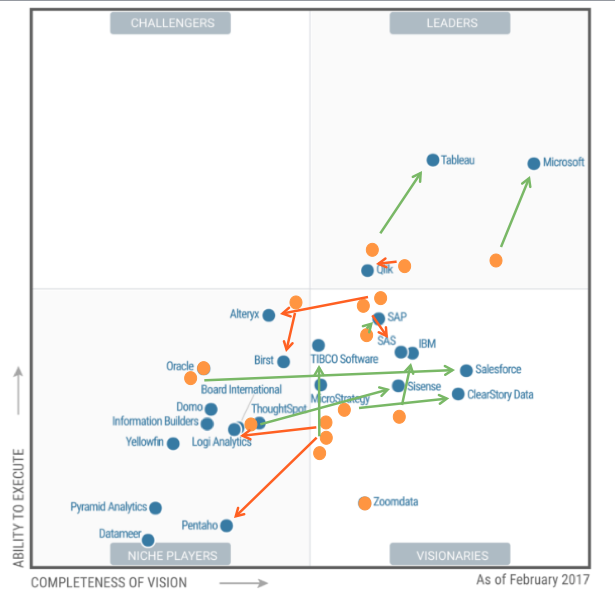
Gartner MQ BI and Analytics Platforms – Lots of Movement
Last week Gartner published the updated version of its Magic Quadrant for Business Intelligence and Analytics Platforms, and I need to say that there has been a lot of movement in both directions, up as well as down. There has been a lot of reshuffling especially in the Visionaries quadrant. This can partly be attributed to a changing market that caused Gartner to combine a few of last year’s assessment criteria as well as adding two more critical criteria as below: Critical Capabilities Dropped or Changed: Combined BI Platform Administration with Security and User Administration Modified Data Source Connectivity to Data Source Connectivity and Ingestion Combined Publish Analytics Content and Collaboration and Social BI to Publish, Share and Collaborate on Analytic Content Added Visual Appeal to Ease of Use Capabilities Added: Smart Data Discovery Platform Capabilities Workflow Integration Smart Data Discovery emphasizes the increasing importance of AI and machine learning as part of analytics systems. Gartner defines it around the automatically “finding, visualizing and narrating of important findings such as correlations, exceptions, clusters, links and predictions in data that are relevant to users without requiring them to build models or write algorithms. Users explore data via visualizations, natural-language-generated narration, search and natural-language query technologies”. Workflow Integration acknowledges that there is no actionable insight if there is a standalone analytics system. It is defined around the number of products “needed to deliver the critical capabilities and the degree of seamless integration and workflow between capabilities/components”. This has been true for a long time, but hey, better late than never. Gartner itself states that the changes have been major and that...