

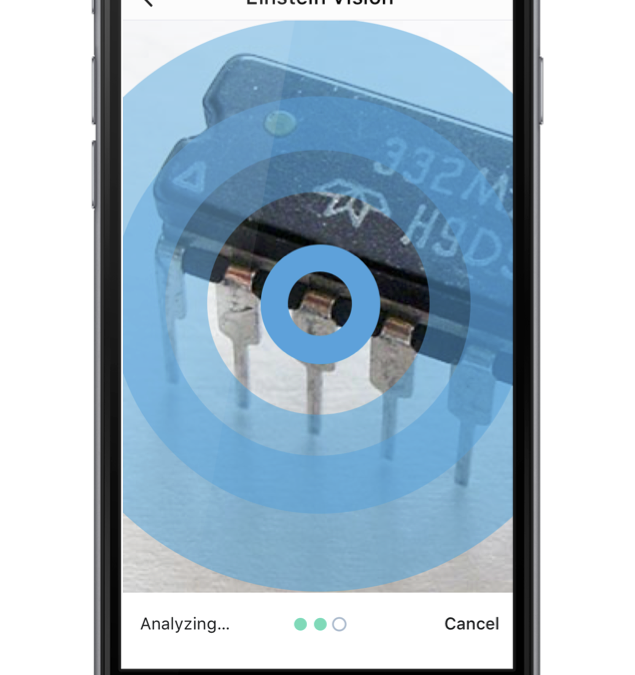
Salesforce brings Einstein to Field Service – A big Move?
On July 12, 2017 Salesforce announced its new, Einstein-enhanced version of Field Service. This release brings mainly three innovations to the already strong Service Cloud, which is the leading Customer Service solution according to Gartner Group. Here the complete wording of the press release, in case you did not want to follow the link but still are interested in it: Salesforce Delivers Einstein AI and Analytics For Field Service Lightning Built on the Service Cloud Platform, new innovations for Field Service Lightning arm the mobile workforce with image recognition technology, smart equipment management and deep analytics to bolster productivity and efficiency Companies including Atlantic Energy are harnessing the power of Field Service Lightning to deliver insight, onsite SAN FRANCISCO—July 12, 2017—Salesforce [NYSE: CRM], the global leader in CRM, today introduced Einstein AI and Analytics for Field Service Lightning, empowering companies to deliver a smarter onsite customer experience that is built on the world’s #1 customer service platform. Field Service Lightning now brings together the insights and intelligence mobile workers need to increase productivity, boost onsite efficiency and drive revenue. The Salesforce Service Cloud has redefined customer service across every major technological shift—cloud, mobile, social, messaging and more. And last year with the introduction of Field Service Lightning, Salesforce extended the power of Service Cloud to create a full service platform for managers, dispatchers and mobile workers. However, as the multi-billion dollar field service market expands into new industries—including finance, healthcare, manufacturing and retail—there is even more demand to deliver onsite service. Field service technicians have to deal with complicated equipment, don’t always have the right parts and often lack...
Customer Service in a World of Ambient Computing
Soon there will be an additional in-app customer service channel. So far we have a bunch of service channels, most of them requiring the user to leave the app to Pick up the phone for a call Browse for self support Open up an additional chat window Take on the social media channels Move on to messenger applications How about getting into your car to get to a store? … And then a customer may be moving back and forth between these channels with all the potential of losing track of the incident status and the friction that cross channel customer service still causes. There is no doubt that providing in-app support is the best possibility to offer fast issue resolution. It can provide telemetry information from within the app, identify the user and therefore provides a lot of relevant context that makes it easier for a service agent to help the customer without unnecessary delays. The customers’ shift to emphasize on the “Now” is also seen by Google research. Not Every Device is a Smartphone But what if the customer cannot pick up the phone to engage in a typed conversation? The customer might be engaged in a VR game, or driving a car, or in any number of situations without having a free hand. Maybe the customer simply doesn’t want to pick up a phone? What if the app doesn’t offer a user interface at all beyond a little light that indicates ‘I am available’? This would e.g. be the situation in an ambient environment that senses the presence of a person and acts accordingly. An environment...
Zendesk – A Mobile CustServ Native?
Mid of April I published an article about the mobile in-app support landscape that, amongst other players, touched on Zendesk. In this article I stated: “Zendesk is not a mobile native. Their chat widget integrates into web pages and the company does not offer in-app chat. Instead the company offers solutions that hook into existing messaging apps like Facebook Messenger or Whatsapp.” This statement was based upon research that I did in the first half of the month with Zendesk publishing their Fabric based in-app support kit on April 19 of the same month. So, maybe I should have posted this article a little later, but good on Zendesk for getting on with mobile in app support. They had, as well as many other bigger vendors in the customer service and call center arena still have, a wide open flank here that gets covered by specialist vendors like Helpshift, Intercom, or LivePerson, or suite vendors like Freshworks. Zendesk, a Mobile Native or Not? I say that, although I maybe did them wrong by stating that they don’t do in-app FAQs – although I do not believe so, as the help center content seems to be delivered from the server and needs an online connection. Still I maintain that they are not a native player. I will explain my reasoning a little later, after summarizing what I got out of talks with Douglas Hanna and, more recently, Greg Dreyfus from Zendesk. As per now Zendesk offers two different SDKs for mobile. The support SDK and the Chat SDK (both links go to the iOS version, there are Android versions, too)....