

Wheels Up, CX Down? Decoding the Suitcase-Customer Experience Connection
Given this title, you probably wonder what the relationship between a suitcase and customer experience could be. Well, I don’t know, too, and this story is more about how a suitcase and customer experience are related to each other. Imagine the following not so uncommon scenario: you are on a multi sector flight, one of the early sectors is delayed. You barely make your last sector – your check-in luggage doesn’t. It takes a detour to your destination airport instead. Sounds familiar? I would be surprised, if not. And it shouldn’t be a problem as there are well established procedures to report this and to get a more or less timely delivery of your delayed luggage. Or so you think. The good news is that the airline (kudos to AA at this point) proactively informed about this situation via text already in flight. With this, there is no lengthy wait at the belt that ends in a disappointment but a direct way to the airline counter to organize the delivery to your hotel. So, you give some details including the hotel that you are going to stay in for the next days. The service person announces the suitcase’s arrival for probably today and likely tomorrow. For the sake of the story, “today” means Monday, so, “tomorrow” is Tuesday. Not ideal, but fair enough, given that the suitcase will likely be handed to a package delivery service and not transported individually. Time to happily go on with your day. After all things are sorted and in the capable hands of professionals. Customer orientation at work and a positive customer experience....
SAP Connect 2025: Unpacking CX, AI, and Does Cinderella Finally Get to Dance?
Before immersing myself into SAP Connect 2025, I had a number of questions that I would like to get answered during the event. These included the ones below and naturally focused on SAP’s CX and AI sides of the house. Some of them I got answered, some of them not, at least not explicitly. What is the plan to make SAP CX more prominent in the CRM/CX marketplace and what are main reasons that you see for customers preferring other CX solutions over SAP’s? What do customers say that they are missing in the CX suite? Where do you see the limits of agentic technology in the near to mid-term? Apart from adoption problems … And where do you see most potential for agentic AI going forward? What are adopted (agentic) use cases that concentrate on business transformation, gaining capabilities, uplift as opposed to “increasing efficiency”? How does SAP deal with the dichotomy between “human augmented by machine” and mass layoffs? SAP Consulting as well as SIs do face a need to change their business models away from billable hours. What do you recommend SIs do? How does SAP support them in this venture? How do you foresee the overall ecosystem change with an estimated increase of use and deployment of generative and agentic AI But more about all this in a minute. Of course, SAP took this event to announce a flurry of new capabilities across its suite of applications, AI, and technology, as evidenced in the long innovation guide and the theme-describing press release for the event, although I’d say that the event went well beyond “AI...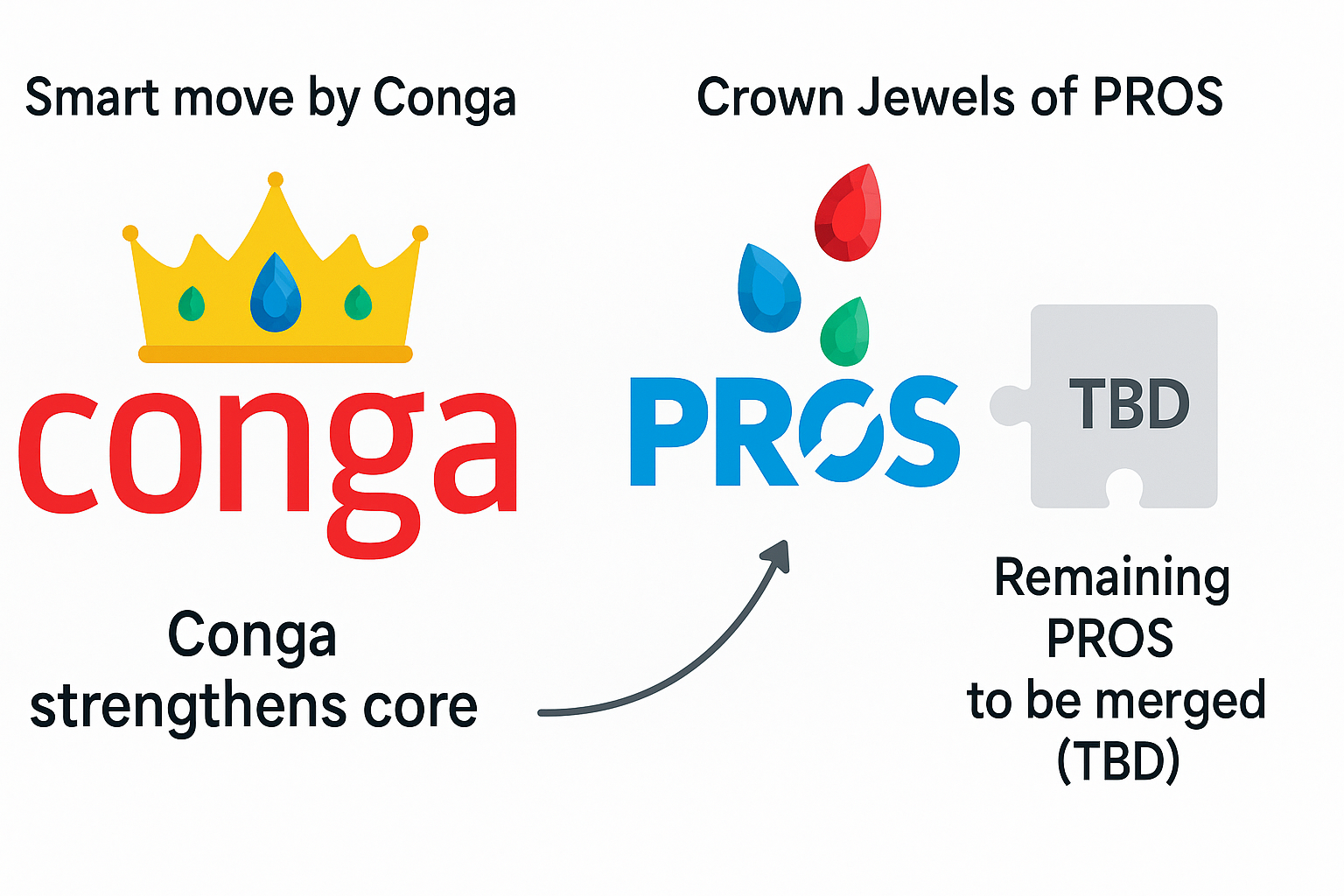
CPQ, Meet Price Optimization: Your Revenue Lifecycle Just Got Serious
The news On October 1, 2025, Conga announced its intent to acquire the B2B business of PROS, following PRO’s acquisition by Thomas Bravo. At the same time, ThomaBravo and PROS announced that PRO’s travel business segment will be run as a standalone business. The bigger picture Revenue operations, revenue management and revenue lifecycle management have become a thing in the past years, as evidenced by the number of specialized companies that solve parts of the overall problem of optimizing revenue. It also got abused to some extent (e.g., surge pricing models) when the users of the corresponding capabilities consider optimizing being the same as maximizing. Reality check: It is not. While optimizing involves a bit of identifying how much a customer is willing to pay, it also involves the thought of repeat business, or in other words customer loyalty, even without a formal loyalty program. And that involves the customer experience, part of which the speed of creating a quote with matching scope and a price that is acceptable for both parties is an important element in B2B. So, the combination of CPQ and price optimization makes perfect sense. As an example, already in 2019, I was involved in a project that in part targeted at combining CPQ and price optimization to get to a good quote, fast. And it worked, although the solution looked different in the end than anticipated at the start of the project. My analysis and point of view Already when the original news of Thoma Bravo acquiring PROS broke I have seen quite some synergies with Conga but also some other players in the...