
For years, the enterprise software complex has sold us on a beautiful fairytale: the single source of truth. We were told that if we just poured enough capital into our CRM systems, and if we just badgered our front-line sales representatives enough to log every transactional interaction, absolute operational clarity would emerge. Now, the enterprise technology industry has found its next silver bullet: generative artificial intelligence. Every major software vendor is frantically bolting an AI copilot, a generic conversation summarizer, or an automated opportunity scoring engine onto their legacy applications. They promise that these shiny additions will magically transform messy, unlogged data into executive-grade operational insights. But let us be completely clear here: it is mostly marketing fluff designed to protect legacy vendor stock prices rather than solve foundational architectural bottlenecks.
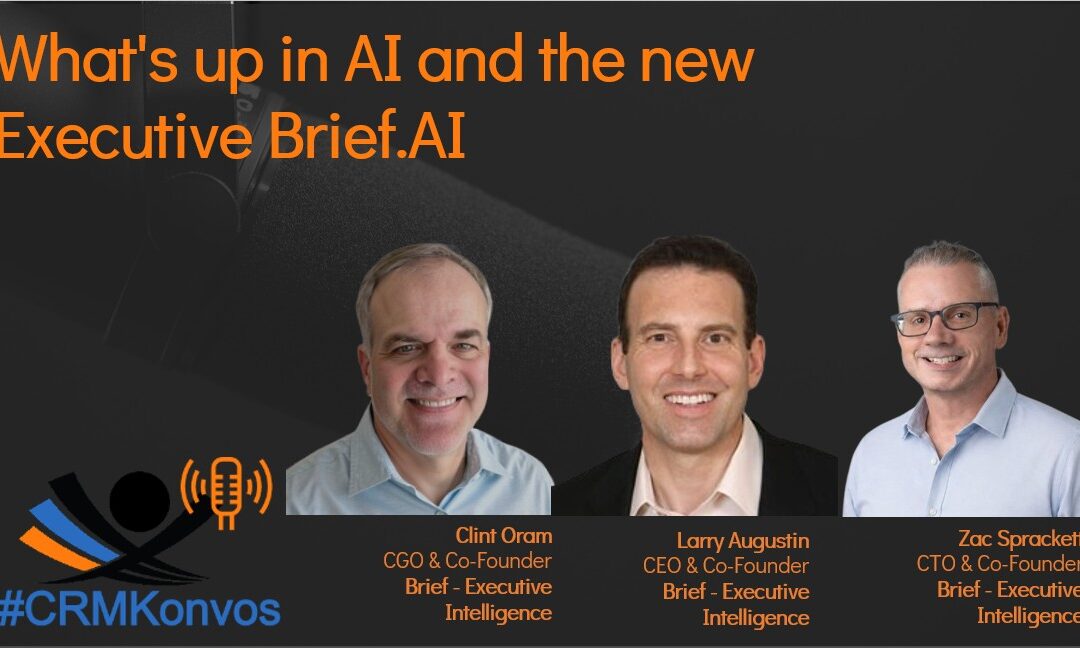
The recent conversation on CRMKonvo with the co-founders of Brief Executive Intelligence cuts straight through this generative AI hype. Larry Augustin, Clint Oram, and Zac Spreckett are not starry-eyed AI tech evangelists; they are battle-hardened industry veterans who built SugarCRM and spent decades in the enterprise application trenches. Their core thesis is as brutal as it is interesting: CRM platforms were natively architected for front-line reps, not for the executives who actually manage the strategic direction of an organization. Bolting a generic large language model (LLM) onto a legacy database framework does not fix the fundamental structural deficiencies of that historical ledger. It merely allows corporate environments to generate summaries of incomplete information faster than ever before.
TL;DR
If you want to watch the full CRMKonvo, please go ahead here (optimized for smartphones) or here (optimized for tablets/computers).
Else, be my guest and continue to read.
Or do both …
Legacy Software Architecture and the Customer-Centric Trap
To understand why current corporate AI initiatives are stalling, we must evaluate the structural foundation of legacy software. Systems of record are fundamentally passive; they are organized around a specific external entity, which in the case of CRM software is the customer. They excel at capturing transactions retrospectively, functioning as a historical record of what your account teams managed to input between active sales calls. This framework works reasonably well for rear-view reporting, but it breaks down when an executive needs to make real-time asset allocations or make time-sensitive decisions.
When vendors attach an AI assistant to a standard CRM framework, that artificial intelligence remains severely restricted by the constraints of the underlying data model. The copilot can surface information about an active customer account—assuming your reps actually took the time to manually input it—but it maintains zero architectural visibility into what is occurring across the rest of the enterprise infrastructure. It possesses no conceptual awareness of internal product pivots hammered out in Slack, the roadmap modifications documented in engineering tools, or the critical budget parameters negotiated in email chains. The bolted-on AI layer is effectively blind to the context of the executive function itself; it optimizes for an isolated department while leaving the senior leadership team completely in the dark regarding cross-functional reality.
The Rampant Enterprise Epidemic of Decision Amnesia
This deep architectural gap manifests in what Clint Oram labels "decision amnesia." In modern corporate environments, organizational activity happens at a dizzying pace. Generative utilities have made it incredibly simple to mass-produce content, which in turn accelerates the sheer volume of daily communications an executive must filter. This structural acceleration creates a striking paradox: modern enterprises are communicating more than ever and are understanding less. Critical corporate decisions are finalized in frantic chat threads, impromptu video calls, and rapidly buried message strings.
Without an enterprise framework that treats these decisions, commitments, and strategic corporate goals as native, first-class data objects, these crucial operational elements simply evaporate into organizational noise. SAP calls this framework to avoid decision amnesia the company memory.
The long-term cost of this decision amnesia is staggering; entire corporate leadership teams spend hours re-litigating the exact same strategic issues they supposedly resolved weeks prior because no internal platform recorded the precise reasoning behind the original alignment, nor the precise agreement. Enterprises find themselves trapped in an operational loop, acting like corporate hamsters spinning a wheel fueled by an endless stream of AI-generated communication exhaust. Organizations become highly active, deeply exhausted, and yet structurally stagnant, moving nowhere.
Beyond Storing Artifacts: The Era of Continuous Understanding
This brings us to a critical architectural distinction: the difference between merely storing data artifacts and actively maintaining an ongoing understanding of work. Traditional software applications are exceptional at storing passive artifacts: a saved document file, a logged call note, or an archived email chain. But a massive collection of independent data artifacts does not equal true institutional knowledge. Without interpretation it remains mere data. Expecting a human executive to manually synthesize thousands of scattered communication artifacts into a coherent operational picture is a guaranteed recipe for immediate corporate burnout.
The alternative approach requires a technology architecture built around a persistent knowledge graph paired with targeted language models. Instead of waiting for a user to actively execute a search query in a blank text box, an executive-grade system must continuously monitor the operational tendrils of the enterprise infrastructure. It must automatically parse ongoing communications, extract underlying corporate commitments, map those vectors against explicit corporate goals, and maintain an ongoing semantic representation of corporate reality. This is not about building a better data indexing engine or expanding an LLM context window. It is about establishing a foundational technology layer that inherently understands how a corporate entity operates.
Proactive Intelligence Versus the Search Box Obsession
Most current corporate AI tools are completely reactive; they sit quietly in a side panel until an executive types a specific prompt into a search interface. But as any seasoned enterprise leader will tell you, an AI search query is only as good as the question you know to ask. If you are completely blind to a developing operational crisis or a slipping cross-functional dependency, you will never think of typing it into your AI copilot. Reactive software infrastructure keeps corporate leadership in a perpetual defensive posture, scrambling to address systemic vulnerabilities after they have already degraded the bottom line.
True executive-grade technology must pivot entirely toward proactive intelligence. The underlying software must understand your current corporate context – the strategic partners you are meeting with, the business accounts that are drifting, the internal commitments coming due – and actively surface relevant insights to you before you realize a gap exists. If you are preparing for an investor call or a board presentation, you should not be spending the prior evening frantically querying disparate data silos to compile a status brief. The platform should already have mapped the operational trajectory and prepared you for the discussion. This is the difference between a simple digital assistant and an enterprise intelligence layer that actively protects your focus and accelerates human execution.
Enterprise AI Buying Strategies: A Guide for CX Leaders
For corporate leaders navigating the chaotic market of enterprise AI, avoiding expensive mistakes requires rigorous architectural skepticism. Consider these three core recommendations.
First, audit the underlying data architecture beyond the copilot hype. When legacy vendors show AI that creates quick summaries, check where that information originates. If the AI merely queries a siloed database, it will never provide cross-functional context. Demand a unified knowledge graph that synthesizes disparate communication channels like email, calendar, and chat. Do not pay a premium for a thin conversational interface over bad data.
Second, prioritize proactive intelligence over reactive search utilities. A system that requires users to constantly query a prompt box is a system that fails them. Evaluate software based on its ability to surface insights autonomously using immediate context. Ask vendors how their platform alerts leadership to misaligned goals or slipping project timelines without requiring manual configuration. Eliminate the administrative burden of searching for information.
Third, insist on absolute data privacy and security at the user level. Executive context contains sensitive enterprise data like financial trajectories and board reports. A generic cloud solution that pools data or exposes it to manual vendor reviews is an unacceptable liability. Ensure a security model where data is encrypted individually with unique keys, preventing vendor access to corporate intelligence.