

Watson meets Einstein – Elementary, my Dear Holmes
This week Salesforce and IBM announced a global strategic partnership to deliver joint, AI based solutions based upon Salesforce Einstein and IBM Watson, their respective AI platforms. The upcoming solutions will be designed to “deliver everage artificial intelligence and enable companies to make smarter decisions, faster than ever before. With the partnership, IBM Watson, the leading AI platform for business, and Salesforce Einstein, AI that powers the world’s #1 CRM, will seamlessly connect to enable an entirely new level of intelligent customer engagement across sales, service, marketing, commerce and more.” IBM Watson will be connected to the Salesforce Intelligent Customer Success Platform in a way that augments the customer specific insights that are delivered by Einstein with its structured and unstructured data that comes from a variety of sources, in order to be able to use specific as well as more generic, yet industry relevant, information. “Together, Watson and Einstein will ingest, reason over and derive recommendations to accelerate decision making and drive greater customer success.” Initially planned solutions are “IBM Watson and Salesforce Einstein Integration: Integrating IBM Watson APIs into Salesforce will bring predictive insights from unstructured data, inside or outside an enterprise, together with predictive insights from customer data delivered by Salesforce Einstein to enable smarter, faster decisions across sales, service, marketing, commerce and more. For example, by combining local shopping patterns, weather and retail industry data from Watson with customer-specific shopping data and preferences from Salesforce Einstein, a retailer will be able to automatically send highly personalized and localized email campaigns to shoppers.” “IBM Weather Insights for Salesforce: The Weather Company, an IBM business, will power a new...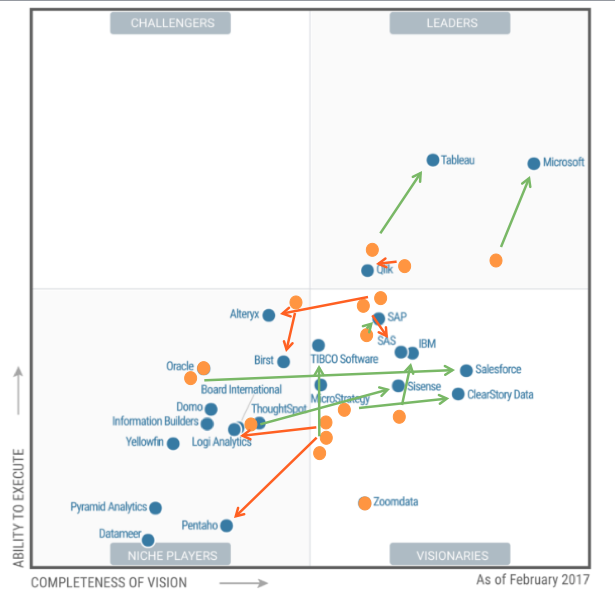
Gartner MQ BI and Analytics Platforms – Lots of Movement
Last week Gartner published the updated version of its Magic Quadrant for Business Intelligence and Analytics Platforms, and I need to say that there has been a lot of movement in both directions, up as well as down. There has been a lot of reshuffling especially in the Visionaries quadrant. This can partly be attributed to a changing market that caused Gartner to combine a few of last year’s assessment criteria as well as adding two more critical criteria as below: Critical Capabilities Dropped or Changed: Combined BI Platform Administration with Security and User Administration Modified Data Source Connectivity to Data Source Connectivity and Ingestion Combined Publish Analytics Content and Collaboration and Social BI to Publish, Share and Collaborate on Analytic Content Added Visual Appeal to Ease of Use Capabilities Added: Smart Data Discovery Platform Capabilities Workflow Integration Smart Data Discovery emphasizes the increasing importance of AI and machine learning as part of analytics systems. Gartner defines it around the automatically “finding, visualizing and narrating of important findings such as correlations, exceptions, clusters, links and predictions in data that are relevant to users without requiring them to build models or write algorithms. Users explore data via visualizations, natural-language-generated narration, search and natural-language query technologies”. Workflow Integration acknowledges that there is no actionable insight if there is a standalone analytics system. It is defined around the number of products “needed to deliver the critical capabilities and the degree of seamless integration and workflow between capabilities/components”. This has been true for a long time, but hey, better late than never. Gartner itself states that the changes have been major and that...
A Love Affair – Nimble Smart Contacts for Outlook
Social Selling pioneer Nimble has an awesome start into 2017. First it got number 1 in CRM satisfaction by G2Crowd earlier in January, then friend and CRM godfather Paul Greenberg named Nimble a winner of the 2017 CRM Watchlist awards, and now Nimble announces the Smart Contacts add-in for Outlook, a deep integration into Outlook for iOS, with an integration into Outlook for Android coming soon. The Nimble Smart Contacts add-in brings the power of Nimble’s view on contacts to Outlook for mobile users, after the widget and Outlook add-on already offered this functionality for the web- and Outlook clients. The add-on follows the philosophy that for most companies the e-mail account is still their CRM system; given this, this is a straightforward enhancement. Nimble acknowledges that there are two main email systems used in businesses: Gmail and Office365, and now fully supports them both. This integration delivers the profiling data that the Nimble back end gathers practically at any place. The browser add-in already today allows to get profiling information about contacts in other CRM systems, e.g. Salesforce or MS Dynamics and works seamlessly in Google Apps and Office365. “The biggest cause of communication failure is lack of knowledge of who someone is or what their business is about,” says Jon Ferrara, CEO of Nimble. This add-on is closing one missing link in the chain by making it part of Outlook and reducing the need for having yet another app. Relevant business insight about people in a mail conversation and their companies is now directly available in the email client. The add-on, along with the above-mentioned Outlook Add-in,...
Another Strong Year for SAP
On January 24, 2017 SAP released its results of their fiscal year 2016 – and the fourth quarter thereof. In a nutshell SAP: Delivered to its increased 2020 guidance Had an increase of 31 per cent in cloud subscription and support revenue, while still being able to increase the software license and support revenue. Cloud revenue increased especially in Q4 and promises to stay at a high level with a very healthy backlog Increased its full year operating profit by 20 per cent to 5.12 Billion Euro (IFRS) Has a strong backlog of cloud bookings This success has a slightly negative effect on the company profitability while it negotiates the shift from license revenue to subscription revenue while being in an investment mode. It, however, seems to be driven by an increasing adoption of S/4HANA, a strong increase of the Hybris set of CEC solutions, including e-commerce and increasing traction in the HCM space. So it is broad. Based upon the strong delivery of 2016 SAP expects the cloud business to increase by up to 34 per cent in 2017 (all numbers of course at constant currencies) and increases its guidance of revenue and profit for 2017. In line with this the company is also bullish in its mid term outlook to 2020, which it increases, too. My Take Of course the big increase in revenues, expressed as a percentage, is partly owed to the fairly low number. In comparison Salesforce reported 2.14 Billion dollar for their third quarter alone, as opposed to 2.99 Billion Euro for SAP’s fiscal year. Oracle reported 798 million dollars in their FY Q1...