
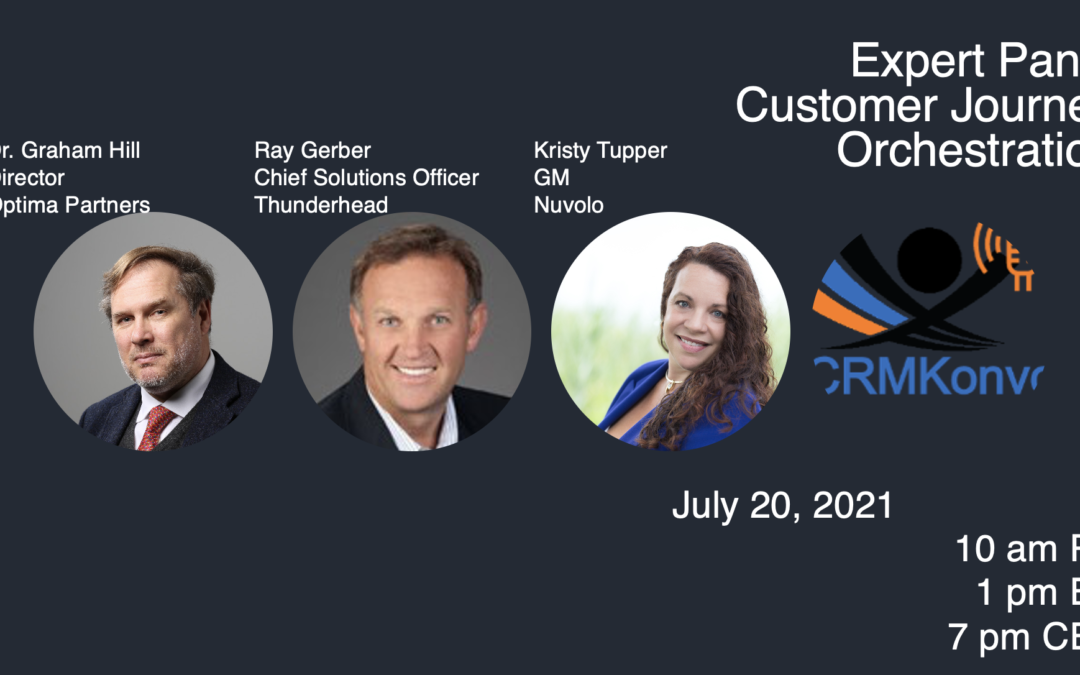
How to do great Customer Journey Orchestration
Following the great discussion about Customer Journey Orchestration that we had with Graham Hill it was obvious that this topic deserves and requires more attention. We had a lot of points and different terms, starting from customer journey management, customer managed journeys, customer journey analytics, customer journey mapping and so on. Provocative statements like “customer journey mapping is utterly useless” popped up and were discussed. Is this tool utterly useless? Well, the discussion shed some light! So, we asked the most active participants of the chat conversation whether they would be up for a panel discussion. Graham Hill, Ray Gerber and Kristy Tupper agreed. So, here we are with a panel discussion about this exciting topic. The three of them have different views that help in furthering our knowledge. The CRMKonvos team is really excited to host this discussion, which is cut in three sections. Interested in the leading questions? Have a look at the next three short videos. Or dive right into the discussion, which is at the end of this post. What is customer journey orchestration? Who benefits most of Customer Journey Orchestration? How do customer journey orchestration and customer journey mapping relate to each other? These good questions and points of view opened up exciting and well received discussions. Enjoy watching...
Together, Zoom and Five9 shape a new market
The News On July 18, 2021, Zoom Video Communications, Inc. announced the acquisition of Five9, Inc. in an all-shares transaction. The transaction values Five9 at around $14.7 billion. According to the press release “the acquisition is expected to help enhance Zoom’s presence with enterprise customers and allow it to accelerate its long-term growth opportunity by adding the $24 billion contact center market.” According to Eric S. Yuan, CEO and founder of Zoom, the company is “continuously looking for ways to enhance our platform, and the addition of Five9 is a natural fit that will deliver even more happiness and value to our customers”. He continues with “enterprises communicate with their customers primarily through the contact center, and we believe this acquisition creates a leading customer engagement platform that will help redefine how companies of all sizes connect with their customers”. Rowan Trollope, CEO of Five9 adds that “businesses spend significant resources annually on their contact centers, but still struggle to deliver a seamless experience for their customers”. Trollope will become a president of Zoom and continue as CEO of Five9. Zoom expects the acquisition of Five9 to be “complementary to the growing popularity of its Zoom Phone offering […] The combination of both firms also offers both companies significant cross-selling opportunities to each other’s respective customer bases”. As especially Rowan Trollope emphasizes upon repeatedly in the acquisition briefing, this acquisition is about accelerating growth by combining the respective assets, software as well as customers. The bigger picture The trend towards call centers in the cloud has been there before and it has been amplified with the Covid pandemic. Connecting...
The Platform CAN Do the Work. Let it!
On June 15, 2021, the CRMKonvos crew had the chance to chat with Andreas Schuster, Customer Success Director for SugarCRM in Europe, about the company’s evolving vision and goals. He did not disappoint. Schuster has filled a variety of roles over the years, both in the software industry and outside of it, and has developed an appreciation of what well-administered CRM can do for a business and its customers. “I have been able to get to know CRM in the industry and in sales, and I keep getting to know it again and again,” Schuster said. “I never get bored watching companies actually supporting their sales management with software, but also just the way they work together with the customer and with the customer. And it is always exciting.” One important thing that Schuster believes, though, is that CRM is more than technology; it is behavior and culture which technology can enable to be better. “CRM is not so much a technical tool; it really is an approach,” Schuster said. “It’s a strategic sales approach, and there’s a lot that goes into it now, but it’s still the same.” The technology is an important starting point though, especially with larger and more complex businesses. Schuster added: “I keep coming back to this: the software that’s used has to work great, it has to be intuitive, it has to look good. But taking this CRM approach is first of all a strategic thing in a company. You have to want it. You have to prepare for it. And you also have to set an example for your company from the...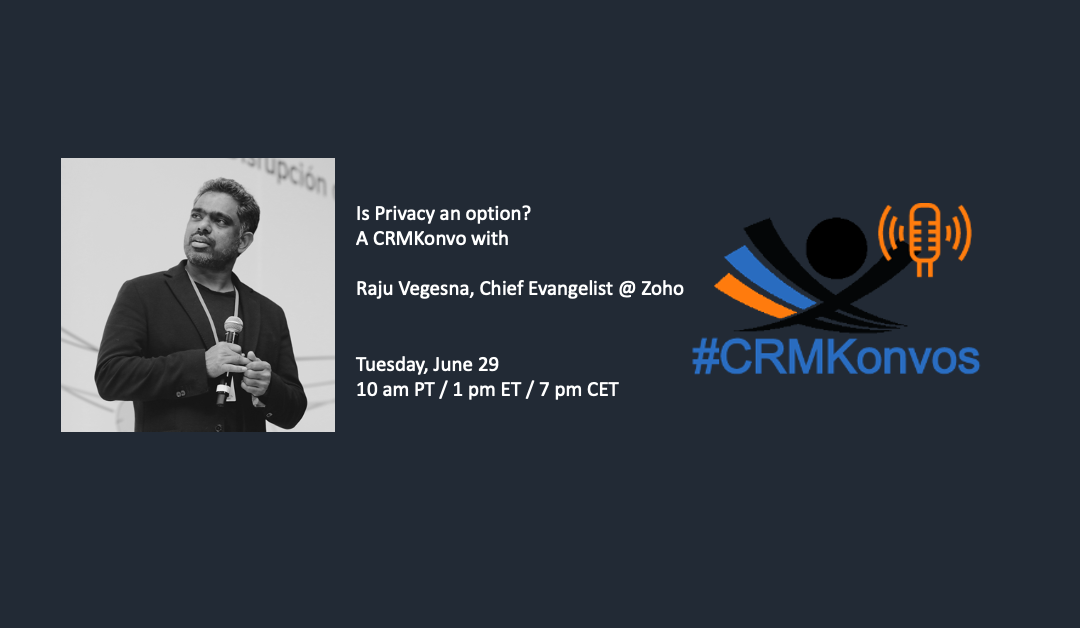
Why privacy is not an option
Data breaches, ransomware, stolen identities, collecting of data for no benefit of the customer, are only some of the things that we do see every day. There does not seem to be any privacy anymore. This makes privacy and data protection hot topics not only for customers, but also for software vendors – or at least should make it hot topics. Apple put in some privacy controls and got chided for it by Facebook and the rest of the adtech industry. Google, with FLOC, tried to establish a technology that aimed at being able to track users in a post cookie world. To adapt a quote of the Asterix books: The whole world tracks users and customers. The whole world? No, there is one brave company that doesn’t. All this is reason enough to have a #CRMKonvo with one of the most accomplished and outspoken protagonists of privacy in the enterprise software arena and we were very excited about the opportunity to have an intense and interactive discussion with Raju Vegesna of...