
Only Is a Great Word For B2B Customer Focus
This post is a guest piece from Richard Rosen, CEO and founder of Fastcall, a Salesforce CTI vendor and one of my clients. I was talking with Rich about customer focus for focused businesses in a crowded market, and our talk drifted into how limits aren’t a bad thing.Our chat was fun. It was deep. Quotes from the Tao Te Ching and/or a Star Wars prequel may have been thrown around, and I didn’t want to keep it private. To that end, I asked Rich to turn it into something applicable to other business readers. Fastcall is my client and it’s my job to show its strengths, so of course it’s the example in play here. But Rich presents a much-needed perspective whether you’re a user or developer of business applications. I turn things over to him now.Representing your brand as an owner requires a tricky balancing act in an industry where integrity and thought leadership are highly valued. You want to attract new customers and shout the qualities of the product, of course. But that’s making a sales pitch, and nobody wants to read a sales pitch. Then again, integrity and thought leadership mean revenue in the future, when your company (especially a smaller one) needs revenue now.I’ve been holding back from writing about what Fastcall is capable of—that’s what the website and the AppExchange listing are for—but this is an incredible company and there’s plenty for me to brag about. So here’s my plan: I will talk about what we at Fastcall do best, but with as little reference to our products as possible. It’s about why...
How to create customer experience with blade technology
Starting with the concept of blades we went across a number of different topics related to customer experience with our guest Denis Seynhaeve. Denis is the CEO of 3CLogic, a company that is dedicated to ‘pluggable’ contact centers in the cloud, helping organizations to provide good customer experience via voice technology. So, naturally a number of questions arises. What is blade technology (hint, it doesn’t have anything to do with the blade runner but is closer to the blades used in data centers …)? How does this technology contribute to a customer experience? Why choosing AWS and not another hyperscaler – or run out of own data centers? And, first, and foremost: Why the concentration without exclusivity on ServiceNow? Here, Denis clearly has a strategy that differs from the one pursued by Richard Rosen of Fastcall, who has an exclusive focus on Salesforce. And, last but not least the fundamental question: How to choose the right ecosystem to play in, if one is not an 800-pound gorilla? Answers to these questions and more in our...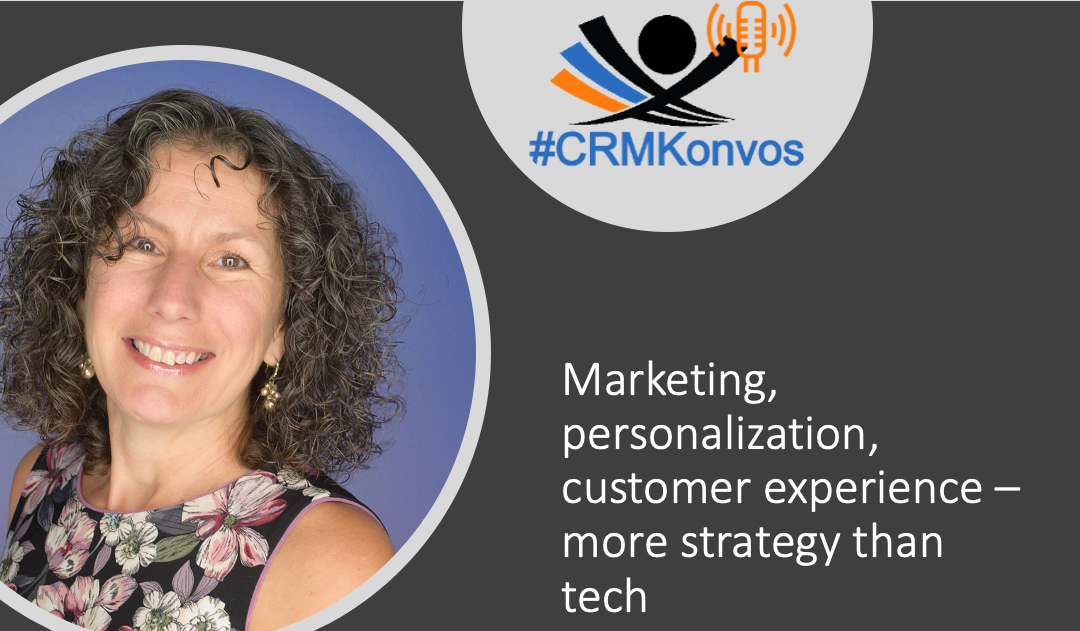
How to do marketing from a strategic point of view
The CRMKonvos gang had the immense pleasure to chat with Ginger Conlon, CRM Playaz alumna and freshly minted Thought Leadership Director at Genesys. Throughout her career, Ginger has seen and and gained more than a little marketing experience, looking more at the strategic angle than tactical execution. How to build brands and messaging around brands etc. Some fascinating questions around these topics are: Who does own customer experience (besides everyone)? Or how to create win-win situations? Listen to Ginger who opens up her in-depth experience for us. This was good for a lively and insightful conversation, hopefully not only for us but also for our audience. And it is not only talk, Ginger also has the...
Work from anywhere done right
Work from Anywhere needs the right culture and the right tools The pandemic has taught us through the past year that it becomes urgent for businesses to adequately deal with the need for new working models that help employees to become as productive when working from any place as when working from an office. This is all the more important as research indicates that the change that we are undergoing now is going to stay at least to some extent. And that is reasonable, as with all the investments made by businesses it is possible to combine the best of both worlds. Many, if not most of us, will be able to truly work from anywhere. After all, some activities are better done in office spaces, others work better in a remote setting. And then there is a good chance that travel will increase again. Travel time often is unproductive time. And with all the infrastructure that is now in place, travel time can get brought to more productive use – if not driving a car, that is. But what does it take to be able to work efficiently from anywhere? The answer is: More than just technology. It is equally, if not more, important to have a corporate culture in place and to credibly send the message to employees that makes them truly believe that it is their choice from where they work. A good part of this is that managers rather look at results than monitoring time spent. While the latter cannot be ignored, at the end of the day it is about achieving results. This is...