


Freshdesk acquires Pipemonk – A Snap Analysis
Last week Freshdesk announced the acquisition of Bengaluru based SaaS data integration company Pipemonk, the seventh acquisition since mid of 2015. Pipemonk has been launched in 2014 and since has implemented integrations between many leading e-commerce-, accounting-, CRM-, Marketing-, and Billing applications, including Amazon, Shopify, Salesforce, Zoho, Hubspot, Mailchimp, and Stripe. So far Freshdesk was not on their list. Pipemonk’s promise and objective is to deliver easy-to-setup, pre-built bi-directional integrations between SaaS applications. On their web site they reported to have more than 2,000 customers acquired in the short life span, with a seed capital of only 2 million dollar. So one can say that they delivered successfully. Freshdesk itself has its roots in customer service and since increased its portfolio to include help desk (hotline), a sales application (Freshsales), chat (Freshchat) and social testimonials using acquisitions and own developments. My Take I think that this was an important step for Freshdesk. It enables Freshdesk to easily expand its reach to integrate with a raft of SaaS applications in different business domains, prebuilt or custom. Further, I was wondering for a while whether and how Freshdesk would go on integrating their own application stack, which as per my understanding so far consists of different, only lightly (if at all) integrated applications – although my understanding may be wrong. Assuming that Freshdesk intends to continue their aggressive growth trajectory with this acquisition the team also has the foundation to integrate new and newly acquired functionality fast, based upon an established architecture. Overall, congratulations to both...
AI and Machinelearning in 2017 – What to Expect
2016 has been the year of Artificial Intelligence and machinelearning. With the year being almost at an end, let me chime in to the gang of pundits who venture into prediction land and pronounce what we get out of our glass balls. So here are my 5 plus 2 bonus ones. AI gets mainstream in Consumer Environments Alexa paved the way, the Google Assistant is on its heels, Microsoft Cortana wants to get there, too – and Apple, amazingly, is a late starter in this environment. Amazon started with a pretty smart strategy by not overselling the capabilities of its underlying AI, as Apple did with Siri, which caused some grief for Apple and some laughs for many people around. More and more helpful Alexa skills are developed and implemented that improve its usefulness. Similarly Google; they started late but are in the game now, too – following a different strategy of adding new functionality by just making it available in contrast to Amazon, who opt to have users individually enable ‘skills’. Identification of what these systems can do will be an interesting question. Facebook’s Mark Zuckerberg created a butler for his house, who he calls Jarvis, like the one of Tony Stark in the Ironman movies. Google recently based its translation engine on machinelearning and AI, seeing vastly improved translations. Facebook’s translations base on an AI, too – although this one still seems to have a lot to learn. Not to mention all the countless other consumer services Google has, that utilize machinelearning and AIs in the background. Two of the main developments to look at here are...
Why the Phone is Dead – And How to Accommodate for It
As our (digital) lives circle more and more around mobility, and consequently the mobile phone, the questions around communication-, and in particular around service- and support channels become more interesting by the day. Facebook triggered what can be dubbed a little revolution when opening its messaging platform for chatbots in 2016; meanwhile even Skype offers chatbot support. It is safe to say that chatbots have been one of the main technology trends in 2016. Slack, originally released only mid of 2013, has become one of the main collaboration- and communications platforms. Artificial Intelligence and machine learning in various flavors and strengths have become part of many business applications throughout business’s value chains. And the combination of conversational user interfaces and AI/machine learning has the potential of changing the way people interact with businesses (and data, for what it is worth in this context). Facebook, Google, Amazon, Apple, Microsoft, to name only the big players, offer voice driven digital assistants, which already now provide a hint of new engagement models between customers and companies. Intelligent, conversational systems are what we are about to see, first predominantly using chat-like user interfaces, then also merging voice into the mix, first to cover isolated situations, then increasingly for more complicated ones. Some Data Points Business Insider reported in September that the usage of chat apps has surpassed the usage of social media, measured in monthly active users. Additionally, Google found already in 2014 that 59 per cent of smartphone owners globally install games within a week of getting the phones, which is a higher percentage than any other type of app. On the...
Kustomer – A New Kid on the Customer Service Block
Sparked by an article by Bob Thompson, titled You had me at “Treat Customers as People” about Kustomer, a new kid on the customer service block, I ventured to reach out to founder Brad Birnbaum and his team to get some more information. After all the customer quadrant of software is quite crowded, and a new company needs to offer good ideas to keep up and go beyond the incumbents, most of them being young companies as well. One of the basic questions that I had was: Do we need another customer service solution? After all, G2Crowd already lists 19 in their Help Desk grid; and these are only the ones that made it into the grid. Overall G2Crowd counts 78 solutions, excluding Kustomer. And quite some of them are quite strong. Figure 1: G2Crowd Grid for Help Desks as of December 2016 Brad and his team certainly seem to be of the opinion that there is an unmet need; as are their investors who brought in $ 12.5 million into seed- and series A funding in less than a year. The founders bring experience that dates back to 1996 and includes the success of Assistly, now desk.com, which is part of Salesforce. Another question is: How does Kustomer want to differentiate itself or, which issue do they solve that the other companies do not yet solve. Quite simply put, Kustomer claims that there are too many unconnected point solutions that customers – and hence employees – need to deal with. This issue gets addressed by the Kustomer platform that acts as an integration hub and connects customer service...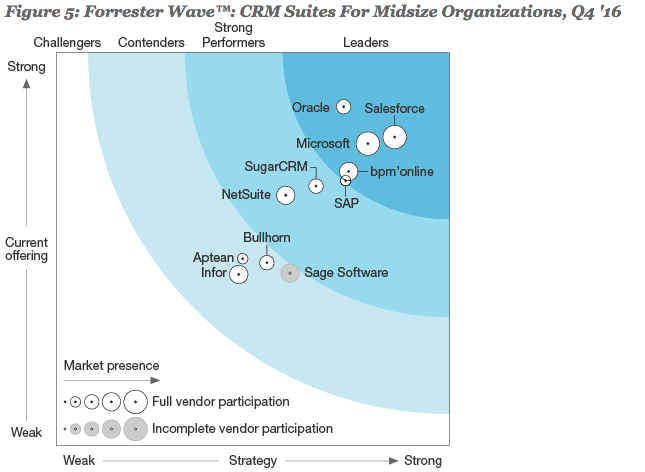
Forrester Wave CRM Suites for Mid-Sized Businesses – What it Means
Finally, the much-anticipated Forrester Wave on CRM Suites for Mid-Sized Businesses Q4/2016 has been published by Kate Leggett and her team at Forrester Research. Besides the usual suspects Oracle, Microsoft, Salesforce, and SAP it covers 7 more vendors that fulfil Forrester’s definition of a CRM suite for mid-sized businesses. This definition roughly is To be considered a suite the software covers at least three of the CRM disciplines Marketing Sales Force Automation Customer Service Field Service E-Commerce Customer Analytics There needs to be prebuilt integration between the products, if they are not within the same system; integration shall be via open standards to allow for integrating other applications. The software needs to be targeted at organizations between 250 and 999 employees. Multiple industries need to be targeted. Of course, the solutions need to be in active use and there need to be customer references. The Forrester Wave has some interesting results, some confirming what other people see, too, others somewhat surprising. Let me start with the confirmations, continue with bits that surprised me, and close with an SAP specific view. The Confirmations Of course, we are talking cloud – cloud and nothing else. As can be expected all vendors strive to deliver a toolset that helps their customers to deliver consistent customer experiences. Now I, and others, would argue that the experience is largely in the realm of the end customer and the users and that there is nothing like a ‘system of experience’. Delivering consistent experiences encompasses far more than a CRM suite. But then it is far easier (and sexier) to talk about delivering experiences than about...
It is the Customer’s Way – Or No Way!
Today’s customer is impatient. They want – and have the right to – get answers to their questions and concerns about a company’s products and services without being in the need to preform lengthy searches or to dig around. This holds true for pre-purchase questions as well as to post-purchase questions. We regularly see or read statistics that tell us that customers are not very forgiving in cases of poor customer service, but on the contrary are inclined to leave when encountering a single instance of poor service. If customers do not get the answers to their questions without difficulties they are moving on, no matter of the company or its size. This meanwhile has become a kind of public domain knowledge. The only way for a company to avoid customers leaving with the first bad experience is by building up and maintaining a good and credible history of helping a customer with solutions to address their needs (aka jobs-to-be-done) and by regularly providing good customer service. At all stations of the customer journey. An important part of this good service is being available to help the customers on their preferred channels, at the time of their choosing, and at their pace. Theirs, not the company’s! This includes that a customer initiating a conversation, or engaging in a conversation that is initiated by a company, may not respond in a while, or chooses to continue using another device, or both. On the other side a customer will not accept the company being unresponsive or losing information during handovers between different service agents. The conversation between a company and a customer...
SAP and MachineLearning – A Strong Approach, but none too early
In my yesterday’s analysis of SAP’s HANA announcement, I wondered why SAP stays silent on the AI and MachineLearning frontiers. Well, today I know. They saved this announcement for today. And the announcement is a bang. SAP will deliver what they call ‘intelligent business applications’ that are based upon SAP’s new machine learning platform. The platform itself shall be made available with SAPPHIRE NOW 2017. The first significant intelligent application by SAP that is mentioned, is a brand intelligence application that leverages deep learning to analyze brand exposure in video and images to provide ‘accurate, real-time insights into sponsoring and advertising ROI”. You may remember that SAP earlier showcased an application to reduce recruiting bias, which is based on the machine learning platform, too. According to Juergen Mueller, Chief Innovation Officer at SAP, the new machine learning platform is intended to serve SAP’s and their ecosystem’s applications with the goal of creating more business value. Consequently, there are two more aspects to the announcement. SAP launched a partner program dedicated to SAP Application Intelligence. SAP invests into education offerings, starting with a ‘massive open online course’ on Enterprise Machine Learning on their OpenSAP platform. MyPoV This announcement clearly shows that SAP is as serious about machine learning as the company is about leveraging the power of its ecosystem. As I, and many other people, have often said, SAP is a formidable organization if and when it chooses to drive a topic. This is shown here again. And SAP is absolutely on the right track by pursuing this three-pronged approach of delivering a platform with first solutions, encouraging partners, and...
SAP HANA 2 – Revolution or Evolution?
Yesterday SAP announced SAP HANA 2, an updated and improved version of its flagship product SAP HANA, and new SAP HANA microservices through SAP Hybris as a Service. SAP HANA 2 will be available for first customers on November 30 and an express edition shortly after its general availability. Note: if SAP talks about RTC this usually differs from General Availability, which is only after a successful ramp-up period of about 3 months to validate a product with early adopter customers. So the Express Edition will probably be released around end of Q1/2017. In usual bold marketing words SAP HANA 2 is poised to be a “new foundation for digital transformation” and is according to Bernd Leukert, member of the executive board, Products and Innovation at SAP SE, the continuation of “breakthrough innovation on a highly stable core data platform for our customers”. SAP HANA 2 shall deliver enhancements in the areas of database management, data management, analytical intelligence and application management as well as well as two more services for cloud customers: Text Analysis and Earth Observation Analysis. The latter in a beta status only. These latter two new HANA functionalities are likely to be the reason of tying the two announcements. The update cycle of HANA 2 shall be 6 months. Some Observations It is interesting that SAP refers to the new HANA services as microservices. This suggests that these services are built on top of the HANA 2 core – or else HANA itself has been rearchitected to be built on a microservice architecture. I rather think the former, also as the delivery is via YaaS....