Another Strong Year for SAP
On January 24, 2017 SAP released its results of their fiscal year 2016 – and the fourth quarter thereof. In a nutshell SAP: Delivered to its increased 2020 guidance Had an increase of 31 per cent in cloud subscription and support revenue, while still being able to increase the software license and support revenue. Cloud revenue increased especially in Q4 and promises to stay at a high level with a very healthy backlog Increased its full year operating profit by 20 per cent to 5.12 Billion Euro (IFRS) Has a strong backlog of cloud bookings This success has a slightly negative effect on the company profitability while it negotiates the shift from license revenue to subscription revenue while being in an investment mode. It, however, seems to be driven by an increasing adoption of S/4HANA, a strong increase of the Hybris set of CEC solutions, including e-commerce and increasing traction in the HCM space. So it is broad. Based upon the strong delivery of 2016 SAP expects the cloud business to increase by up to 34 per cent in 2017 (all numbers of course at constant currencies) and increases its guidance of revenue and profit for 2017. In line with this the company is also bullish in its mid term outlook to 2020, which it increases, too. My Take Of course the big increase in revenues, expressed as a percentage, is partly owed to the fairly low number. In comparison Salesforce reported 2.14 Billion dollar for their third quarter alone, as opposed to 2.99 Billion Euro for SAP’s fiscal year. Oracle reported 798 million dollars in their FY Q1...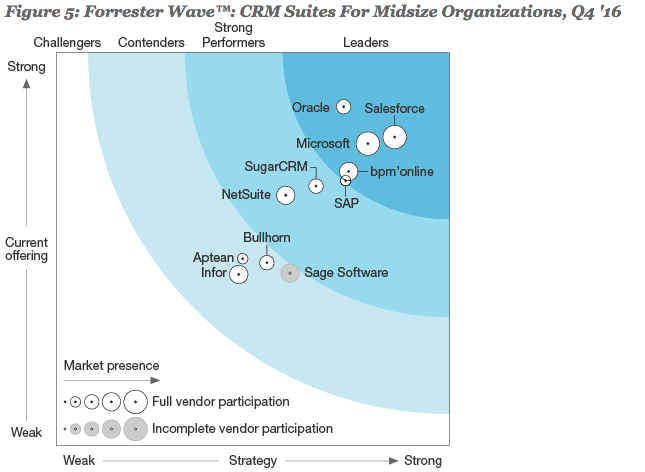
Forrester Wave CRM Suites for Mid-Sized Businesses – What it Means
Finally, the much-anticipated Forrester Wave on CRM Suites for Mid-Sized Businesses Q4/2016 has been published by Kate Leggett and her team at Forrester Research. Besides the usual suspects Oracle, Microsoft, Salesforce, and SAP it covers 7 more vendors that fulfil Forrester’s definition of a CRM suite for mid-sized businesses. This definition roughly is To be considered a suite the software covers at least three of the CRM disciplines Marketing Sales Force Automation Customer Service Field Service E-Commerce Customer Analytics There needs to be prebuilt integration between the products, if they are not within the same system; integration shall be via open standards to allow for integrating other applications. The software needs to be targeted at organizations between 250 and 999 employees. Multiple industries need to be targeted. Of course, the solutions need to be in active use and there need to be customer references. The Forrester Wave has some interesting results, some confirming what other people see, too, others somewhat surprising. Let me start with the confirmations, continue with bits that surprised me, and close with an SAP specific view. The Confirmations Of course, we are talking cloud – cloud and nothing else. As can be expected all vendors strive to deliver a toolset that helps their customers to deliver consistent customer experiences. Now I, and others, would argue that the experience is largely in the realm of the end customer and the users and that there is nothing like a ‘system of experience’. Delivering consistent experiences encompasses far more than a CRM suite. But then it is far easier (and sexier) to talk about delivering experiences than about...
Fresh wind in the SME CRM Market with Freshsales?
It appears to be demo week for me. After Jon Ferrara gave me a deep dive into the leading social sales application Nimble and I got a dive into the new travel management solution Traform by my old friend Balamurugan Kalia, Sreelesh Pillai introduced me to Freshsales. Freshsales is the new social sales solution by Freshdesk, a company that got founded in the second half of 2010 only and until now focused their efforts on customer service and support. An interesting twist in Sreelesh’s story is that Freshdesk built Freshsales initially to accommodate their own needs and to deal with the demand caused by their growth. Growing at about 50% over the last year or so, the Freshdesk team realized that the applications (yes, plural, including tier 1 solutions) that they used did not really fit their needs. The Freshsales solution covers simple applications for leads, contacts, accounts, deals (opportunities). Leads and contacts can get imported into the system by means of a csv upload. This way it is also possible to migrate Salesforce data into the system. Google contacts or contacts from Office365 are not automatically synced or used. E-Mail and phone conversations that are initiated within Freshsales are tracked against the lead/contact to provide a historic context about what is going on with the person. In case mails are sent directly from an email account one needs to bcc the own Freshsales email address (e.g. sales@aheadcrm.freshsales.io) in order to have the interaction tracked by the system. This then transparently creates a new lead if the recipient e-mail address is not yet known to the system. Using territories and...