
How to do great Customer Journey Orchestration
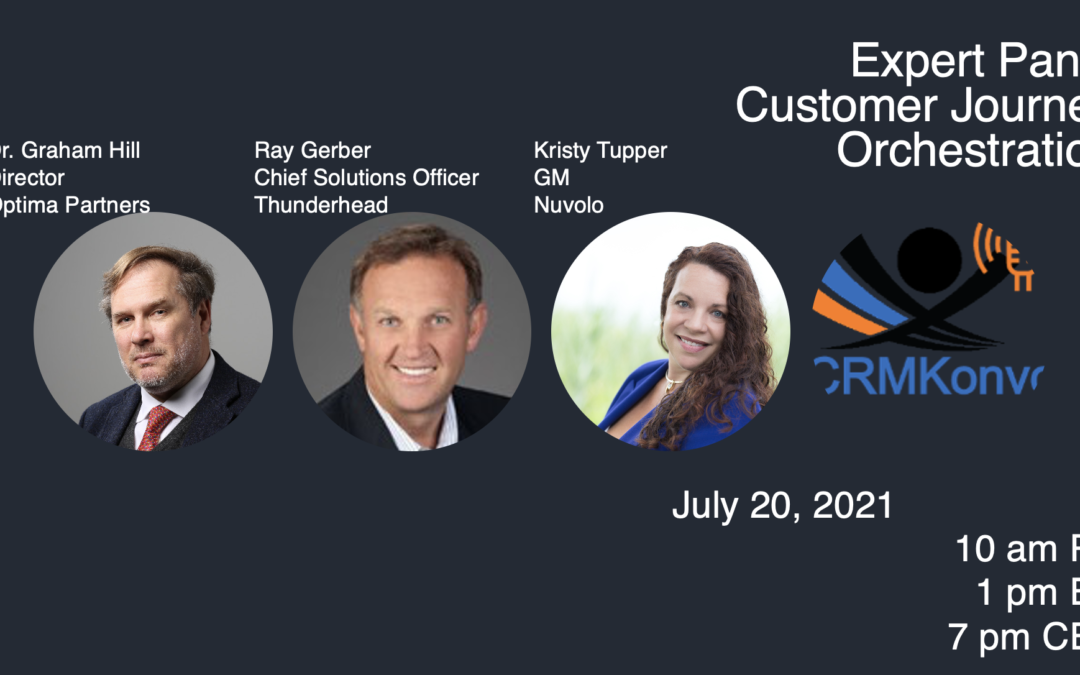
Following the great discussion about Customer Journey Orchestration that we had with Graham Hill it was obvious that this topic deserves and requires more attention. We had a lot of points and different terms, starting from customer journey management, customer managed journeys, customer journey analytics, customer journey mapping and so on. Provocative statements like “customer journey mapping is utterly useless” popped up and were discussed. Is this tool utterly useless? Well, the discussion shed some light! So, we asked the most active participants of the chat conversation whether they would be up for a panel discussion. Graham Hill, Ray Gerber and Kristy Tupper agreed. So, here we are with a panel discussion about this exciting topic. The three of them have different views that help in furthering our knowledge. The CRMKonvos team is really excited to host this discussion, which is cut in three sections. Interested in the leading questions? Have a look at the next three short videos. Or dive right into the discussion, which is at the end of this post. What is customer journey orchestration? Who benefits most of Customer Journey Orchestration? How do customer journey orchestration and customer journey mapping relate to each other? These good questions and points of view opened up exciting and well received discussions. Enjoy watching...
Together, Zoom and Five9 shape a new market
The News On July 18, 2021, Zoom Video Communications, Inc. announced the acquisition of Five9, Inc. in an all-shares transaction. The transaction values Five9 at around $14.7 billion. According to the press release “the acquisition is expected to help enhance Zoom’s presence with enterprise customers and allow it to accelerate its long-term growth opportunity by adding the $24 billion contact center market.” According to Eric S. Yuan, CEO and founder of Zoom, the company is “continuously looking for ways to enhance our platform, and the addition of Five9 is a natural fit that will deliver even more happiness and value to our customers”. He continues with “enterprises communicate with their customers primarily through the contact center, and we believe this acquisition creates a leading customer engagement platform that will help redefine how companies of all sizes connect with their customers”. Rowan Trollope, CEO of Five9 adds that “businesses spend significant resources annually on their contact centers, but still struggle to deliver a seamless experience for their customers”. Trollope will become a president of Zoom and continue as CEO of Five9. Zoom expects the acquisition of Five9 to be “complementary to the growing popularity of its Zoom Phone offering […] The combination of both firms also offers both companies significant cross-selling opportunities to each other’s respective customer bases”. As especially Rowan Trollope emphasizes upon repeatedly in the acquisition briefing, this acquisition is about accelerating growth by combining the respective assets, software as well as customers. The bigger picture The trend towards call centers in the cloud has been there before and it has been amplified with the Covid pandemic. Connecting...
The Platform CAN Do the Work. Let it!
On June 15, 2021, the CRMKonvos crew had the chance to chat with Andreas Schuster, Customer Success Director for SugarCRM in Europe, about the company’s evolving vision and goals. He did not disappoint. Schuster has filled a variety of roles over the years, both in the software industry and outside of it, and has developed an appreciation of what well-administered CRM can do for a business and its customers. “I have been able to get to know CRM in the industry and in sales, and I keep getting to know it again and again,” Schuster said. “I never get bored watching companies actually supporting their sales management with software, but also just the way they work together with the customer and with the customer. And it is always exciting.” One important thing that Schuster believes, though, is that CRM is more than technology; it is behavior and culture which technology can enable to be better. “CRM is not so much a technical tool; it really is an approach,” Schuster said. “It’s a strategic sales approach, and there’s a lot that goes into it now, but it’s still the same.” The technology is an important starting point though, especially with larger and more complex businesses. Schuster added: “I keep coming back to this: the software that’s used has to work great, it has to be intuitive, it has to look good. But taking this CRM approach is first of all a strategic thing in a company. You have to want it. You have to prepare for it. And you also have to set an example for your company from the...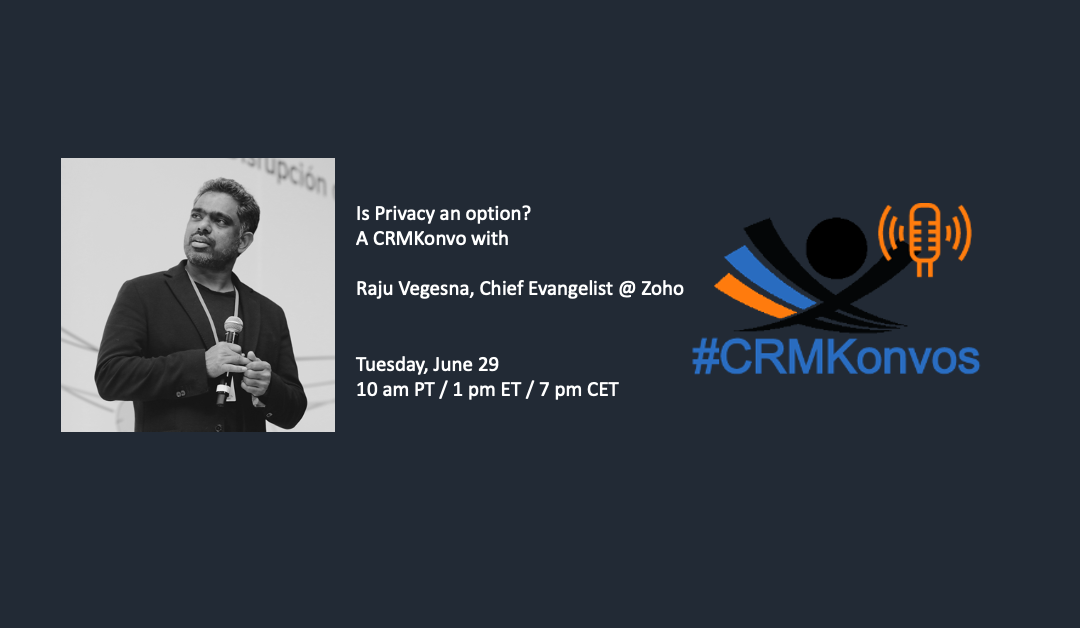
Why privacy is not an option
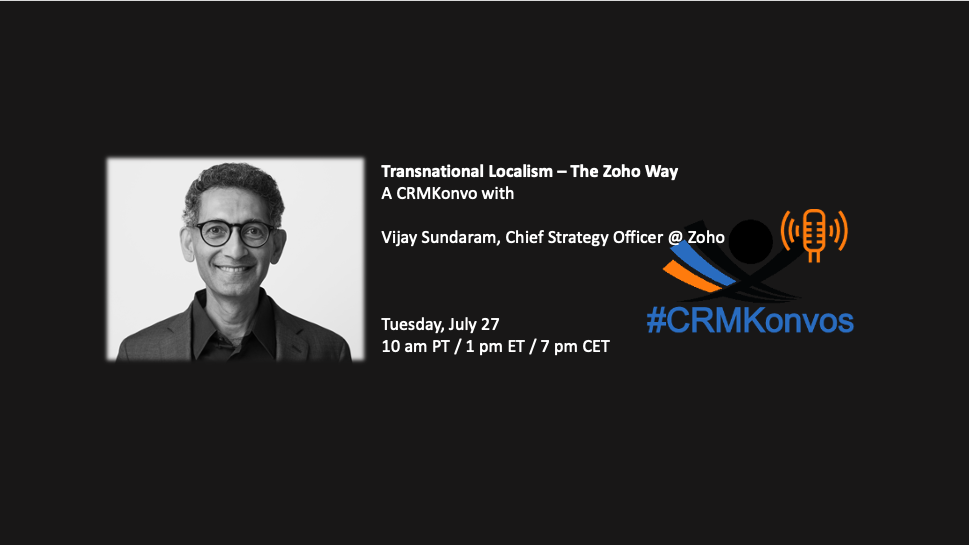
Data breaches, ransomware, stolen identities, collecting of data for no benefit of the customer, are only some of the things that we do see every day. There does not seem to be any privacy anymore. This makes privacy and data protection hot topics not only for customers, but also for software vendors – or at least should make it hot topics. Apple put in some privacy controls and got chided for it by Facebook and the rest of the adtech industry. Google, with FLOC, tried to establish a technology that aimed at being able to track users in a post cookie world. To adapt a quote of the Asterix books: The whole world tracks users and customers. The whole world? No, there is one brave company that doesn’t. All this is reason enough to have a #CRMKonvo with one of the most accomplished and outspoken protagonists of privacy in the enterprise software arena and we were very excited about the opportunity to have an intense and interactive discussion with Raju Vegesna of...
Nimble strengthens its ability to be where the user is
I haven’t written much about Nimble recently; actually I haven’t written too much about anything lately. Now it is time to have a look into some interesting news that hit my desktop. The News On June 30, 2021, Nimble announced an integration with Microsoft Teams to streamline workspace collaboration. The integration offers Nimble users to prepare meetings and provides the tools to help getting information on meeting participants from their contact records, the ability to take notes that will be synched to Nimble as well as the ability to send trackable follow-up emails. The capability will be delivered via an add-in to MS Teams. For your convenience, the press release is also copied below. Nimble Integrates with Microsoft Teams to Power Virtual Business Meeting Engagements Nimble Offers Microsoft Teams Add-in to Help Teams Thrive in The Hybrid Workspace SANTA MONICA, Calif. — June 30, 2021 — Nimble, the simple CRM for Microsoft 365 and Google Workspace teams, announced today that they have integrated with Microsoft Teams to give teams a shared view of every customer, and to streamline collaboration between teams. Improve Collaboration and Build Better Customer Relationships Customer data is the most important asset for every organization. The success of every customer relationship management application lies in the data accuracy. Business owners and professionals rely on Nimble to offer a 360 view into the relationships with their customers. Integrating with collaboration applications and seamless synchronization of information and the history of conversations is crucial to improving customer relationships and team productivity. “Our customers rely on Microsoft Teams to work effectively across their organizations and to build and nurture...
How to overcome the process knowledge challenge with a little AI
Many a company has a severe challenge with how their processes actually work. Documentation may or may not be there. Tribal knowledge exists. Lots of repositories, too, including file systems, collaboration tools, chat tools, email, etc. In brief, there is the need for a solution. Startup Sevantiz has taken on this challenge with its Flockwise platform, which is reason enough for the CRMKonvos team to invite Sri Sabesan, Mani Manivannan and David Pickrell into our studio to discuss their approach and how it relates to CRM (spoiler alert: it does) and CX (it does, too). But what is Flockwise? Flockwise brings knowledge from the documentation, tribal knowledge and the transaction systems to answer the questions that employees in businesses have every day. Although we utilize a chat interface, It is much more than an Chatbot. Flockwise is designed to discover knowledge and serving it to the user in a way that the user get the right answer to the question. Flockwise creates the opportunity for the Enterprise Flock and their trusted advisors / consultants and outsourcers to capture knowledge and provide answers to the questions in a way that no other solution does. Creating an efficient way for something that we have always talked about. And that is capturing expert knowledge in a way that is truly reusable for the benefit of productivity of the employees and customers and suppliers of an organization. Sounds good? Then dive deeper into this CRMKonvos...
Platform Partners: A Question of Trust
The enterprise software world is one where few, if any, companies can stand alone. Cloud computing has greatly increased the availability and usability of business applications. However, no vendor can claim to supply a complete homegrown solution. The SaaS world is one of partnerships. Partnerships are best when all the partners are trustworthy.Business software customers still need to pick a brand and stick with it for a while. That brand—the platform—represents a serious investment of time and trust. Sure, you own your data, and changing platforms is supposed to be easy. But ask anybody who’s done it whether they would want to do so again next year.Platform customers have to weigh more than just the price and features of each platform provider. They must also consider what the future holds for that platform and its partners. None of the big platforms are likely to disappear or merge anytime soon, but their fates and fortunes are not constant. They also have histories and reputations. Increasingly, they have prominent social and/or political stances as well. Those issues matter enough to some business owners and investors to affect their decisions. There are also simpler matters, like whether the customer likes the feel of the software environment, or has concerns about possible changes. Can I Trust You? In the end, these decisions boil down to variations on a single question: “Can I trust you with my business?” Contracts and commercial laws deal with businesses that act in bad faith; this is more about responsibility, reliability, and safety. Examples: Will you continue to support the applications I use?Is my data secure?Do you have good...
Ecosystems, how to play for small players
Lately, we have talked a lot about ecosystems, in particular business ecosystems. Normally, business ecosystems follow a hub and spoke model rather than a network approach; one major player sets it up, and then adds customers and partners like independent software vendors, systems integrators, analysts, consultants, suppliers, or other similar entities. Good examples of successful ecosystems are the ones around the big four enterprise software vendors: Microsoft, Oracle, Salesforce and SAP. Sure, there are other ones, but these are easy reference examples. In theory, ecosystems shall provide more value to customers, better serving their needs by making it easier for them to get access to information, knowledge, skills and productized enhancements to the core solution that they chose to implement. They also get a broader choice of possible enhancements, provided by different vendors in the ecosystem. Of course, this also benefits the other participating stakeholders. Customers are, of course, an important group of every ecosystem. Treating them as partners helps the platform company to create a transparent prioritization process for delivering requested new functionalities that extend the own solution in an optimal way. Not all customers provide the necessary input, though. For the platform provider, the ecosystem creates stickiness. Still, this company cannot develop and provide all the functionality that is ever needed by its customers. Nor can it provide sufficient implementation services. And it does not want to, either. So, it needs ISVs and SIs as members of its ecosystem to provide this functionality, either as products, or as consulting solutions. What these companies deliver on top of the core solution also increases the attractiveness of the ecosystem. ...