

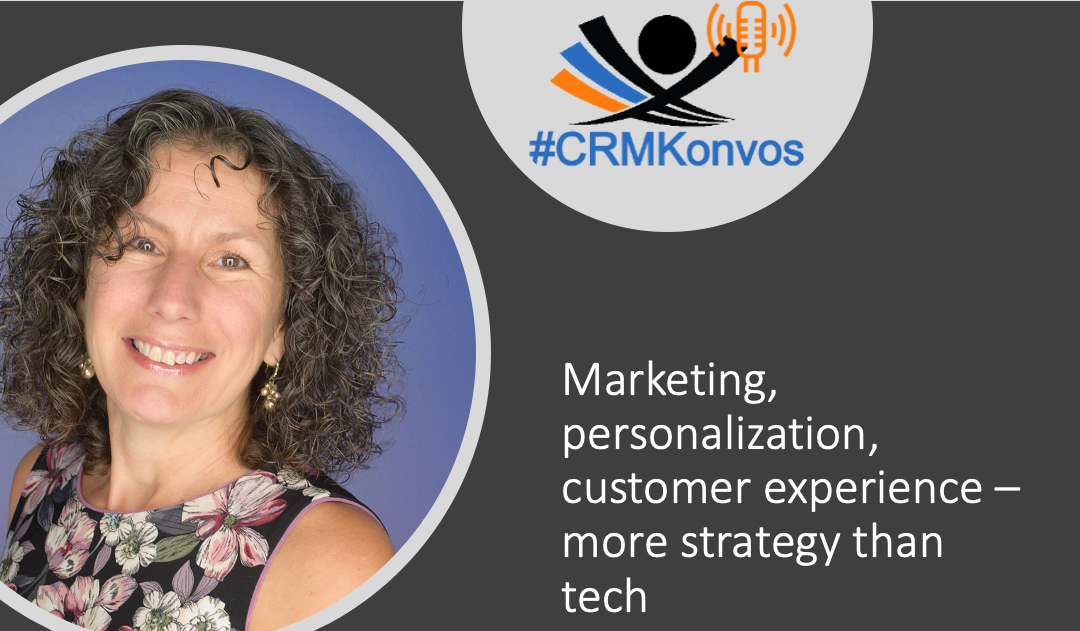
How to do marketing from a strategic point of view
The CRMKonvos gang had the immense pleasure to chat with Ginger Conlon, CRM Playaz alumna and freshly minted Thought Leadership Director at Genesys. Throughout her career, Ginger has seen and and gained more than a little marketing experience, looking more at the strategic angle than tactical execution. How to build brands and messaging around brands etc. Some fascinating questions around these topics are: Who does own customer experience (besides everyone)? Or how to create win-win situations? Listen to Ginger who opens up her in-depth experience for us. This was good for a lively and insightful conversation, hopefully not only for us but also for our audience. And it is not only talk, Ginger also has the...
Work from anywhere done right
Work from Anywhere needs the right culture and the right tools The pandemic has taught us through the past year that it becomes urgent for businesses to adequately deal with the need for new working models that help employees to become as productive when working from any place as when working from an office. This is all the more important as research indicates that the change that we are undergoing now is going to stay at least to some extent. And that is reasonable, as with all the investments made by businesses it is possible to combine the best of both worlds. Many, if not most of us, will be able to truly work from anywhere. After all, some activities are better done in office spaces, others work better in a remote setting. And then there is a good chance that travel will increase again. Travel time often is unproductive time. And with all the infrastructure that is now in place, travel time can get brought to more productive use – if not driving a car, that is. But what does it take to be able to work efficiently from anywhere? The answer is: More than just technology. It is equally, if not more, important to have a corporate culture in place and to credibly send the message to employees that makes them truly believe that it is their choice from where they work. A good part of this is that managers rather look at results than monitoring time spent. While the latter cannot be ignored, at the end of the day it is about achieving results. This is...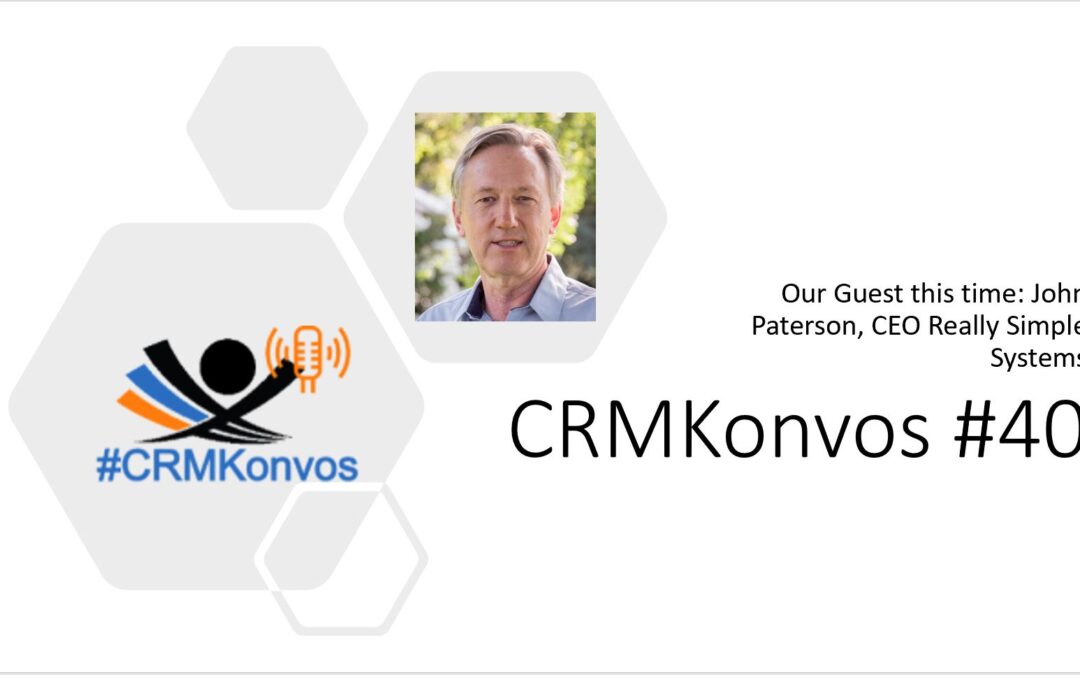
CRM for SMB. The way it needs to be
Now this title is not a case of do a rhyme or get bitten but actually summarizes the topic pretty well. The CRMKonvos team had a long and good discussion with John Paterson, CEO of Really Simple Systems about the needs and wants of a CRM for SMBs. Are the requirements that an SMB has really different from the ones that an enterprise has? At the end of the day the original challenges seem to be fairly similar. Especially on the sales side, people avoid the system, just like Denis Pombriant found in a study that we talked about earlier this year in our CRMKonvo about why salesreps hate their CRM. Here a short version that just answers this very question. The parallels in thinking and observations between Denis and John are striking! But then, there are a few differences. Listen to John explaining them. But then this isn’t all. Talking about value of the systems we couldn’t not also talk about the value of AI. Is there any? Where? Spoiler alert: There is, but one needs to know what one is doing. What? The discussion reveals it in the last 15 or so minutes. Enjoy the conversation. We learned a lot. You can,...
Ecosystems are about the customer! Are they? Think again!
Ecosystems is all I say – was his post in Linkedin. And as you can imagine, this sparked quite a discussion. Why? Because “he” is SAP’s venerable Chief CX Evangelist Esteban Kolsky. Not that it needs a reason to invite Esteban to a CRMKonvo (because he is always good for a well founded opinion) but this discussion and the topic itself certainly made it highly interesting to cover some ground and Esteban is always good for a lively discussion. What is an ecosystem – and how does it relate to the word “symbiosis” – if at all? How does one get an ecosystem viable? What is fairness in that context? Is trust a factor? Fairness? Or is that all too fuzzy? And – spoiler alert – as you can imagine by the title: They do not revolve around the customer. I will not tell you what it is though and leave that to Esteban himself. Best of all: Some highly interesting insight in the comments as well. Enjoy the CRMKonvo. We certainly...
The “New Normal” and Data Driven Experiences
As a consequence of an organizational stuff up we had a CRMKonvo that was even better than could be expected in our wildest dreams. Our guests Sheryl Kingstone of 451 Research and Laurie McCabe of the SMB Group have a lot of data and insight to share about data driven experiences and what the digital maturity of companies small and large actually is. Do we talk digital transformation or just digitalization – even only digitization? Will, whatever changes towards digital communication and collaboration stay? Will it change back to what it was? Something in between? Sheryl and Laurie have some very interesting data points and observations on these topics. Two strong and renowned analysts – leading experts in their field – with different company focus and different approaches offer significant insight for us. Great stuff....
Outlaw Spirit – Lessons from The Zoho Analyst Day 2021
The 2021 Zoho analyst day certainly was different. Different not only because it was not an offline but an online event but in the way it was prepared and conducted. Apparently, the team around Sandra Lo has taken up quite some lessons that other events had to learn, too. This is kind of the advantage one has not being the first one in a season. But this was only one part of it. The second part is that the whole event was run using Zoho software, in particular Zoho Backstage and Zoho Meeting. Overall, there have been some 150 attendees with what I assume, very different levels of knowledge about Zoho. The event In contrast to most other analyst events, this one required actual preparation, as product and roadmap topics have been sent out beforehand for self-study – and were kind of “required reading”. Going through all videos at least once was an exercise that lasted more than five hours. The event itself was split into two days of two and a half hours each, covering topics from corporate responsibility via status up to roadmap topics. Day one started with a corporate presentation, the past 25 years and a view into the next 25 years, based upon CEO Sridhar Vembu’s vision and the partly interrelated themes that he sees (and builds his company around): De-Layering the tech stack, which means that within the tech stack from chip level to business solutions that a company operates, less vendors will be neededExtreme financial bubbles that we have seen and will continue to seeThe emergence of self-reliant regional economies and the regionalization...
We all want to be recognized
Abraham Lincoln reportedly said “Don’t worry when you are not recognized, but strive to be worthy of recognition.” I am wondering how this applies to the companies we interact with. I would worry if I was not recognizing my customers, and I work to be recognized by them. Recognition is a concept that goes both ways. And as a customer, I worry when I am not recognized, or no longer recognized. Technology has enabled amazing one-to-one marketing for businesses selling to consumers (B2C). But how effective is this marketing in reality? I am always shocked that I can walk into a car dealership and not be recognized. When I am shopping for a car I always point out what I have leased in the past. I am trying to help the car salesman recognize me. Another example might be Nordstrom. You could expect a shopping experience where you only see clothes in your size or even style. “Hey Rich – we know you – here is what we suggest.” Shoppers want to be recognized but it just hasn’t happened yet.Companies selling to business customers (B2B) will find these in many different sizes, from small businesses to the Fortune 500. Very large customers are easy to recognize.There is complexity in selling to the company and its many divisions or departments, but you know they are large and important, because the deals tend to be bigger than deals with SMBs. Ford, General Electric, Starbucks – when selling to a big account the seller certainly recognizes the opportunity and treats the account accordingly by offering solutions to their needs. Selling to small businesses is...The New Cost-Effectiveness Argument
You don’t buy size 12 shoes for size 9 feet. You don’t get a Bugatti Chiron for grocery store runs. You don’t swat flies with field artillery. And you don’t buy more contact center technology than your business can reasonably grow into.The customer service neighborhood of CRM was the wrong side of the tracks for many years. The contact center could only cost the company money (so it was thought), so the responsible strategy was to cut costs to the bone and never spend anything there unless forced to. Asking for more staff or better equipment was like getting the state to renovate the prison library—impossible without somebody of the calibre of Andy Dufresne in The Shawshank Redemption. That attitude was changing by the dawn of the 21st Century. Research proved that better customer service led to better retention, loyalty, and advocacy among customers. These led to a strengthened brand and increased revenue in the long term. New integration technology meant the contact center could save and even generate sales in its own right. The rise of online communities and social networking showed the strength of the motivated and well-connected customer. A shout of praise when a company went the extra mile for a customer in need could be amplified. So could a howl of outrage when one was treated callously, with potentially disastrous results. Spending in the contact center was not only necessary, it was the smart thing to do.The freedom to make decisions based on results rather than thrift was never license to burn money, but it meant that customer service had a stronger voice at the...