


Trust in Crisis – Customer Experience is the Way Out
Trust is eroding. Not only in governments and media as we could clearly observe but also in independent organizations like NGOs and businesses. And in business leaders, experts, even into the famed ‘people like me’. According to the recently published 2017 Edelman Trust Barometer NGOs and businesses are barely not distrusted. Especially businesses are now on the brink of distrust. They are often seen as part of the problem: While Automation may be good on a society level there are vital job concerns for individuals. Wealth distribution becomes increasingly unequal. While societies improve economically this is not felt on an individual level. In fact, amongst those who think that the current social-economic system is failing only NGOs are not actively distrusted. On the other hand amongst those who are uncertain about the current system businesses are the most trusted entities. So there is a way! Source: Edelman Trust Barometer 2017 A Focus on Customer Experience Guides on the Way The trust barometer lists as the 5 most important actions that businesses can take: Treat your employees well Offer high-quality products/services Listen to your customers Pay your fair share of taxes Engage into ethical business best practices Although one doesn’t need to fully agree with these findings, which are partly overlapping, the points have two things in common: They are key ingredients of a positive brand image and of good customer experience. These five points are also about company values and the culture lived by the company – as opposed to the one that is written down. A positive brand image is a result of good customer experience. And here...
Gartner MQ BI and Analytics Platforms – Lots of Movement
Last week Gartner published the updated version of its Magic Quadrant for Business Intelligence and Analytics Platforms, and I need to say that there has been a lot of movement in both directions, up as well as down. There has been a lot of reshuffling especially in the Visionaries quadrant. This can partly be attributed to a changing market that caused Gartner to combine a few of last year’s assessment criteria as well as adding two more critical criteria as below: Critical Capabilities Dropped or Changed: Combined BI Platform Administration with Security and User Administration Modified Data Source Connectivity to Data Source Connectivity and Ingestion Combined Publish Analytics Content and Collaboration and Social BI to Publish, Share and Collaborate on Analytic Content Added Visual Appeal to Ease of Use Capabilities Added: Smart Data Discovery Platform Capabilities Workflow Integration Smart Data Discovery emphasizes the increasing importance of AI and machine learning as part of analytics systems. Gartner defines it around the automatically “finding, visualizing and narrating of important findings such as correlations, exceptions, clusters, links and predictions in data that are relevant to users without requiring them to build models or write algorithms. Users explore data via visualizations, natural-language-generated narration, search and natural-language query technologies”. Workflow Integration acknowledges that there is no actionable insight if there is a standalone analytics system. It is defined around the number of products “needed to deliver the critical capabilities and the degree of seamless integration and workflow between capabilities/components”. This has been true for a long time, but hey, better late than never. Gartner itself states that the changes have been major and that...
Apple Pay holds Banks in Stranglehold! Really? Poor Banks
In the past days two interesting articles around banks and banking innovation found their ways into my browser. One by Knowledge@Wharton on “How Banks Can Keep Up With Digital Disruptors” and the second one by Mobile Commerce Daily on “How four Australian banks are challenging Apple’s stranglehold on mobile payments”. The first article is essentially stating that banks are not using the “essential assets need to turn aside many of the assaults on their business now underway from fintech”, while the second one seems to sing the song of the poor banks that are held at a disadvantage by evil Apple. The four banks that challenge Apple are Bendigo and Adelaide Bank, Commonwealth Bank of Australia, National Australia Bank, and Westpac. Another large bank, ANZ Bank, cooperates with Apple by offering their customers to import cards into the Apple Wallet and using Apple Pay, and is not involved. But what do the banks want? According to the article they want access to “Apple’s Apple Pay system as well as access to the NFC capabilities of the iPhone”, being narrowed down to “require Apple to only disclose access to the NFC capabilities of the iPhone to the banks and therefore their customers.” Essentially they want to be able to build their own mobile payment system and not go through Apple’s wallet and still be present on “one of the most popular smartphones in the world” And yes, it is true that Google’s Android operating system allows more access to the phone’s NFC capabilities than iOS. On the other hand banks are seeing disruption coming. Fintech companies are coming up left,...
Marketing owns the Customer Data! Does it?
The customer, the elusive entity that every business is about – or at least should be about. The customer gets targeted, marketed to, sold to, serviced, analysed, shall have a positive customer experience, and sometimes even is made happy. The ‘customer’ as an entity is owned by the marketing department, err, the service department, oops, sales … or is it IT? After all IT is likely to run the CRM system. If it is not a cloud system, that is. In reality it is different in every company and probably rightfully so. On the other hand every department has their own requirements and the ‘owner’ of an entity is likely the one who decides upon the relative priorities of these requirements. And the fulfillment of requirements regularly decides upon the effectiveness and efficiency a business unit can operate with. Now the marketing department is heavily invested in collecting all data that a customer leaves behind in order to understand behaviours and be able to entice known and unknown customers into buying (in the case of a B2C business) or solidifying the lead to an extent that it can be handed over to the sales department (in case of a B2B business). They are interested in lots of attributes, segmentation, slicing and dicing towards various dimensions. Born were Data Management Platforms, and Customer Data Platforms, and overall a very thriving industry of Marketing Technology. The sales department now is interested in opportunity management, CPQ (configure, price, quote), relationship with the buyers and their potential influencers, closing the deal as efficiently as possible. Born is a world of sales support software....
A Love Affair – Nimble Smart Contacts for Outlook
Social Selling pioneer Nimble has an awesome start into 2017. First it got number 1 in CRM satisfaction by G2Crowd earlier in January, then friend and CRM godfather Paul Greenberg named Nimble a winner of the 2017 CRM Watchlist awards, and now Nimble announces the Smart Contacts add-in for Outlook, a deep integration into Outlook for iOS, with an integration into Outlook for Android coming soon. The Nimble Smart Contacts add-in brings the power of Nimble’s view on contacts to Outlook for mobile users, after the widget and Outlook add-on already offered this functionality for the web- and Outlook clients. The add-on follows the philosophy that for most companies the e-mail account is still their CRM system; given this, this is a straightforward enhancement. Nimble acknowledges that there are two main email systems used in businesses: Gmail and Office365, and now fully supports them both. This integration delivers the profiling data that the Nimble back end gathers practically at any place. The browser add-in already today allows to get profiling information about contacts in other CRM systems, e.g. Salesforce or MS Dynamics and works seamlessly in Google Apps and Office365. “The biggest cause of communication failure is lack of knowledge of who someone is or what their business is about,” says Jon Ferrara, CEO of Nimble. This add-on is closing one missing link in the chain by making it part of Outlook and reducing the need for having yet another app. Relevant business insight about people in a mail conversation and their companies is now directly available in the email client. The add-on, along with the above-mentioned Outlook Add-in,...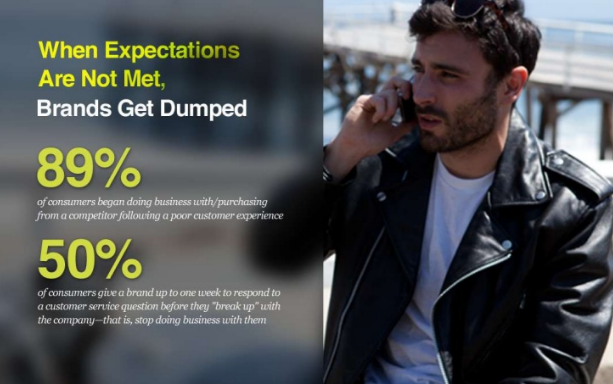
Customers dump Businesses for poor Service? Yeah, Right!
Good customer service, customer experience and customer experience management are all about technology and its right use. This is what many of the articles that one could read on various platforms can make one think. Just that it isn’t. I guess I contributed my share to this misconception, too. My excuse is that I am a techie by trade and at heart. Sure, technology is a part of delivering a good customer experience but there is much more to it. Technology enables the digital presence of a business and helps its employees delivering better experiences – if available and used. But delivering a good customer experience first and foremost involves people, then policy and process. Technology is the last priority contributing, it is an enabler, a means to an end – not the end itself. On the other hand there are reports over reports saying that customers stop doing business with a company after bad experiences, sometimes even after a single bad experience, e.g. shocking 89 per cent according the 2011 Rightnow Customer Experience Report, or 62 per cent according to the 2015 Parature Global Customer Service Report. The 2016 Institute of Customer Service UK Customer Satisfaction Index finds that most UK customers want a balance of price and service, given there is a minimum service level. And the list goes on and on. While all these statistics likely have some grain of truth there are also numerous examples of poor customer experience not having a detrimental impact on a company. This is probably in part due to who asked the question, how the question was asked; this often...
Another Strong Year for SAP
On January 24, 2017 SAP released its results of their fiscal year 2016 – and the fourth quarter thereof. In a nutshell SAP: Delivered to its increased 2020 guidance Had an increase of 31 per cent in cloud subscription and support revenue, while still being able to increase the software license and support revenue. Cloud revenue increased especially in Q4 and promises to stay at a high level with a very healthy backlog Increased its full year operating profit by 20 per cent to 5.12 Billion Euro (IFRS) Has a strong backlog of cloud bookings This success has a slightly negative effect on the company profitability while it negotiates the shift from license revenue to subscription revenue while being in an investment mode. It, however, seems to be driven by an increasing adoption of S/4HANA, a strong increase of the Hybris set of CEC solutions, including e-commerce and increasing traction in the HCM space. So it is broad. Based upon the strong delivery of 2016 SAP expects the cloud business to increase by up to 34 per cent in 2017 (all numbers of course at constant currencies) and increases its guidance of revenue and profit for 2017. In line with this the company is also bullish in its mid term outlook to 2020, which it increases, too. My Take Of course the big increase in revenues, expressed as a percentage, is partly owed to the fairly low number. In comparison Salesforce reported 2.14 Billion dollar for their third quarter alone, as opposed to 2.99 Billion Euro for SAP’s fiscal year. Oracle reported 798 million dollars in their FY Q1...
AI and Bots will kill our Future – Or Not
After the Hype 2016 has been the year of bots, AI, and automation the beginning of 2017 seems to be the time of looking at wider implications. There is a lot of discussion going on in academia, politics, and on the web, e.g. the one spurred by Denis Pombriant with a very readable article, and two follow-ups here and here, in November and December 2016. Denis, supported by Vinnie Mirchandani, took a very optimistic stance – something that is highly important in times of simplification and pessimism. There is no doubt in my mind that technologies that are driven by artificial intelligence can have a tremendous benefit for both, companies and organizations, as well as consumers. Consumer technology like Amazon’s Alexa, Google Assistant, Siri, generally intelligent home automation, self driving cars, etc., can simplify peoples’ lives tremendously by taking away routine activities or making it just easier to execute them. Organizations can create improved customer and employee experiences via automating existing processes, and they could create entirely new experiences using technology – doing things more effectively. Opportunities to do so can be found within the complete value chain. Automation also serves the aspect of doing the same, or more, at less cost, i.e. more efficiently. And in the last point lies a catch. This means that less people are needed to deliver on an amount of work. This means less employed people and, on a first view, more unemployment. This means less disposable income. Because advances in technology have the tendency to benefit only a few, which are those who deliver the automation systems and those who are able...